Written by: Mariana Fonseca, Editorial Team, AI Growth Agent
Key Takeaways
- AI Share of Shelf measures a CPG brand’s weighted presence across AI-generated answers to retailer and category prompts, so teams can track revenue impact instead of simple visibility.
- Effective measurement relies on four data pillars: Search Intelligence, AI Analytics, Bot Tracking, and AI Ranking, supported by 500 to 2,000 prompt samples run weekly across ChatGPT, Perplexity, and Google AI surfaces.
- The eight-metric dashboard separates Mention Rate from Recommendation Rate and tracks Retailer Share of Shelf versus Category Share of Shelf, which connects AI visibility directly to conversion and revenue outcomes.
- Common pitfalls include over-reliance on head terms, single-run sampling, and mixing mentions with recommendations; avoiding these keeps insights statistically credible and actionable.
- AI Growth Agent acts as the single headless engine that measures and improves AI visibility, mapping prompt universes, producing authoritative content, and reporting incremental gains week over week. Schedule a consultation to see your first article live within a week.
Prerequisites: Building Your Four-Pillar Data Foundation
A credible AI Share of Shelf measurement program rests on four data pillars that must be in place before the first prompt is sampled.
- Search Intelligence. Build a complete portrait of the traditional search landscape, including positioning, competition, and search volume. This baseline universe of queries shows what your brand should already be winning before you layer AI surfaces on top.
- AI Analytics. Track brand value and consumer behavior across the full journey, from external touchpoints like Google and AI-tool queries through content consumption, demographics, and sentiment. As of early 2026, almost none of CPG marketing mix models include AI search as a discrete channel, so most teams lack visibility into a channel that already shapes purchase decisions.
- Bot Tracking. Capture every bot interaction, including traditional crawlers and AI training agents. Research shows LLM search engines return fewer URLs per response than traditional search, which compresses the citation window and makes per-article bot tracking essential for knowing whether your content is being read at all.
- AI Ranking. Treat order of mention and citation context as the new rank. AI answers do not carry a static ordered list, so where your brand appears in the answer, and how that position evolves week over week, becomes the leaderboard.
The objective function for the entire system is real-time Google AI Overview and ChatGPT search data. These surfaces reveal which long-tail queries deserve investment and which competitors already win them. Access to a 500 to 2,000 prompt capacity produces statistically credible results at the retailer and category level, as detailed in Step 2 below.
Process Overview: From Prompts to Weekly Revenue Signals
The measurement workflow runs in five phases. First, define the prompt universe using real-time Google and ChatGPT data. Second, execute the 500 to 2,000 prompt sample on a weekly cadence. Third, score the eight-metric dashboard. Fourth, slice visibility by retailer and category to connect findings to commerce outcomes. Fifth, automate the measurement-to-action loop through a headless engine.
Each phase feeds the next. The output is a weekly dashboard that a marketing director can present to a CMO with confidence intervals attached, not a one-time audit that goes stale the day it ships.
Step-by-Step Guide
Step 1: Define Your Universe with Real-Time Google and ChatGPT Data
Your universe is the full set of queries and prompts that describe your brand’s market, head terms and long tail together. Most CPG brands track a handful of head terms and lose the rest of the conversation by default. Shopper research queries on AI assistants for CPG categories have grown significantly in recent years, and the average commerce query on ChatGPT mentions 5.5 brands, while on Perplexity it mentions 5.6 brands.
Use real-time AI Overview and ChatGPT results as the objective function for which long-tail queries deserve pursuit. Organize the universe around seed terms, the strategic anchor topics that each spawn dozens of long-tail queries underneath them. For a CPG brand, seed terms include category names, retailer-specific category queries, use-case queries, and dietary or ingredient claims. Effective prompt sourcing methods include converting existing non-branded SEO keywords into natural-language questions, mining People Also Ask and AI Overviews, analyzing Reddit and Quora discussions, and using paid search data as commercial-intent signals.
Step 2: Build and Run the 500 to 2,000 Prompt Sample
Reliable AI visibility metrics require repeated sampling, not single snapshots. Rand Fishkin and Patrick O’Donnell measured non-determinism with 2,961 repeated runs of the same prompts across ChatGPT, Claude, and Google’s AI in late 2025, finding that two runs of one prompt returned the same list of brands less than 1 time in 100. A statistically credible CPG measurement program requires three separate sample-size decisions.
- Prompt coverage. For mid-market CPG brands, a minimum prompt library of 60 prompts distributed across four intent categories is recommended; enterprise brands with multiple product lines should scale to 100 or more prompts with dedicated sub-libraries per product line. At the portfolio level, 150 to 200 prompts per engine per period produce a margin of error near plus or minus 5 percentage points at a 30% mention rate.
- Repeat depth. The practical default is 40 to 100 buyer-intent prompts run 2 to 3 times per week over 4 to 6 weeks, producing 300 to 900 prompt-runs per AI engine per test period. Studies of AI response stability have shown that repeated runs of the same prompt can produce varying brand results.
- Platform coverage. Run across at least ChatGPT, Perplexity, and Google AI Mode or AI Overviews. Platform-specific citation styles require tailored tracking: ChatGPT uses inline links, Perplexity uses numbered footnotes, and Google AI Overviews uses carousel cards.
Run the program on a weekly cadence. Slice prompts by retailer-specific queries such as “Best [category] at [retailer]?” and by category use-case queries such as “Best [category] for [use case]?” to produce the retailer and category cuts the dashboard requires. Track brand comparison prompts in a separate group because brand-name prompts nearly guarantee visibility and inflate category-level metrics if mixed in.
Step 3: Score the Eight-Metric Dashboard
Each prompt run feeds a focused set of eight metrics that separate visibility from influence and brand awareness from purchase intent. Some metrics track how often your brand appears, others track how often AI engines endorse you, and together they reveal whether AI visibility is translating into commercial impact.
Map every prompt run to the eight metrics below. The table shows how each metric serves a distinct measurement purpose, with a clear definition, calculation basis, and CPG application.
| Metric | Definition | CPG Application |
|---|---|---|
| AI Share of Shelf | Brand’s weighted presence across AI answers | Retailer and category prompts |
| Mention Rate | Percentage of prompts where brand appears | Category shortlist queries |
| Recommendation Rate | Percentage of prompts where brand is actively recommended | Purchase-intent prompts |
| Citation Share | Share of source URLs attributed to brand | PDP and retailer listings |
| Accuracy Score | Alignment of AI description with brand claims | Ingredient and benefit claims |
| Sentiment Score | Positive, neutral, or negative tone average | Review and comparison prompts |
| Retailer Share of Shelf | Visibility within retailer-specific prompts | “Best [category] at [retailer]” |
| Category Share of Shelf | Visibility within category prompts | “Best [category] for [use case]” |
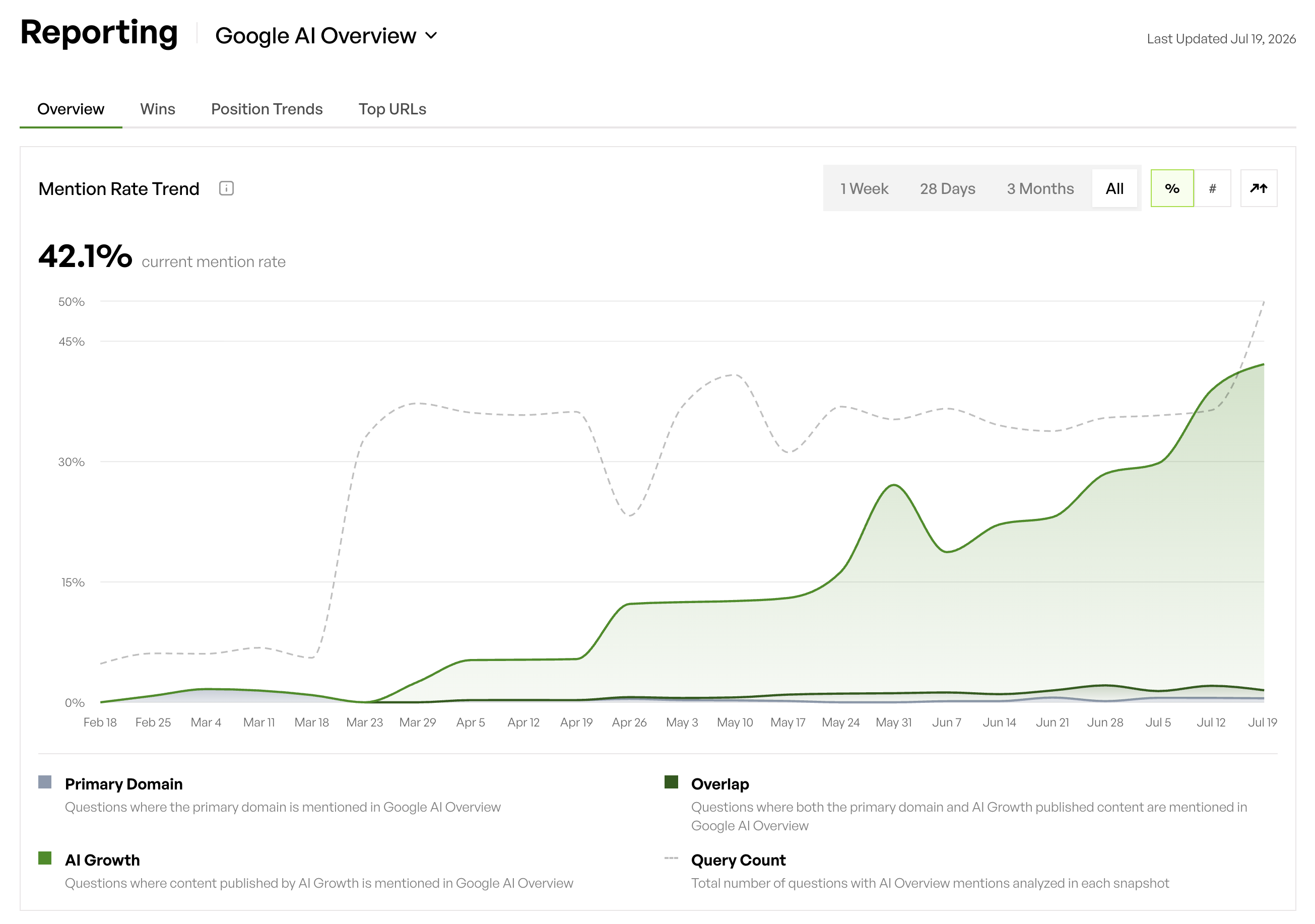
Recommendation Rate and Mention Rate measure different outcomes. A brand mention is any appearance of a brand name inside an AI-generated answer that does not present the brand as the primary answer to the user’s question; an active recommendation occurs when an AI engine names the brand as the answer or places it on a shortlist. Scrunch research found that when an AI platform recommends a brand to someone new, that person becomes approximately 182% more likely to search for the brand on Google within a week and 185% more likely to view its products. Tracking only Mention Rate while ignoring Recommendation Rate produces a dashboard that overstates commercial impact.
For Citation Share, focus on the structural gap that defines CPG specifically. A Gradial analysis of 28 retail and consumer brands found that brands are mentioned more often than they are cited in AI responses, with citations often flowing to third-party review sites. Closing the mention-to-citation gap requires owning the informational content, buying guides, ingredient explainers, and comparison pages that AI engines actually link to.
Step 4: Slice Visibility by Retailer and Category to Link to Commerce Outcomes
Aggregate AI Share of Shelf functions as a brand metric, while Retailer Share of Shelf and Category Share of Shelf function as commerce metrics. CPG brands with strong AI visibility often see higher conversion rates at the retail point of purchase versus brands with weak AI visibility. To surface that linkage, the prompt set must include retailer-specific queries run separately from category queries.
Retailer-specific prompts follow the pattern “Best [category] at [retailer]?” and isolate whether your brand wins the AI shelf at each retail partner. Category prompts follow the pattern “Best [category] for [use case]?” and isolate whether your brand wins the category conversation independent of retailer. Comparing the two cuts reveals where brand authority is strong but retailer-specific content is weak, or the reverse, and directs content investment accordingly.
Brands that have incorporated AI share of voice into their marketing mix models have found it to account for a meaningful portion of decomposed revenue, which shows that AI visibility is a measurable input to category performance, not a soft brand metric.
Step 5: Automate Measurement-to-Action with the Headless Engine
Measurement without action functions as a rearview mirror. The gap between a monitoring dashboard and a commerce outcome is the content that earns the citation and the recommendation. Fragmented stacks, with a GEO monitor here, a content agency there, and a schema plugin somewhere else, cannot close that gap at the speed AI surfaces update.
A headless engine replaces the stack. It maps the full prompt universe using real-time Google and ChatGPT data, produces authoritative content validated against primary sources, publishes with full technical and agentic SEO including Blog MCP, llms.txt, and agent discovery, and reports incremental visibility week over week. The measurement cadence and the content cadence run in the same workflow, so a drop in Retailer Share of Shelf triggers new content against that retailer’s query set within the same week, not the next quarter.
Common Mistakes and Troubleshooting
Three errors consistently undermine CPG AI visibility programs, and each one treats AI visibility as a static metric instead of a probabilistic system.
The first error is over-reliance on head terms. Head terms like “best protein powder” represent a small fraction of the queries buyers actually ask. Profound’s analysis of 100.7 million prompt runs found that category alone reproduces ChatGPT Shopping trigger behavior with 95 to 97% accuracy, but across roughly 2 million prompts run 10 or more times each, 79% never triggered Shopping in any run and only about 6% triggered reliably. A prompt set built only from head terms misses the long tail where most buying decisions are shaped.
The second error is single-run sampling. A 2026 study by Ronald Sielinski found that achieving a plus or minus 5-point confidence interval on citation share required roughly 30 to 50 runs on one engine and closer to 90 to 100 runs on another, with one engine not stabilizing even at 200 queries. Any dashboard built from a single weekly run per prompt reports noise, not signal.
The third error is mixing mentions with recommendations. Share-of-voice dashboards that count any brand appearance as equivalent obscure the gap between outcomes that drive revenue and those that do not, because a high share of voice with low citation and recommendation rates indicates AI engines know the brand but do not trust its content or endorse its products. The eight-metric dashboard separates these signals deliberately. Collapsing them into a single score destroys the diagnostic value.
Verifying Outcomes
Outcome verification confirms that new content actually moves AI visibility, not just internal dashboards. Incremental visibility reporting isolates what a new content effort generated, separate from the visibility the brand already had. Cross-reference the AI Share of Shelf dashboard against two independent signals: Google Search Console impressions on the content driving citations, and bot traffic logs showing which AI crawlers read which pages.
Adobe’s AI Content Visibility Checker analysis of U.S. retail websites found average machine-readability scores of 75% for homepages and 66% for individual product pages. If bot traffic is rising but Citation Share is flat, the content is being read but not trusted enough to cite. If Citation Share is rising but Recommendation Rate is flat, the content earns attribution but does not steer buyers. Each gap points to a specific content fix.
Product pages not updated within 90 days are three times more likely to lose AI citations. Living, self-healing content that updates automatically is not a nice-to-have for CPG brands managing large SKU counts across multiple retailers. It functions as a structural requirement.
Advanced Scenarios for CPG AI Share of Shelf
Multi-retailer portfolios. Run a dedicated Retailer Share of Shelf prompt set for each key retail partner. Differences in AI visibility across retailers reveal where brand content, retailer listing quality, or third-party review coverage is weakest. Ulta Beauty is seeing double the conversion and intent from shoppers finding its products through Gemini and ChatGPT, a result that requires retailer-specific content investment, not just brand-level improvements.
New product launches. Establish a pre-launch baseline across the category prompt set, then track weekly Recommendation Rate and Citation Share from launch week forward. AI-referred shoppers on product detail page sessions converted at nearly 50% higher rates than organic search visitors in Shopify’s Q1 2026 data, which makes early AI visibility for new SKUs a direct revenue lever, not a brand awareness exercise.
Competitive response. Treat a competitor’s rising Recommendation Rate in your category prompt set as a content signal, not a monitoring curiosity. Challenger CPG brands that publish detailed comparison guides, transparent ingredient sourcing stories, and thorough product education content are outperforming better-known category leaders in AI-driven purchase recommendations. The headless engine identifies which prompts the competitor is winning and produces authoritative content against those specific queries within the same measurement cycle.
Frequently Asked Questions
How many prompts do I actually need for a statistically valid AI Share of Shelf measurement?
Prompt volume depends on three variables: the margin of error you can tolerate, the mention rate you expect, and the number of repeat runs per prompt. For a CPG brand at a 20% mention rate, 50 prompt-runs produce a margin of error of approximately plus or minus 11 percentage points, while 500 prompt-runs reduce that to approximately plus or minus 3.5 percentage points. The 500 to 2,000 prompt range recommended in this framework is designed to produce retailer-level and category-level slices, each with their own confidence intervals, rather than a single aggregate number.
A single aggregate built from 50 prompts may look precise but cannot be sliced by retailer without the margin of error becoming too wide to act on. The weekly cadence matters as much as the total count. A frozen prompt set run repeatedly over time produces a time series where sustained multi-week trends are far more reliable than isolated week-on-week changes.
What is the difference between Mention Rate and Recommendation Rate, and why does it matter for CPG?
As explained in Step 3, Mention Rate and Recommendation Rate track different outcomes. Mention Rate measures the percentage of prompts where your brand appears anywhere in the AI answer. Recommendation Rate measures the percentage of prompts where the AI actively endorses your brand or places it on a shortlist in response to a purchase-intent query.
The divergence between them is often dramatic in CPG. A brand might appear in 60% of category prompts, which signals high Mention Rate, but be actively recommended in only 15%, which signals low Recommendation Rate. In that scenario, AI engines recognize the brand but do not trust its content enough to steer buyers toward it. Optimizing for Mention Rate alone produces a dashboard that looks healthy while the commercial impact remains near zero.
How do AI visibility metrics differ across CPG categories and retailers?
Category and retailer context materially change which metrics matter and what drives them. In food and beverage, nutritional claims and dietary certifications such as organic, non-GMO, and gluten-free act as primary recommendation signals, with brands maintaining clear, consistent certification documentation appearing in AI recommendation responses at significantly higher rates than brands with ambiguous claims. In personal care, ingredient transparency and clinical endorsements drive recommendation logic. In cleaning products, sustainability claims and safety certifications carry the most weight.
At the retailer level, queries structured as “Best [category] at [retailer]?” produce a different competitive set than category-level queries, because the AI draws on retailer-specific listing quality, availability signals, and review coverage for that retailer’s platform. A brand that wins the category conversation on ChatGPT may lose the retailer-specific query because its product detail pages on that retailer’s site lack the structured content AI engines can cite. Retailer Share of Shelf and Category Share of Shelf must be tracked separately for this reason.
Can AI Share of Shelf be tied directly to sales or revenue outcomes?
AI Share of Shelf can be tied directly to revenue when the right measurement architecture is in place. The linkage runs through two paths. The first is direct: AI-referred visitors carry measurably different commercial behavior than organic search visitors, with higher conversion rates, longer time on site, and higher average order values documented across multiple large-scale studies.
The second path is indirect but quantifiable through marketing mix modeling. Adding weekly AI share of voice as a variable in an MMM isolates the demand contribution attributable to AI visibility, separate from paid media, shelf position, and pricing. CPG brands with strong AI visibility often see higher conversion rates at the retail point of purchase versus brands with weak AI visibility. The measurement program described in this framework, with weekly cadence, retailer-level slicing, and incremental visibility reporting, produces the inputs an MMM needs to make that attribution defensible to a CMO or CFO.
Conclusion
AI Share of Shelf functions as a commerce metric, not a monitoring metric. The eight-metric dashboard, built on a 500 to 2,000 prompt sample run weekly across retailer and category query sets, gives CPG marketing directors a defensible, statistically credible system for presenting AI visibility to a CMO and linking it to category performance. The four-pillar data foundation, Search Intelligence, AI Analytics, Bot Tracking, and AI Ranking, provides the inputs. The measurement-to-action loop, where weekly dashboard findings trigger content against the specific prompts where visibility is weakest, closes the gap between observation and execution.
AI Growth Agent acts as the single headless engine that both measures and improves AI visibility. It maps the full prompt universe, produces authoritative living content validated against primary sources, publishes with full technical and agentic SEO, and reports the incremental visibility it generates week over week. This approach turns AI Share of Shelf into a steering wheel for CPG growth, not a rearview mirror.