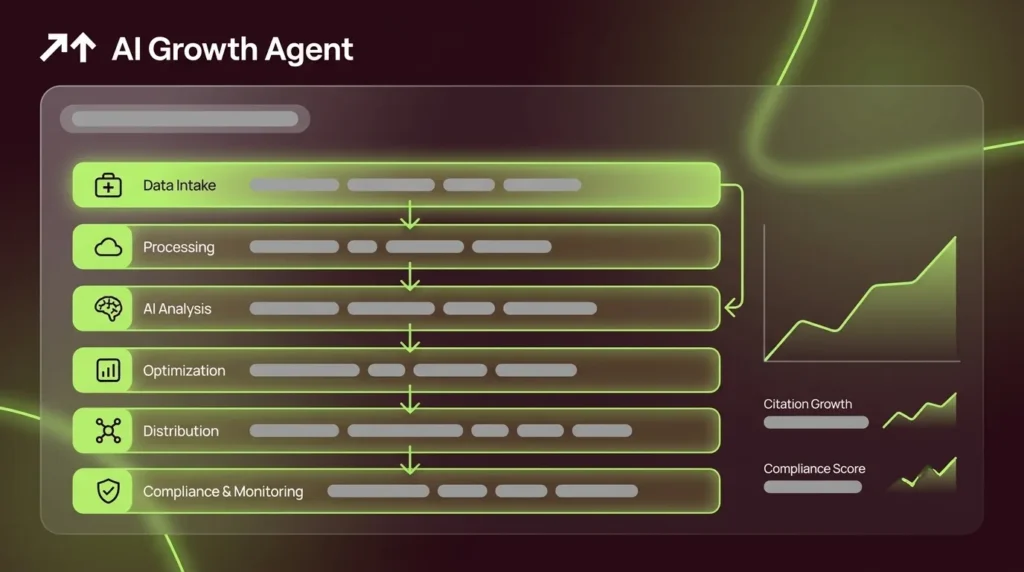
Written by: Mariana Fonseca, Editorial Team, AI Growth Agent
Enterprise MedTech marketing teams now compete inside AI surfaces like ChatGPT, Perplexity, and Google AI Mode. Clinical buyers start there, not on traditional search results pages. Generic AI marketing stacks struggle in this environment because they bolt compliance on at the end instead of building it into the system. This article introduces a 6-layer operating model that bakes MLR, HIPAA, and AI citation requirements into the architecture from day one. The table below shows how each layer connects technical requirements with governance controls.
| Layer | Description | Technical/Agentic SEO Requirements for AI Citation | Governance Controls |
|---|---|---|---|
| 1. Data and Claims Foundation | Approved claims library, BAA-covered LLM vendors, PHI segmentation, and first-party data architecture that separates marketing data from clinical records | Primary-source URLs treated as canonical, manifesto-driven content grounding, no reliance on model training data for regulated claims | BAA execution with every AI vendor touching PHI, written AI usage policy, claims library RAG integration, deny lists and domain filters |
| 2. MLR-by-Design Workflow | Structured prompt templates, source-documented claims via RAG, risk-tiered MLR routing, and human review checkpoints embedded before any asset publishes | Every published claim traceable to IFU, 510(k) summary, PMA, label, or peer-reviewed evidence, anti-hallucination cascade validates sources pre-publication | Named medical/legal/regulatory reviewers with documented SLAs, right-first-time submission tracking, audit trail for every AI-assisted asset |
| 3. Hub-and-Spoke Content Architecture | Seed-term hubs with long-tail spoke articles mapped to buying committee personas across the extended MedTech sales cycle described later | Internal linking that compounds authority across the universe, schema markup on every asset, living content that self-heals as clinical evidence evolves | Brand voice memories enforced at generation, style and factual memories applied to every article, legal disclaimers with Chicago-style superscripts |
| 4. Agentic Technical SEO | Full traditional and agentic technical SEO stack: structured HTML, rich schema, Blog MCP, llms.txt, llms-full.txt, agent discovery via /.well-known/, and natural language query parameters | Blog MCP with schema, manifest, discovery, and capability guidance exposed to agents, OpenAI discovery and Agent Card guidance, Markdown served to agent crawlers, proper sitemap.xml and robots.txt | Automated web stories, instant indexing, autoredirects and 404 tracking, no manual schema work required from client team |
| 5. AI Surface Citation Engine | Evidence-based long-tail content production using real-time AI Overview and ChatGPT results as the objective function, universe refreshed weekly across 3,000+ searches | Citation context tracking: order of mention, grouping, and claim cited, bot tracking for every ChatGPT, Perplexity, and Google AI Mode crawl, AI Ranking monitored week over week | Anti-hallucination post-draft claim re-extraction, verified external research only, no model training data used for regulated claims |
| 6. Incremental Visibility and Maturity Reporting | Isolated reporting that separates AI Growth Agent-generated visibility from existing brand visibility, pipeline velocity and MLR cycle time tracked as commercial KPIs | Google Search Console as independent audit, per-article bot analytics, cross-referenced citation and impression data, weekly universe snapshot | Separate publishing environment for incremental attribution, client owns all content and the site outright, flat-fee pricing with no prompt caps |
Key Takeaways for MedTech AI Marketing Leaders
- MedTech buyers now start research inside AI surfaces like ChatGPT, Perplexity, and Google AI Mode, so AI citation has become the new competitive battleground.
- Four intelligence pillars, Search Intelligence, AI Analytics, Bot Tracking, and AI Ranking, determine whether a MedTech brand appears in AI-mediated conversations.
- Generic 5-layer stacks fail in regulated environments because they treat compliance as a final review step instead of embedding MLR controls from the start.
- The 6-layer operating framework connects Data and Claims, MLR workflow, Hub-and-Spoke content, Agentic Technical SEO, AI Surface Citation, and Incremental Visibility reporting into one governed system.
- AI Growth Agent delivers this governed, self-healing engine that isolates incremental visibility and accelerates pipeline velocity; review your current MedTech AI marketing framework in a working session.
Core Concepts Behind the 6-Layer Model
The 6-layer operating model relies on several core concepts that shape how AI surfaces find and cite MedTech content. The universe is the full set of queries and prompts that describe a MedTech brand’s market, head terms and long tail together. Most enterprise MedTech teams track a small set of head terms and lose the rest of the conversation by default. The long tail is where AI surfaces actually operate, because robots explore hundreds of ways a clinical buyer, hospital administrator, or procurement lead can ask the same question.
Seed terms act as the strategic anchors that organize this universe and feed directly into the Hub-and-Spoke Architecture in Layer 3. Each seed term spawns dozens of long-tail queries underneath it. Citation context replaces the old idea of a single ranking number and becomes the signal that powers the AI Surface Citation Engine in Layer 5. It describes where the brand appears in an AI answer, who it is grouped with, and what claim it is cited for. Large language model optimization (LLMO) focuses on writing and structuring content so that AI surfaces find it, trust it, and cite it. Living content supports this by updating and self-healing over time so the brand’s presence does not decay as clinical evidence, regulatory guidance, or competitive positioning evolves. Incremental visibility reporting in Layer 6 then isolates the visibility a new effort actually generated from the visibility the brand already had.
Two named sub-frameworks operationalize these concepts in regulated MedTech environments. The MLR AI Framework embeds medical-legal-regulatory review at the generation layer instead of the publication layer, using claims-library RAG, risk-tiered routing, and human review checkpoints so every asset that reaches an AI surface is traceable to an approved source. The Hub-and-Spoke Operating Model organizes content around seed-term hubs with long-tail spoke articles mapped to each buying committee persona across the full MedTech sales cycle, which commonly runs 6 to 18 months and requires sustaining credibility across multiple stakeholders including clinical leads, procurement, IT, compliance, and finance.
See how these concepts plug into your current MedTech AI stack.
Current Market Shifts Driving This Framework
AI adoption in MedTech has moved from experimentation to production. NVIDIA’s 2026 State of AI in Healthcare and Life Sciences survey found that 70% of healthcare and life sciences organizations are actively using AI, up from 63% in 2024. Sixty-nine percent of organizations are using generative AI and large language models, up from 54% the prior year, while 47% are using or assessing agentic AI. A majority of executives report that AI is helping increase revenue and reduce costs.
Those adoption numbers are reshaping what enterprise MedTech marketing leaders must deliver. The pressure is no longer simply to use AI, because that threshold has already been crossed. Leaders now need AI programs that satisfy MLR, HIPAA, and the FDA’s promotional boundaries while still producing measurable commercial outcomes. A practical workflow pattern for MedTech teams is to build an internal approved claims library containing every claim, indication, statistic, and study citation that has passed regulatory review, then pipe it into the foundation LLM as retrieval context so the model draws only from pre-approved language. Enterprise AI vendors that touch PHI must operate under a Business Associate Agreement, and marketing data should be segmented away from clinical or patient records.
Skipping that foundation creates more than a missed opportunity. It creates regulatory exposure. The U.S. Department of Justice recovered more than $5.7 billion in healthcare False Claims Act matters in fiscal year 2025. Enterprise MedTech marketing leaders who cannot demonstrate a governed AI workflow are not just behind on adoption. They are carrying undisclosed compliance risk that regulators and internal stakeholders will eventually surface.
Benchmark your AI marketing maturity against 2026 MedTech leaders.
How the 6-Layer Operating Model Works in Practice
The 6-layer Enterprise MedTech AI Marketing Operating Framework described in the table functions as a single architecture that satisfies MLR, HIPAA, and AI surface citation requirements at the same time. Each layer supports the others. Removing or deferring any one of them creates the compliance gaps that generic consulting stacks often introduce.
Layer 1, the Data and Claims Foundation, acts as the prerequisite for every other layer. Promotional claims in MedTech AI workflows must trace back to approved product sources such as IFUs, 510(k) summaries, PMAs, labels, or peer-reviewed evidence. AI output that cannot be traced to these sources does not ship, which requires retrieval-augmented generation tied to a claims library rather than free-text generation. Without this foundation, every downstream article carries hallucination risk and regulatory exposure.
Layer 2, the MLR-by-Design Workflow, brings compliance into the generation process instead of treating it as a final gate. Organizations deploying automated MLR capabilities can reduce MLR review cycle times, improve right-first-time submission rates, and cut cost and effort across content production. Structured prompts, source-documented claims via RAG, and human review checkpoints allow AI to draft quickly while governance controls decide what publishes.
Layer 3, the Hub-and-Spoke Content Architecture, translates seed terms into persona-specific coverage across the extended sales cycle described earlier. AI helps decode complex B2B buying committees in MedTech by analyzing behavior data to reveal patterns, such as clinicians focusing on clinical validation while ignoring economic briefs. The Hub-and-Spoke model then produces content for each persona at scale from a single governed engine.
Layer 4, Agentic Technical SEO, makes the entire content universe legible to AI agents and traditional crawlers. Blog MCP, llms.txt, llms-full.txt, agent discovery via /.well-known/, and natural language query parameters function as structural requirements, not optional enhancements. Vendors must become legible to the AI systems that interpret and synthesize information on behalf of human buyers.

Layer 5, the AI Surface Citation Engine, uses real-time AI Overview and ChatGPT results to decide which long-tail queries deserve coverage. The universe refreshes weekly across more than 3,000 searches. Citation context, order of mention, and bot tracking replace a static rank number as the key performance signals.
Layer 6, Incremental Visibility and Maturity Reporting, separates what the framework actually generated from existing brand visibility. Pipeline velocity and MLR cycle time serve as the commercial KPIs that connect content output to revenue outcomes. AI Growth Agent publishes into a separate environment to make that isolation possible, so enterprise MedTech marketing leaders can present a defensible story to regulatory, legal, and C-suite stakeholders every week.
Review how a 6-layer operating model would change your current MedTech marketing stack.
Key Evaluation Factors for MedTech AI Engines
Three evaluation factors separate governance-first AI marketing engines from generic stacks in regulated MedTech environments.
The first factor is compliance gating. Every AI vendor that touches PHI must operate under a BAA. The approved claims library must sit inside the system as RAG context, not as a static style guide tacked onto a prompt. Human review checkpoints must be named, documented, and auditable. Unmanaged use of consumer AI tools like ChatGPT in MedTech creates compliance gaps because organizations lack visibility into shared data, review workflows for outputs, and audit trails for physician-facing communications.
The second factor is data segmentation. PHI, patient identifiers, unredacted clinical study data, and any data covered by HIPAA’s 18 identifiers must stay out of consumer-tier AI tools. Most marketing use cases such as SEO, content drafting, ad copy, and ABM enrichment of business contacts do not involve PHI and remain low risk when teams receive proper training. The real risk comes from ungoverned AI marketing rather than from AI itself.
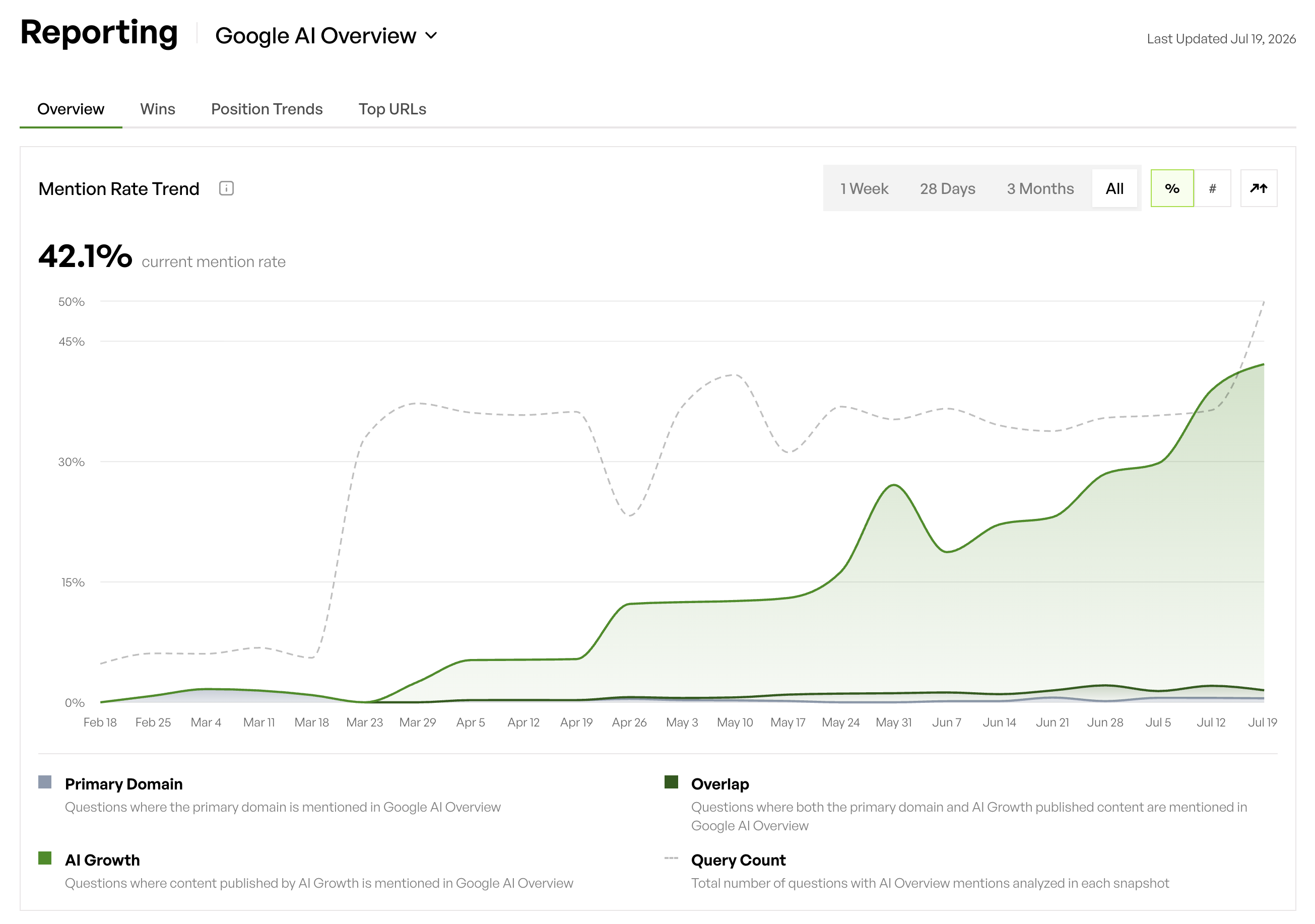
The third factor is incremental visibility reporting. Capped monitoring tools and agency stacks cannot clearly separate their contribution from existing brand visibility. AI Growth Agent’s flat-fee, self-healing engine publishes into a separate environment and reports week over week exactly what it generated, cross-referencing bot traffic, Google Search Console, and citation data that no single monitoring tool unifies. That reporting makes an AI marketing investment defensible to a CFO or a regulatory affairs team.
Compare potential AI marketing partners against these compliance and reporting standards.
Implementation Stages for Enterprise MedTech Teams
Enterprise MedTech AI marketing maturity progresses through four stages, and each stage connects directly to measurable commercial KPIs.
Stage 1 is the Readiness Assessment. A practical five-phase framework for AI deployment in regulated industries begins with an AI Readiness Assessment across data infrastructure, compliance systems, skills and capability, and organizational ownership, because skipping this step leads to weak foundations and failed implementations. For MedTech marketing, this stage means documenting the claims library, establishing the MLR workflow, executing BAAs with chosen LLM vendors, and writing the AI usage policy before any production deployment.
Stage 2 is the Pilot, which builds directly on the readiness work. AI Growth Agent stands up a fully optimized, client-owned site within the first week of kickoff. Content often indexes in as little as ten days. The standard pilot runs three months, during which the engine maps the full universe, produces authoritative long-tail content against approved claims, and begins generating incremental visibility data. MLR cycle time is tracked from the first article to establish a baseline.
Stage 3 is Scaled Integration. The Hub-and-Spoke architecture expands across the full buying committee persona set. Enterprise marketing teams measure AI value through efficiency metrics such as cost-per-asset reduction and revision cycles, quality metrics such as approval pass rates, and business metrics including campaign velocity, pipeline influence, and content-attributed revenue. Pipeline velocity and MLR cycle time reduction become the primary KPIs at this stage.
Stage 4 is Autonomous Operation. The engine self-heals content, refreshes the universe weekly, tracks bot activity across every AI surface, and reports incremental visibility without requiring headcount from the client’s marketing team. When governance and operating models are established, AI in marketing can tie directly to performance indicators such as pipeline contribution, efficiency gains, and cost control instead of remaining an abstract innovation initiative.
Plan a staged rollout of your enterprise MedTech AI operating model.
Ongoing Management of a Self-Healing MedTech Engine
Living, self-healing content functions as a structural requirement in MedTech, where clinical evidence, regulatory guidance, and competitive positioning change continuously. Every article AI Growth Agent produces updates automatically when Google Search Console signals or bot-traffic data indicate decay. When the year turns, every article in a sector receives a refresh so content does not go stale the day it ships.
Weekly universe refreshes run more than 3,000 searches to maintain a current picture of the battleground. Bot tracking captures every crawl, citation, and training sweep by ChatGPT, Perplexity, Google AI Mode, and traditional crawlers. Incremental visibility reporting isolates AI Growth Agent’s contribution week over week, giving enterprise MedTech marketing leaders a defensible number that remains separate from existing brand visibility.
This ongoing management layer replaces the SEO agency, content tool, web agency, GEO monitor, schema plugin, analytics stack, and PR firm with a single engine at a flat fee. There are no per-article charges, credit limits, or per-prompt billing. The client owns the site and all the content outright. The engine handles technical SEO, schema, bot tracking, publishing, and self-healing without requiring technical skill from the client’s team.
Activate ongoing management for your enterprise MedTech AI marketing engine.
Risks and Limitations in Regulated MedTech AI Marketing
Four specific risks define the common failure modes of AI marketing in regulated MedTech environments and connect directly back to the 6-layer framework.
The first risk is hallucination without claims-library RAG. Research on AI in clinical applications shows that fully automated systems can generate issues related to clarity, alignment with standards of care, and communication, while systems with human oversight are more likely to produce clinically validated outputs without critical errors. In MedTech marketing, hallucinated claims damage credibility and create regulatory exposure under FDA promotional guidelines and FTC substantiation requirements.
The second risk is regulatory exposure from consumer-tier tools. The architecture that succeeds uses an enterprise LLM with BAA connected to a retrieval index of approved claims and brand-voice samples, while the pattern that fails relies on consumer chatbots, free-text prompts, and no review step.
The third risk is content decay without self-healing. Without content governance, organizations face risks including brand inconsistency, factual inaccuracy, and regulatory non-compliance, and the speed of AI content generation amplifies these issues because more content appears faster with less human review per piece. Content that was compliant at publication can become non-compliant as labeling, indications, or clinical evidence change.
The fourth risk is failure to map the full long tail. AI now acts as a filter for the market by summarizing options, comparing vendors, and generating an initial shortlist before a human stakeholder brings recommendations to the broader buying committee, which means vendors absent from that initial set rarely receive consideration. Capped monitoring tools that track a handful of prompts leave enterprise MedTech brands invisible across most of their own market.
AI Growth Agent mitigates all four risks through manifesto-driven governance, claims-library RAG, anti-hallucination post-draft claim re-extraction, living self-healing content, and a universe map that covers hundreds of seed terms and their long-tail queries refreshed weekly.
Audit your current AI marketing risk exposure in regulated MedTech.
Summary with Decision Support for MedTech Leaders
Generic 5-layer stacks struggle in regulated MedTech environments because they treat compliance as an afterthought. The 6-layer Enterprise MedTech AI Marketing Operating Framework succeeds because MLR controls and Hub-and-Spoke execution sit inside every layer from day one. The Data and Claims Foundation anchors every asset to approved sources. The MLR-by-Design Workflow embeds review at generation instead of at publication. The Hub-and-Spoke Architecture maps content to every buying committee persona across the extended sales cycle. Agentic Technical SEO makes the content legible to AI surfaces. The AI Surface Citation Engine builds authority across the full long tail. Incremental Visibility Reporting gives enterprise MedTech marketing leaders a defensible commercial case.
A governance-first, headless engine is the only practical way to operationalize that framework at enterprise scale without adding headcount or compliance risk. AI Growth Agent functions as that engine. It replaces the SEO agency, content tool, web agency, GEO monitor, schema plugin, analytics stack, and PR firm with a single flat-fee engine that stands up a fully optimized, client-owned site within the first week, produces living self-healing content validated against approved claims, and reports the incremental visibility it generates week over week.
Map your enterprise MedTech AI operating model and see a compliant article live within a week.
Frequently Asked Questions
What makes an MLR AI framework different from a standard content review process?
A standard content review process treats MLR as a final gate, where content is drafted and then submitted for medical, legal, and regulatory review before publication. An MLR AI framework embeds compliance at the generation layer. The approved claims library is integrated as retrieval-augmented generation context, so the AI model draws only from pre-approved language rather than generating claims freely and submitting them for review afterward. Structured prompt templates enforce source documentation at the drafting stage. Risk-tiered routing sends high-sensitivity physician-facing content through named reviewers with documented SLAs, while lower-risk internal drafts follow a lighter path. Human review checkpoints sit inside the workflow instead of being appended to it. The practical outcome is a higher right-first-time submission rate, shorter MLR cycle times, and a full audit trail for every AI-assisted asset, which matches the standard enterprise MedTech organizations need to demonstrate to regulatory affairs and legal stakeholders.
How does the Hub-and-Spoke operating model address long MedTech B2B buying cycles?
MedTech B2B sales cycles commonly run 6 to 18 months and involve buying committees that include clinical leads, IT and security reviewers, procurement, compliance officers, and finance signers, each holding veto power over decisions. The Hub-and-Spoke operating model addresses this by organizing content around seed-term hubs that represent the strategic anchor topics in a MedTech brand’s market, with long-tail spoke articles mapped to each buying committee persona at each stage of the cycle. A clinical champion in the early education phase needs outcomes data and clinical validation. A procurement lead in the decision phase needs contract terms and implementation guides. A finance signer needs an ROI framework. The Hub-and-Spoke model produces all of that content at scale from a single governed engine, with internal linking that compounds authority across the universe and living self-healing content that remains current as the clinical and regulatory landscape evolves. The result is sustained credibility across every stakeholder throughout the full cycle without requiring a separate content team for each audience.
What is the difference between AI surface citation and traditional SEO ranking in MedTech marketing?
Traditional SEO ranking produces a static ordered list of blue links where a brand’s position is a number and the goal is to move that number up. AI surface citation behaves differently. AI surfaces like ChatGPT, Perplexity, and Google’s AI Mode synthesize answers from content they can find, trust, and parse. There is no static ordered list. The performance signal becomes citation context, which includes where the brand appears in the answer, what claim it is cited for, who it is grouped with, and how that position evolves week over week. For enterprise MedTech brands, this means content must be structured so AI surfaces can parse it, backed by validated primary sources so the AI trusts the claim, and formatted in ways the surface can actually pull from, including full schema, Blog MCP, llms.txt, llms-full.txt, and agent discovery endpoints. It also means the full long tail of queries that clinical buyers, hospital administrators, and procurement leads actually ask must be covered, not just the head terms a brand pre-decided to defend. Capped monitoring tools that track a handful of prompts leave most of that long tail invisible.
How does AI Growth Agent handle HIPAA compliance in enterprise MedTech marketing workflows?
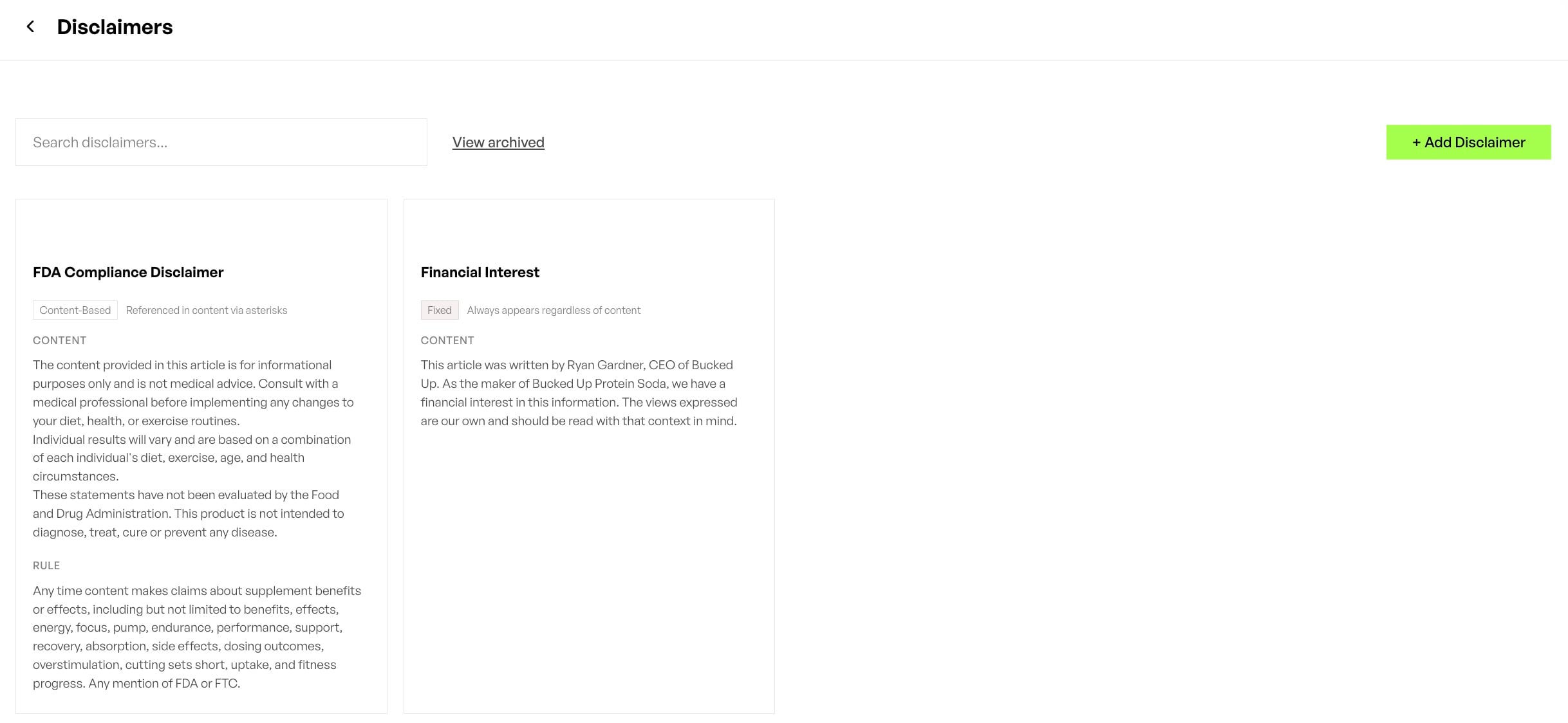
AI Growth Agent’s approach to HIPAA compliance in enterprise MedTech marketing operates at the architecture level rather than only at the policy level. Marketing data is structurally separated from clinical or patient records. The engine does not require PHI to produce authoritative content, because it draws from the client’s manifesto, approved claims library, primary-source URLs, and product pages, none of which involve patient identifiers or the 18 HIPAA-covered data categories. For enterprise clients whose workflows touch PHI, AI Growth Agent supports BAA execution with the relevant AI vendors in the stack. Every claim, source, and quote is validated against evidence found online rather than a model’s training data, which reduces the hallucination risk that creates regulatory exposure in physician-facing content. Legal disclaimers with Chicago-style superscripts are configured once and applied to every future generation. The result is a content production workflow that satisfies HIPAA’s data handling requirements without restricting the scope of content the engine can produce across the full long tail of MedTech queries.
What commercial KPIs should enterprise MedTech marketing leaders use to measure AI marketing maturity?
Enterprise MedTech marketing leaders should track two categories of KPIs, operational KPIs that measure the efficiency of the AI marketing workflow and commercial KPIs that connect content output to revenue outcomes. On the operational side, MLR cycle time and right-first-time submission rate measure how effectively the MLR AI framework reduces review bottlenecks. Content indexing speed and bot visit volume measure how quickly AI surfaces find and cite new content. On the commercial side, pipeline velocity measures how the Hub-and-Spoke content architecture accelerates deals through a 6-to-18-month buying cycle. Incremental visibility, reported week over week and isolated from existing brand visibility, measures the actual contribution of the AI marketing engine instead of riding existing brand equity. Citation rate and brand mention rate across ChatGPT, Perplexity, and Google’s AI Mode measure presence on the AI surfaces where MedTech buyers now begin their research. Together, these KPIs give enterprise MedTech marketing leaders a defensible commercial case for AI marketing investment that satisfies regulatory, legal, and C-suite stakeholders at the same time.