Written by: Mariana Fonseca, Editorial Team, AI Growth Agent
Key Takeaways
- Enterprise AI visibility splits into two needs: internal governance that secures AI usage and external brand control that shapes public AI answers.
- Internal governance tools stop at the organization’s perimeter and cannot influence what ChatGPT or other AI systems say to new or unknown customers.
- Monitoring platforms identify gaps in AI visibility but do not close them. Four pillars of AI search intelligence require active content and publishing engines to deliver results.
- External brand control relies on a headless marketing engine that produces living, self-healing content, provisions full schema and agent-discovery files, and generates measurable incremental citations and impressions.
- AI Growth Agent replaces the full agency stack with a single headless engine that delivers first citations within two to three weeks. Book a demo to map your current stack against external visibility requirements.
The Discovery Shift and the Two Enterprise Needs
Customer discovery has shifted from blue links to AI answers, and the answer increasingly appears without a click. Customers ask ChatGPT, Perplexity, and Google’s AI Mode, and what those systems can find, trust, and cite now decides whether a brand appears in the conversation at all. BrightEdge’s year-in-review data shows Google search impressions climbed 49% in the twelve months following AI Overviews’ launch, while click-through rates dropped nearly 30% over the same period. Visibility is rising while the confirming click is disappearing.
For enterprise marketing leaders, this creates two separate problems that often get blended into one. The first is internal: the organization must govern AI tool usage, protect sensitive data, and audit model behavior inside its own walls. The second is external: AI systems answer questions about the brand for customers, and someone must control that narrative.
These problems require different architectures. Conflating them leads to a common and costly mistake: investing in internal governance platforms and believing the brand’s public AI presence is covered. It is not. The following table shows how these two needs differ across four critical dimensions.
| Dimension | Internal Governance | External Brand Control |
|---|---|---|
| Primary question | How does AI behave inside our organization? | What does AI say about us to the world? |
| Audience | Employees, IT, compliance teams | Customers, buyers, AI surfaces |
| Output | Audit logs, access controls, policy enforcement | Citations, mentions, recommendations in AI answers |
| Who owns it | CISO, IT, legal | CMO, VP of Marketing, brand leadership |
Map your visibility requirements and see which path your current stack actually covers.
Internal Governance: Guardrails Inside the Organization
Internal governance for enterprise AI defines the controls that determine how large language models behave inside an organization. These controls decide who can deploy tools, what data bots can access, which systems they can interact with, and how outputs are checked before they leave the system. A 2025 McKinsey report found that 28% of respondents whose organizations use AI report that their CEO is responsible for overseeing AI governance, which shows that most enterprises are still building this foundation.
Platforms in this category address prompt injection, data leakage, access control, and output risk. Enterprise LLM security operates as a model that connects application security, identity security, data governance, SOC operations, privacy, and AI governance rather than a purely technical task. ChatGPT Enterprise’s admin controls, third-party security platforms, and knowledge base governance tools all operate within this frame.
The critical boundary is what these tools cannot do. Internal knowledge controls in enterprise LLM deployments determine what the model can access and trust through data certification, lineage, and classification, while external citation influence in public AI answers depends on public web signals and content extractability. Internal governance stops at the organization’s perimeter. It has no mechanism for influencing what ChatGPT says to a customer who has never interacted with the company’s internal systems.
Review external control options and clarify what your governance investment does and does not cover.
Why Monitoring Alone Fails: The Four Pillars of AI Search Intelligence
Internal governance focuses on behavior inside the organization, so many enterprises turn to monitoring platforms to understand their external AI presence. The monitoring category has grown rapidly. Tools that track whether a brand appears for a capped set of prompts now occupy a visible portion of the enterprise martech conversation. The problem is structural: monitoring provides observation, not action. Passionfruit’s analysis of 11.2 million AI citations across ChatGPT, Claude, Gemini, and Perplexity over seven months shows why external AI search programs must run continuously to sustain citation volume at scale. A dashboard that shows a brand is missing from AI answers does not fix the absence.
Four pillars of AI search intelligence work together to move from observation to control, and each pillar requires action.
- Search Intelligence. This pillar builds a complete portrait of the traditional search landscape, including positioning, competition, search volume, and the structure of who is already winning. This foundation reveals the raw situation and turns it into an actionable diagnosis.
- AI Analytics. This pillar builds on the search foundation and tracks brand value and consumer behavior across the whole journey, from external touchpoints like Google and AI-tool queries through content consumption, demographics, and sentiment.
- Bot Tracking. This pillar records every bot interaction, including traditional crawlers and AI training agents, across every crawl, citation, and training sweep. With this visibility into who is reading the content, teams can see whether the brand is being read at all and where to intervene.
- AI Ranking. This pillar recognizes that AI answers have no static ordered list, so order of mention and citation context become the new ranking. Where the brand appears in the answer, and how that position evolves week over week, forms the new leaderboard.
Citation outcomes in AI answers are influenced through public content, cross-platform authority signals, and monitoring rather than internal security controls. Monitoring platforms identify the gap. Only a content and publishing engine closes it.
Activate all four pillars and move from passive monitoring to measurable external brand control.
External Brand Control: Headless Marketing in Practice
External brand control focuses on producing the content AI surfaces will use to describe the brand, in formats and structures the models can read, with the validation that earns the citation. This work sits upstream from monitoring and reacts before problems appear in dashboards. AirOps found that 85% of brand mentions in AI answers originate from third-party pages rather than owned domains, so the content strategy must extend beyond the brand’s main site to earn the authority signals AI surfaces trust.
Headless marketing provides the architecture that delivers this at enterprise scale. A single engine replaces the SEO agency, the content tool, the web agency, the GEO monitor, the schema plugin, the analytics stack, and the PR firm. AI Growth Agent stands up a fully optimized blog the brand owns, styled to match its existing site, and connects it through a reverse proxy rewrite under a subdirectory or subdomain. The existing structure stays intact.
The technical stack ships out of the box with every engagement.
- Full schema suite covering article, author, reviews, local business, product, software application, and the rest of the schema suite
- Blog MCP for direct interoperability with AI search, compatible with Chrome 146+ and other WebMCP-enabled browsers
- Agent discovery via
/.well-known/, including OpenAI discovery and Agent Card guidance llms.txtandllms-full.txtpublished so AI surfaces can read the brand the way they need to- Instant indexing, autoredirects, and 404 tracking
- Advanced
robots.txt, propersitemap.xml, and automated web stories - Natural language query parameters via
/?s={query}that auto-trigger personalized, internally linked responses for agent crawlers
Independent industry analyses from Adobe, Onely, Schema App, and ALM Corp identify entity-level signals, not page-level keyword density, as the most transferable foundation for AI citation work in generative search engines. The headless engine provisions all of these signals automatically, with no technical skill required from the client’s team.
See the engine live and compare the full technical stack with your current setup.
Living Content and Incremental Visibility Reporting
Static content that ships and goes stale becomes a liability as the world changes and AI models update their retrieval layers. Early adopters of living content pipelines for statistics-heavy evergreen articles report a 34% average increase in organic traffic to updated pages, driven by improved content freshness signals and accumulated topical depth. Content updated within 30 days receives 3.2 times more AI citations than older material, according to analysis reported by Searchable.com (not ConvertMate’s 80-million-citation study).
AI Growth Agent’s content behaves as living content. It self-heals and updates over time. When the year turns, every article in a sector refreshes automatically. Every article’s relationships, performance, and bot and Search Console data are centralized so authority compounds instead of decaying.
Incremental visibility reporting isolates exactly what the engine generated, week over week, separate from visibility the brand already had. AI Growth Agent publishes into a separate environment and cross-references bot traffic, Google Search Console, and citation data to prove the result. Across the first twelve weeks, clients average more than 12,000 additional AI citations and mentions, over 100,000 additional bot visits, and a 20%+ lift in impressions, with content indexing in as little as ten days.
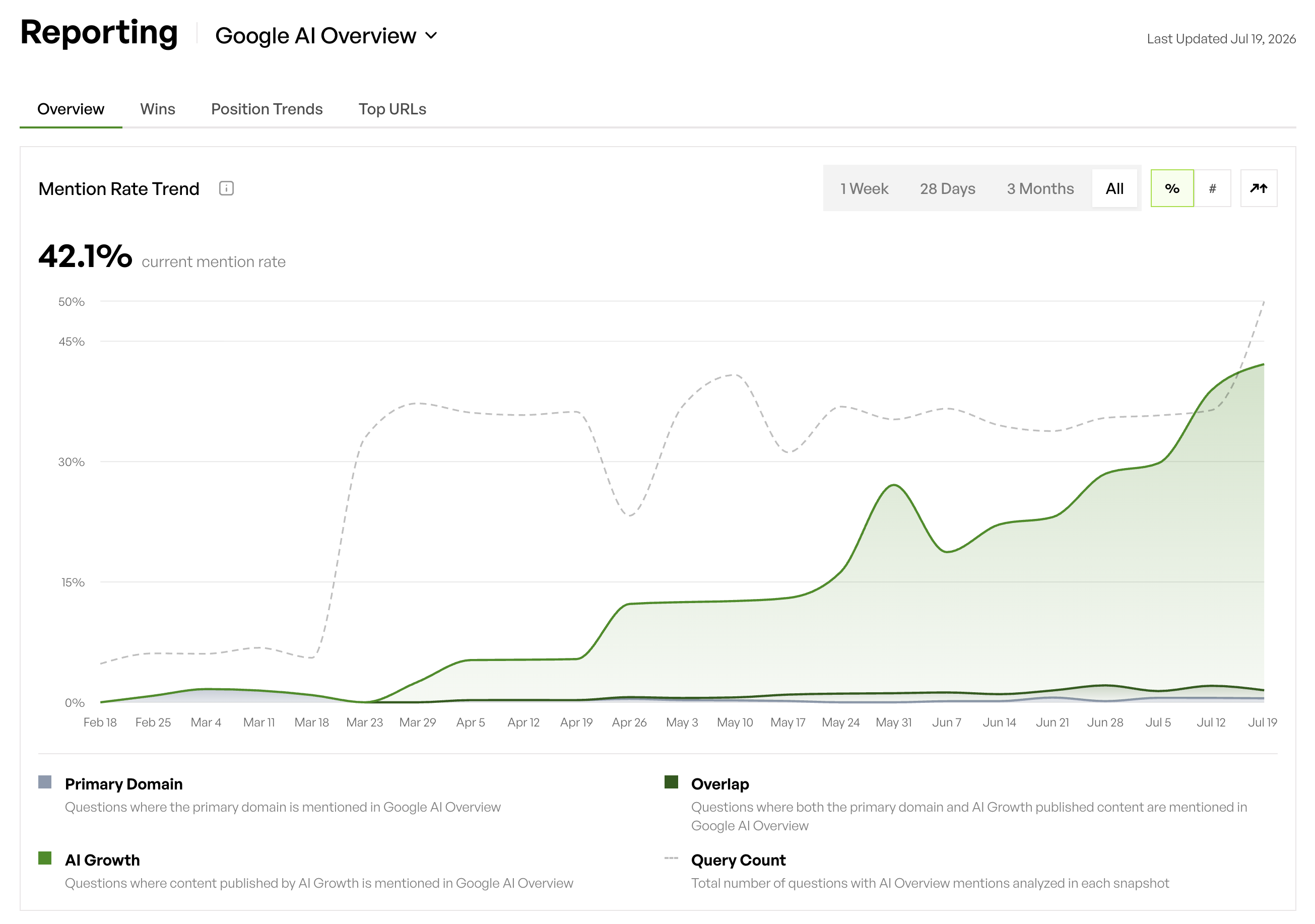
Leva Sleep, now the most mentioned retailer for adjustable beds in Canada, saw ChatGPT citing its content over 10,000 times per month and closed $40,000 to $50,000 in deals in under three weeks from buyers who discovered the brand through AI Growth Agent content. Breadless reached a 30x lift in Google Search Console impressions over six months, with ChatGPT citing eatbreadless.com over 45,000 times per month.
Decision Matrix: Governance, Monitoring, and Headless Control
The following matrix compares the three primary approaches to AI visibility and shows how each differs in scope, output, ownership, and time to value.
| Dimension | Internal Governance Tools | AI Search Monitoring Platforms | External Headless Engine (AI Growth Agent) |
|---|---|---|---|
| Scope | Controls AI behavior inside the organization | Tracks brand appearance for a capped prompt set | Maps the full universe of queries, with no prompt cap |
| Output | Audit logs, access controls, policy enforcement | Visibility reports and gap identification | Published, self-healing content, citations, bot traffic, impressions |
| Ownership | CISO, IT, legal | Marketing or SEO team | CMO owns the site, content, and reporting outright |
| Time to value | Months of deployment and configuration | Immediate dashboards, no content produced | First article live within one week, indexing in as little as ten days |
Run this matrix against your current stack and identify the gaps your existing tools leave open.
Frequently Asked Questions
How quickly can external visibility programs show first citations?
AI Growth Agent delivers the first published article within approximately one week of kickoff. Content has indexed in as little as ten days and typically within two weeks. First citations in AI answers follow indexing and usually align with this two-to-three-week window. The standard engagement is a three-month pilot because indexing timelines vary by industry and domain authority, but movement appears early. Jelly, a restaurant inventory management platform, received its first citation within three weeks. Exceeds.ai received its first citation within two weeks.
What technical dependencies exist for headless deployment?
The only integration step required from the client’s side is the reverse proxy rewrite that connects the AI Growth Agent blog to a subdirectory under the brand’s domain or a subdomain configuration. Setup documentation is generated for the client’s specific host, whether Cloudflare, Vercel, or another provider. Everything else, including the full schema suite, Blog MCP, agent discovery files, llms.txt and llms-full.txt, instant indexing, autoredirects, 404 tracking, and the advanced WordPress plugin, ships automatically with every package. No engineering team or technical skill is required from the client’s side beyond the initial proxy configuration.
How does the engine maintain compliance and brand ownership?
Brand voice, factual references, deny lists, and legal disclaimers are configured during the kickoff interview and applied to every future generation. The engine supports fixed and dynamic legal disclaimers with Chicago-style superscripts for regulated sectors, claim prioritization for sensitive claim types such as ingredients or financial figures, and a cascade of anti-hallucination checks that validate every claim, source, and quote against evidence found online rather than a model’s training data. Requirements are configured once and respected everywhere. The client owns all content produced and retains full control of the site and its relationship with AI surfaces.
Who retains final control of site and content?
The client owns the site outright. AI Growth Agent stands up a property the client controls, connected to their domain through a reverse proxy rewrite or subdomain. There is no agency in the loop, no lock-in, and no dependency on AI Growth Agent to maintain access to the site or the content. The client can operate the engine on full autopilot through the AI Growth Agent team or use a human-in-the-loop review workflow in the studio to read, chat with, and steer each article before it publishes. In both cases, the brand retains final authority over what goes live.
Conclusion: Choose the Path That Changes the Answer
Internal governance secures how AI behaves inside the organization. External headless control decides what AI says about the brand to the world. These priorities do not compete. They represent separate problems that require separate architectures. Treating one as a substitute for the other creates risk.
Monitoring platforms identify the gap between where a brand stands and where it needs to be. They do not close it. A Princeton and Georgia Tech study found that structuring content for extraction, including statistics, expert quotations, and structured data, increased AI visibility by up to 40% over keyword-based approaches. The research cited here shows that the engine that produces, publishes, and self-heals extraction-optimized content provides the only reliable path to measurable incremental visibility.
AI Growth Agent replaces the full agency stack, ships living content, provisions the complete technical and agentic SEO suite out of the box, and isolates the incremental visibility it generates week over week. The brands cited in AI search this year are training the next generation of models with their own narrative. The brands that wait are training it with whatever happens to be sitting on the open web.
See your first article live within a week and start changing the answers AI gives about your brand.