
Written by: Mariana Fonseca, Editorial Team, AI Growth Agent
Key Takeaways for Medtech AI Visibility
- Medtech AI search visibility now depends on entity consistency, structured clinical data, and regulatory schema rather than traditional page rankings.
- AI answer engines have diverged sharply from Google results, with citation overlap dropping below 20 percent, so entity-level signals now drive visibility.
- Four integrated data pillars, Search Intelligence, AI Analytics, Bot Tracking, and AI Ranking, support precise, week-over-week visibility decisions for medtech brands.
- A seven-step playbook that includes canonical entity profiles, JSON-LD regulatory schema, clinical-evidence content, third-party citations, and living content refresh cycles drives sustained AI citations.
- AI Growth Agent executes this system on autopilot; book a demo to see how the platform turns entity consistency and structured clinical data into repeatable medtech visibility.
Why Entity Consistency and Structured Clinical Data Now Decide Visibility
AI answer engines now cite different sources than Google, and that shift changes how medtech brands get discovered. Longitudinal tracking of citations across ChatGPT, Claude, Perplexity, Gemini, and Google AI Overviews shows that citation overlap with Google organic results fell from 70% in 2024 to under 20% by May 2026. Ranking on Google no longer guarantees presence in the AI answers your buyers read.
Hospital procurement teams and clinicians now resolve supplier questions through AI answer engines before a sales conversation begins. AI tools now serve as the first stop for clinicians and buyers seeking supplier options filtered by clinical outcomes, compliance, cost, and deployment time. These tools synthesize web content, public filings, and structured datasets into instant shortlists.
Page-level formatting improvements now deliver only marginal gains. A citation-architecture study across multiple generative engines found that entity-level consistency across a brand’s content footprint is the strongest predictor of sustained AI citation, outperforming page-level formatting changes. Gemini applies entity-level verification by cross-referencing a source’s claims against its broader knowledge graph before promoting a source from retrieved to cited. Isolated pages with perfect schema therefore underperform brands with strong entity chains.
Beyond entity consistency, structured clinical data creates a second layer of citation advantage. In verticals such as healthcare, original research and proprietary data often achieve higher citation rates than standard blog posts. For medtech brands, that gap often decides whether a device appears in a procurement shortlist or remains invisible.
The brands winning AI citations in medtech do not simply publish the most content. They maintain consistent, structured, machine-readable entity signals, regulatory data, and clinical evidence across every surface AI systems read.
The Four-Pillar Data Foundation for Medtech AI Decisions
Medtech visibility in AI search requires four distinct data streams that operate as a single system. Without all four, teams act on partial signals and misallocate content investment.
The four pillars work as an integrated sequence. Search Intelligence establishes the competitive landscape and query universe for each device category, clinical indication, and procurement question. AI Analytics then shows how clinicians and procurement teams move across that landscape, including external discovery, on-site behavior, and sentiment.
Bot Tracking reveals which AI systems are crawling, training on, and citing your content, and at which stage, citation selection or citation absorption, they fail. Generative engines operate in two stages: citation selection, which determines which sources are retrieved, and citation absorption, which determines how much influence each cited source exerts on the final answer. AI Ranking then measures where your brand appears inside those answers and how that position changes week over week.
Together, these four pillars feed a single headless engine that maps device queries, produces authoritative content, and reports incremental visibility every week. Teams that see all four data streams and act on them in the same week build durable AI search presence in medtech.
Seven-Step Implementation Playbook for Medtech Teams
This seven-step playbook aligns every tactic with FDA and CE realities and with the hospital procurement journey, from initial clinician query through committee evaluation and final approval.
- Build a canonical entity profile. Define the device brand’s name, manufacturer identity, device classifications, UDI, and regulatory status in a single source of truth. AI first selects a shortlist of trusted entities based on safety and coherence signals; medical device companies that fail to establish a clear canonical entity rarely enter AI-generated responses even with strong clinical content. Standardize naming across every owned and third-party surface before publishing new content.
- Deploy regulatory schema in JSON-LD. Implement MedicalDevice, Product, Organization, FAQPage, and MedicalIndication schema on every product and indication page. Clean, exhaustive schema markup functions as a machine-readable spec sheet that LLMs treat as canonical for AI retrieval in medical device searches. Nest MedicalDevice inside Product so both commerce and medical types resolve, and add sameAs links to FDA 510(k) or CE certificate records to support entity verification. Audit schema quarterly and verify that author and publisher data match official licensing records.
- Produce clinical-evidence content mapped to buyer questions. Structure content around the questions procurement committees and clinicians ask at each stage of the hospital buying journey. AI answer engines shortlist healthcare vendors by evaluating clear entity signals, specific use-case coverage, comparison context, credible proof, structured content, consistent terminology, and passages that directly answer buyer questions. Each clinical application page should state the intended clinical task, target population, known limitations, and regulatory clearance status in plain language.
- Anchor content to validated clinical evidence. Link to peer-reviewed publications, registry data, and multi-site validation studies. Many FDA-cleared AI medical devices had no clinical performance studies reported at approval, so hospitals and AI procurement systems prioritize third-party studies, registry data, and peer-reviewed publications when evaluating evidence strength. Devices with published multi-site validation evidence hold a structural advantage in AI citation selection for procurement queries.
- Build third-party citation coverage. Earn consistent mentions across medical trade publications, clinical society resources, and structured directories. An AirOps report found that brands were 6.5 times more likely to be mentioned through third-party sources than through their own domains across brand discovery queries. For medtech, this means targeting clinical journal coverage, device registry listings, and health system supplier directories, not only general press.
- Publish regulatory transparency pages. Create dedicated pages that document FDA clearance or CE marking status, PCCP commitments, post-market surveillance plans, and version history. FDA guidance on AI-enabled medical devices emphasizes Total Product Lifecycle oversight, including model development and validation, post-market performance monitoring, and algorithm modification management via Predetermined Change Control Plans. AI engines surface this transparency data in procurement queries when it appears in structured, machine-readable formats.
- Implement AI-citation tracking and refresh content on a regular cycle. Healthcare sources have relatively short citation half-lives, indicating faster citation decay. Track which pages are being cited, by which engines, and for which queries. Refresh clinical-evidence pages and buyer-question content on a cycle that matches the citation half-life so your brand remains present in AI answers throughout the procurement journey.
90-Day Execution Plan With Weekly Milestones
This 90-day plan sequences the seven-step playbook and integrates a citation-tracking dashboard from week one.
| Phase | Weeks | Actions | Citation Dashboard Milestone | |||||||||||||||||||
|---|---|---|---|---|---|---|---|---|---|---|---|---|---|---|---|---|---|---|---|---|---|---|
| Foundation | 1–2 |
Complete entity profile and canonical naming audit. Deploy JSON-LD schema across product and indication pages. Validate schema against Google’s Rich Results Test.  Publish regulatory transparency pages with FDA and CE data in structured format. Stand up llms.txt, llms-full.txt, and Blog MCP for agent discovery. Produce clinical-evidence content mapped to buyer questions at each procurement stage. Publish multi-site validation summaries and clinical application pages with FAQPage schema. Launch third-party citation outreach targeting clinical trade publications, device registries, and health system supplier directories. Run the first content refresh cycle based on healthcare citation half-life data. Complete an internal linking audit to strengthen authority across device and indication pages. Audit schema against updated regulatory records. The citation-tracking dashboard monitors four weekly metrics: citation count by AI engine, order of mention in AI answers for target procurement queries, third-party citation share versus brand-owned citation share, and bot visit volume by crawler type. Different AI engines cite varying numbers of URLs per healthcare answer, so tracking by engine shows where to add content and where engines already absorb your clinical evidence. 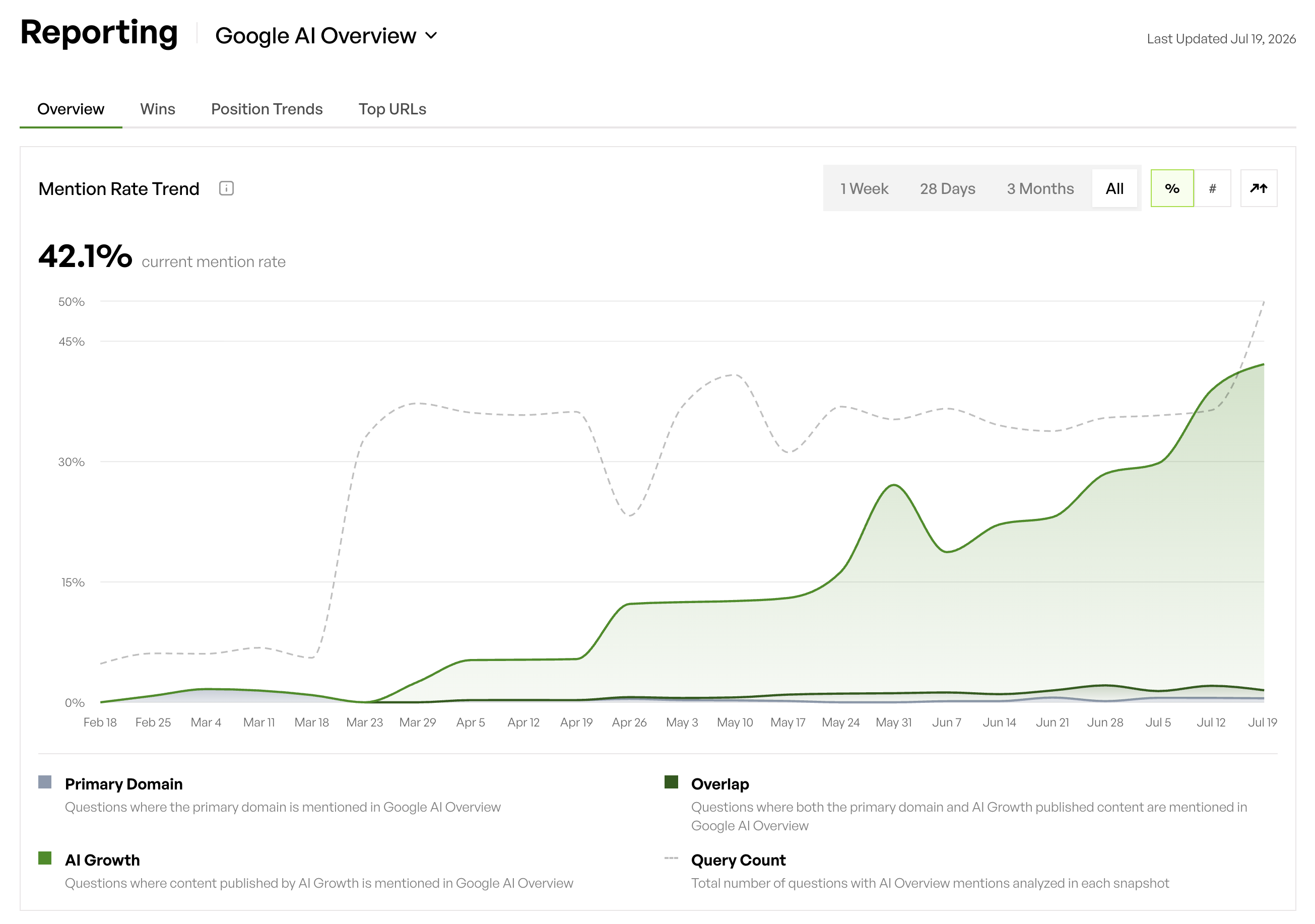 How AI Growth Agent Runs the Medtech System on AutopilotTraditional search tools report where your brand stands, while AI Growth Agent focuses on making your brand the answer. The platform executes the seven-step system through a single headless engine that replaces a fragmented agency stack. The comparison below shows what changes when a medtech team moves from a traditional SEO stack to a headless engine.
The headless engine handles agentic technical SEO that traditional stacks do not cover. Blog MCP supports direct interoperability with AI search agents. Llms.txt and llms-full.txt guide AI surfaces so they read the brand the way they need to. OpenAI discovery and Agent Card guidance are served via /.well-known/, and natural language query parameters return personalized, internally linked responses to agents that pass queries directly into the URL. Content behaves as a living system. Clinical-evidence pages, regulatory transparency pages, and buyer-question content self-heal and update automatically so AI citation presence does not decay between procurement cycles. Across the first twelve weeks, clients average more than 12,000 additional AI citations and mentions, over 100,000 additional bot visits, and a lift of more than 20% in impressions. Frequently Asked QuestionsWhat schema types matter most for medical device AI search visibility?The highest-impact schema types for medical device pages are MedicalDevice nested inside Product, FAQPage on buyer-question and indication pages, Organization with sameAs links to FDA or CE records, MedicalIndication for clinical application pages, and Article schema with clear author credentials and publication dates on clinical content. FAQPage schema works especially well because it surfaces buyer questions directly in AI answers and rich results. Every schema implementation should be validated before publishing and audited quarterly so author and publisher data match official licensing records. Mismatched content between page text and JSON-LD data creates trust penalties with AI systems faster than missing schema entirely. How does entity consistency affect AI citation rates for medtech brands?Entity consistency means that a device brand’s name, manufacturer identity, device classification, regulatory status, and clinical claims stay identical across every surface an AI engine reads, including owned pages, third-party directories, clinical publications, and review platforms. When these signals diverge, AI systems interpret the inconsistency as unreliability and deprioritize the brand in citation selection. As noted earlier, Gemini’s entity-level verification process rewards brands that maintain strong, consistent entity chains across their full content footprint. Those brands sustain AI citations over time, while brands with isolated high-quality pages but inconsistent entity signals underperform in procurement queries. Why do third-party citations matter more than owned content for medtech AI visibility?AI engines build entity confidence through consensus across sources, not through brand claims alone. For medtech, this means clinical trade publications, device registries, health system supplier directories, and peer-reviewed publications carry more citation weight than brand-owned pages alone. Healthcare AI citations show the highest news and editorial citation share among industries analyzed, because AI platforms apply conservative source standards in regulated medical queries and favor published research, government health sites, and major medical publications. Procurement algorithms in AI-driven healthcare sourcing favor suppliers that provide structured credentials including schema markup, machine-readable case studies, links to peer-reviewed research, regulatory references, and reproducible outcome data. A medtech brand that earns consistent third-party coverage aligned with its entity profile builds the citation consensus AI engines require to surface it in procurement shortlists. How often should medtech brands refresh clinical-evidence content to maintain AI citation presence?Given the short citation half-life documented for healthcare sources, clinical-evidence pages, regulatory transparency pages, and buyer-question content require regular refresh cycles to maintain AI citation presence throughout the procurement journey. Living content that self-heals and updates automatically provides a scalable way to sustain AI visibility across a full procurement cycle without rebuilding content from scratch each month. Conclusion: Shape Your Medtech Narrative in AI AnswersThe seven-step playbook, entity profiling, regulatory schema, clinical-evidence content, third-party citations, regulatory transparency pages, buyer-question mapping, and AI-citation tracking functions as a single system. Each step strengthens the signal the next one depends on, and the four-pillar data foundation, Search Intelligence, AI Analytics, Bot Tracking, and AI Ranking, keeps that system calibrated as the AI search landscape shifts week over week. Medtech brands that establish authoritative, entity-consistent, schema-structured clinical content now train the next generation of AI models with their own narrative. Brands that delay leave that narrative to whatever the open web says about them when a procurement committee asks an AI engine for a shortlist. The leaderboard in medtech AI search is being written this year. The brands that rise do not simply publish the most content. They present the most consistent, structured, machine-readable clinical evidence across every surface AI systems read. 
|
