Written by: Mariana Fonseca, Editorial Team, AI Growth Agent
How the AI Reputation Score Works
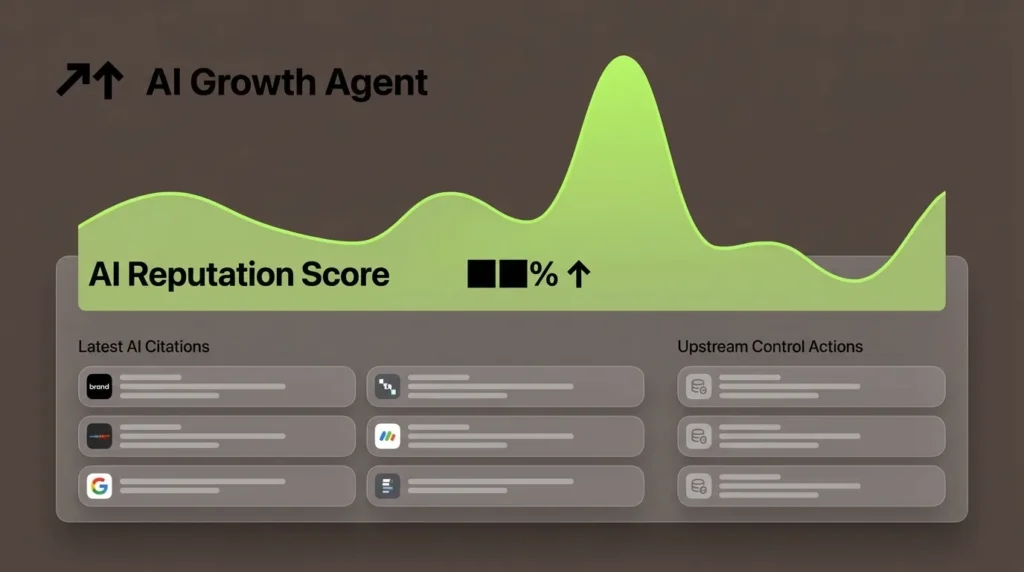
The AI Reputation Score is a composite metric that shows how accurately, prominently, and consistently AI answers represent a brand. It combines entity resolution rate, mention rate, citation rate, source authority mix, cross-engine consistency, and sentiment framing into one number. Teams use this score to move from reactive monitoring to upstream narrative control. They set a baseline, then track week-over-week progress as content and entity signals compound.
Key Takeaways for AI Reputation Control
- AI Overviews now appear on nearly half of all queries, and 93% of Google AI Mode sessions end without a click, shifting brand reputation from websites to AI-generated answers.
- Reactive ORM tools only report problems after the AI answer has already been delivered, which prevents brands from shaping the narrative proactively.
- Upstream narrative control depends on producing authoritative, AI-readable content across owned and third-party sources before buyers ask, not monitoring after the fact.
- The 7-step playbook of entity consistency, source-layer building, direct-answer pages, E-E-A-T signals, prompt testing, living content, and AI Reputation Score tracking delivers measurable visibility gains within 30–90 days.
- AI Growth Agent executes the full upstream loop at scale; book a strategy session to take control of your brand’s AI narrative.
Why Monitoring Tools Only Report Problems
Monitoring tools show where a brand stands but do not change that position. That gap separates reactive ORM from upstream narrative control. A monitoring platform that tracks 50 to 100 prompts and reports whether a brand appears functions like a rearview mirror. It surfaces the problem after the AI answer has already reached the buyer. A November 2025 Optimizely survey found that only 27% of marketers feel well-prepared for AI-driven click-less journeys, yet most tools still focus on monitoring instead of production.
The monitoring-only model also suffers from prompt caps. Most tools bill by prompt volume, so brands only see the slice of demand they already expected. The long tail of queries where buyers actually form opinions about a brand remains invisible.
Upstream narrative control flips that model. Teams produce the content AI engines use to describe the brand, in formats and structures those engines can read, backed by validation that earns citations. The brand then appears across the full query universe before the buyer asks, not after the answer has been written.
AI Growth Agent is built for this upstream model. It is not a monitoring company. It produces the content, owns the publishing, and proves the incremental result. Ready to move from monitoring to production? Schedule a kickoff call and get your first article live within a week.
The 7-Step Implementation Playbook for Upstream Control
This 7-step playbook gives brands a complete upstream reputation system. Each step compounds the impact of the previous one.
- Entity setup and NAP consistency. Define a single standard entity phrase and deploy it identically across every owned and third-party property, backed by Organization JSON-LD with a sameAs array.
- Source-layer building. Establish verifiable third-party citations across at least five independent platforms that AI engines cross-reference for trustworthiness.
- Direct-answer page creation. Build pages that answer the specific trust queries buyers submit to AI engines, structured with answer-first content and full schema markup.
- E-E-A-T signal strengthening. Align author bios, expert attribution, and named statistics across every content asset to match the signals AI retrieval systems weight most heavily.
- Prompt testing across ChatGPT and Gemini. Run a structured testing protocol monthly across at least five AI engines and log brand mention rate, position, and description accuracy.
- Living content deployment. Publish content that self-heals and updates over time so the brand narrative does not decay between training sweeps.
- AI Reputation Score tracking. Calculate and track the composite score monthly using the formula below, then correlate movements with content and entity changes.
Entity Consistency and NAP for Clear Brand Signals
AI systems form brand narratives by aggregating repeated descriptors, stable facts, and consistent associations across documents, structured data, and references. Entity inconsistency causes models to either omit a brand from citations or generate responses with mixed information, hallucinations, incorrect data, or wrong attributions.
The fix starts with a master entity document. This single source of truth contains the official brand name, alternate names, legal name, primary domain, preferred URL format, logo files, short and long descriptions, contact details, social profiles, founder names, product names, and category labels. Every owned and third-party asset then aligns to this document.
The standard entity phrase follows this format: [Name] is [category] that [what it does] for [for whom]. That phrase must appear identically on the About page, LinkedIn description, Crunchbase, press releases, founder bios, and website JSON-LD. Many B2B SaaS sites describe themselves differently on their homepage, G2 profile, and LinkedIn company page, which causes AI models to hedge when describing what the company does.
The Organization JSON-LD block must include a sameAs array linking the website to LinkedIn, Crunchbase, Wikidata, and Wikipedia profiles. Schema App measured a 19.72% increase in AI Overview visibility after implementing Entity Linking on its own website.
The audit protocol for entity consistency uses the following prompts across ChatGPT, Perplexity, Claude, Gemini, and Copilot, then compares responses for divergence.
| Prompt | What to Check | Pass Condition | Fail Signal |
|---|---|---|---|
| What is [brand] and what does it do? | Category, description, differentiator | Matches master entity phrase | Different category or description across engines |
| Who founded [brand] and when? | Founder names, founding date | Consistent with official record | Missing, wrong, or conflicting data |
| Where is [brand] headquartered? | NAP accuracy | Matches master entity document | Outdated or incorrect location |
| What are [brand]’s main products or services? | Product taxonomy | Matches current offering | Legacy products or missing lines |
Building the Source Layer with Third-Party Proof
AI search systems show a systematic and overwhelming bias toward earned media, meaning third-party authoritative sources, over brand-owned and social content. Muck Rack’s July 2025 study of over one million AI-cited links found more than 95% come from non-paid sources, of which 85% are earned media, and 27% are journalistic, rising to nearly half when recency is required.
Multi-source authority building establishes brand credibility across at least five independent platforms that AI models cross-reference for trustworthiness. These findings align with the broader pattern that most AI brand mentions originate from third-party sources.
Priority channels for source-layer building, ranked by AI citation weight, include the following.
- Reddit. Reddit is frequently among the most-cited domains in LLM answers, with reported shares ranging from about 7% to 40% depending on the engine and study methodology.
- Wikipedia and Wikidata. Wikipedia accounts for between roughly 3% and 17% of AI citations depending on the study and engine analyzed and acts as a high-authority source that AI models weight heavily for entity identification and factual claims.
- Industry publications. Guest articles and research placements carry high editorial weight and satisfy the earned-media bias of AI retrieval systems.
- Review aggregators. Review platforms comprise 8.5% of all AI Overview links, with G2 holding 23.1% of review-platform citations in LLM citation audits. Structured review profiles on G2 and Capterra are directly retrievable by AI engines for comparison and recommendation queries.
- PR distribution networks. AI-indexable press releases carry medium-high citation weight when messaging stays aligned with the master entity document.
Creating Pages That Answer Trust Questions
AI engines select sources for reputation prompts by matching to evidence that is retrievable, relevant, clear, current, trusted, and easy to synthesize. High-influence pages in a 2026 empirical study of 602 prompts across ChatGPT, Google AI Overview or Gemini, and Perplexity were longer in word count, contained more headings, and showed higher semantic similarity to the generated answer than low-influence pages.
Lists and tables often achieve better extraction accuracy across answer engines than equivalent prose. Direct-answer pages must center on the specific trust queries buyers submit, not the head terms a brand pre-selected to defend.
The direct-answer page framework for trust queries appears below.
| Query Type | Page Structure | Schema Required | Evidence Format |
|---|---|---|---|
| Is [brand] trustworthy? | Answer-first paragraph, then proof points | Organization + FAQPage | Named statistics, third-party citations |
| How does [brand] compare to [competitor]? | Comparison table, then narrative | Article + FAQPage | Feature-level specifics with dates |
| What do customers say about [brand]? | Attributed quotes, then context | Review + Organization | Named reviewers, verified platforms |
| What is [brand]’s experience in [category]? | Definition lead, then case evidence | Article + Organization | Named outcomes, timeframes, metrics |
Each page opens with a Definition Lead sentence in this format: [Brand] is a [category] specializing in [differentiator]. This structure helps AI systems identify the entity by type and category before they evaluate keyword relevance.
Fixing Negatives at the Source Layer
When both Google AI Overviews and ChatGPT surface negative brand sentiment on overlapping prompts, they flag different brands 73% of the time due to reliance on distinct source ecosystems. Suppression on one engine does not transfer to another. Upstream remediation does.
Upstream remediation means publishing authoritative content that directly addresses the negative claim, backed by verifiable evidence, and distributing it across the source layers AI engines trust. Research by Anthropic found that it only takes 250 malicious documents to produce a backdoor vulnerability in an LLM of any size.
The five failure modes that cause narrative drift in AI summaries are identity fragmentation, overclaiming language, category confusion from third-party directories, stale facts on legacy pages, and missing constraints that allow AI to fill gaps with assumptions. Each failure mode is corrected at the source layer, not at the monitoring layer.
Strengthening E-E-A-T Signals for AI Answers
Google’s quality guidelines now explicitly cover Experience alongside Expertise, Authoritativeness, and Trust. First-hand knowledge becomes the one input a model cannot generate. E-E-A-T signals are measurable and directly influence AI citation selection.
Measurable E-E-A-T signals that influence AI citation include the following.
- Named expert attribution. Content with named expert attribution is more likely to be selected and cited accurately by AI models because retrieval systems can extract and validate it more easily.
- Verifiable data with dates. Pages containing definitions, numerical statistics, comparisons, code, or how-to content showed higher mean influence scores than pages without those evidence genres.
- Author schema. Named authors with author schema provide authority signals that AI retrieval systems weight during source evaluation.
- Cross-platform expertise consistency. Align author bios, expertise descriptions, and third-party mentions across LinkedIn, company blogs, guest posts, and podcast appearances so that repeated expertise signals reinforce one another.
- Content freshness. Pages not updated quarterly lose AI citations at three times the normal rate. Article schema with dateModified signals freshness to AI models that show strong recency bias.
Prompt Testing Across ChatGPT, Gemini, and Other Engines
AI mention behavior varies significantly across platforms. ChatGPT relies primarily on training data, Perplexity uses real-time web retrieval, Claude draws from its training corpus, and Gemini uses Google’s search infrastructure. A testing protocol must reflect these differences.
The monthly prompt testing protocol runs a fixed library of 50 to 150 buyer-intent prompts across at least five engines: ChatGPT, Gemini, Perplexity, Google AI Overviews, and Microsoft Copilot. Each prompt runs three times per engine to account for response variability. A March 2026 audit of 50 prompts across five engines found notable prompt-level variance in brand sets, which led to the recommendation of weekly seven-day rolling averages rather than daily tracking.
| Prompt Category | Example Prompt | What to Log | Target Outcome |
|---|---|---|---|
| Category authority | What is the best [category] for [use case]? | Mention position, description accuracy | Top-3 mention with correct description |
| Comparison | How does [brand] compare to [competitor]? | Feature accuracy, sentiment framing | Accurate feature-level comparison |
| Trust | Is [brand] trustworthy? | Sources cited, sentiment | Positive framing with owned or earned sources |
| Problem-first | What solves [specific problem]? | Brand inclusion rate | Brand included in answer |
AI Reputation Score Calculation Formula
The AI Reputation Score uses a weighted composite across five measurable dimensions: entity resolution rate, AI mention rate, citation rate, source authority mix, and cross-engine consistency. Each component is normalized to a 0 to 100 scale before weighting. The final score ranges from 0 to 100.
| Component | Definition | Weight | How to Measure |
|---|---|---|---|
| Entity Resolution Rate | Percentage of engines that describe the brand consistently with the master entity document | 25% | Manual audit across five engines monthly |
| AI Mention Rate | Percentage of target prompts where the brand appears in the answer | 20% | Prompt library run weekly, averaged monthly |
| Citation Rate | Percentage of AI answers that cite a brand-owned or brand-earned URL | 20% | Source attribution log per prompt run |
| Source Authority Mix | Percentage of citations from high-authority third-party sources versus brand-owned only | 20% | Citation source log, classified by domain type |
| Cross-Engine Consistency | Agreement rate on brand description across ChatGPT, Gemini, Perplexity, Claude, and Copilot | 15% | Fleiss’ kappa or manual comparison monthly |
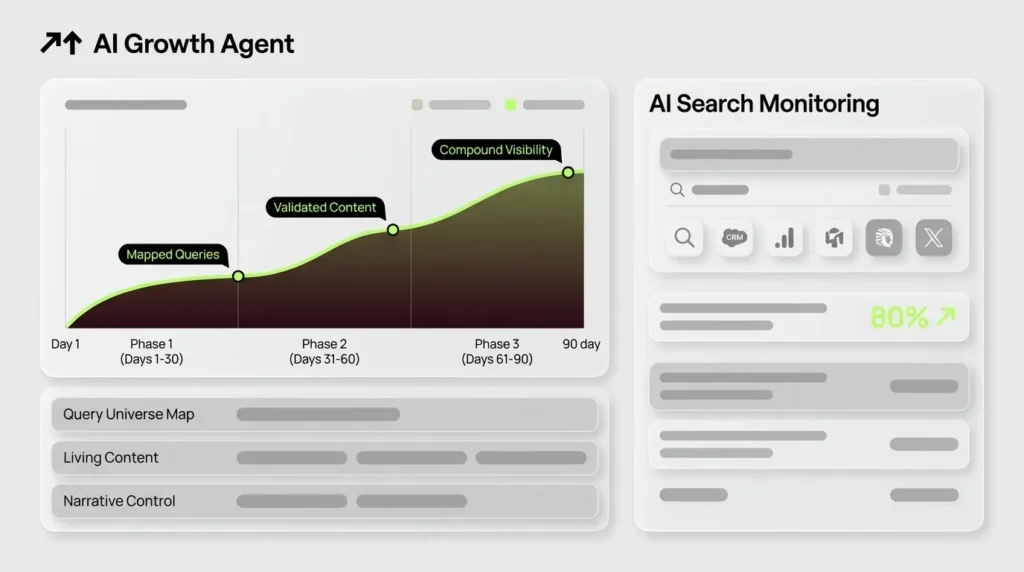
30/60/90-Day Timeline for Upstream Execution
This phased rollout reflects realistic indexing timelines. Content has indexed in as little as ten days and often within two weeks. Incremental visibility then compounds across the full 90-day window.
| Phase | Actions | Milestones | Metrics to Track |
|---|---|---|---|
| Days 1-30 | Master entity document, Organization JSON-LD, sameAs deployment, first direct-answer pages live, source-layer outreach started, baseline AI Reputation Score established | First article indexed, entity consistent across five engines, baseline score recorded | Entity resolution rate, first citation appearances, bot visits |
| Days 31-60 | Source-layer placements live on Reddit, industry publications, and review profiles, direct-answer page library expanded, prompt testing protocol running, E-E-A-T signals deployed across all content | Third-party citations appearing in AI answers, mention rate rising from baseline, Google Search Console impressions lifting | AI mention rate, citation rate, Google Search Console impressions, bot traffic |
| Days 61-90 | Living content updates deployed, stale pages remediated, AI Reputation Score recalculated, cross-engine consistency audit completed, negative-claim remediation content live | AI Reputation Score measurably higher than baseline, brand appearing in top-three positions for priority trust queries, incremental visibility isolated from pre-existing brand visibility | Full AI Reputation Score, cross-engine consistency, source authority mix, mention position |
Measuring Citation Quality, Not Just Volume
Citation quantity does not equal citation quality. A brand mentioned in position six of a seven-brand AI answer carries a fraction of the value of a primary recommendation. For a B2B SaaS brand, a raw Brand Visibility score can map to a lower Weighted AI Visibility Score when most mentions appear in later positions.
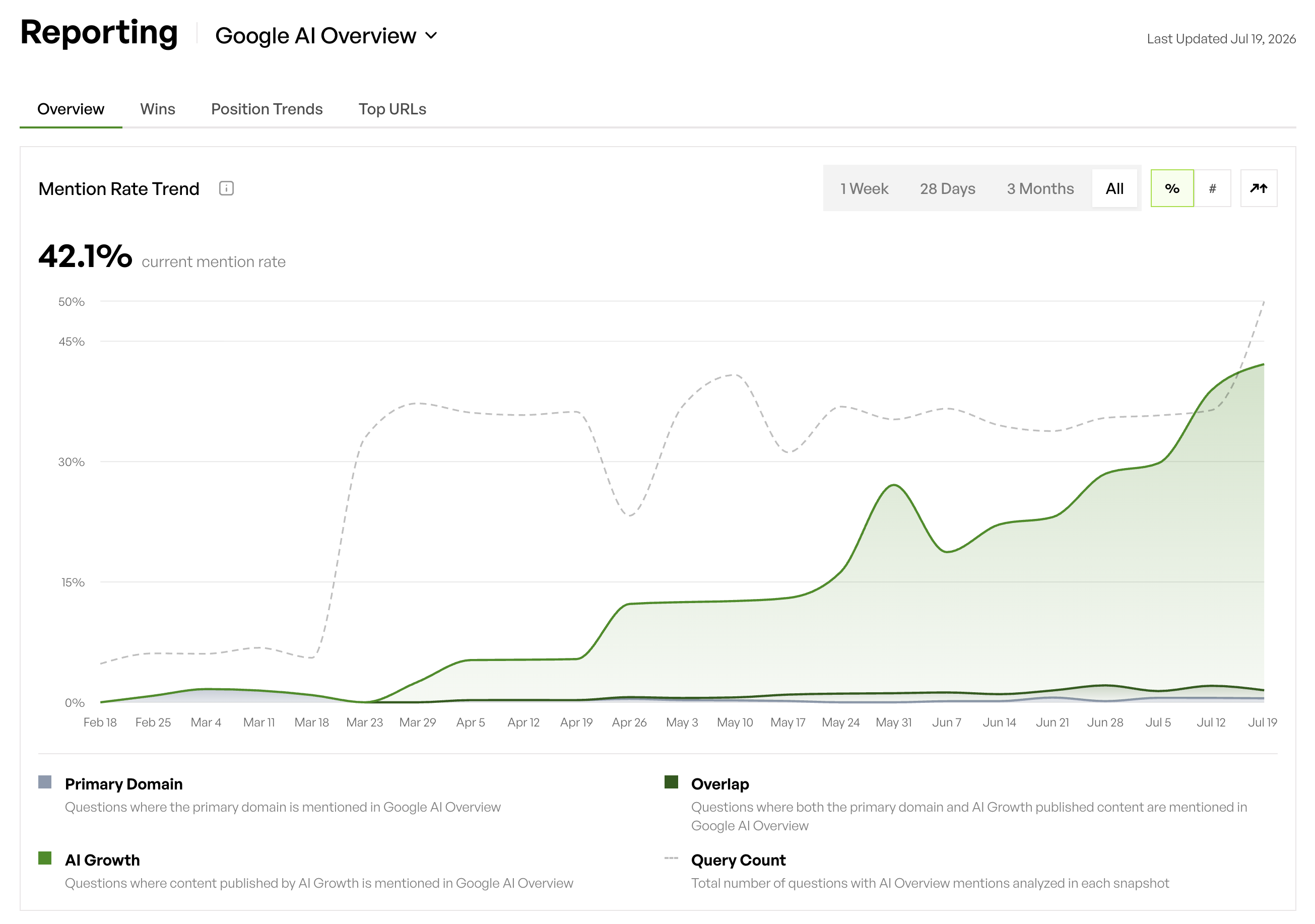
The metrics that prove narrative control include the following.
- Mention position. First-position mentions carry the highest value. AI assistants typically lead with their primary recommendation, so position tracking acts as a direct proxy for recommendation authority.
- Description accuracy. A monthly qualitative assessment of whether AI responses correctly, completely, and positively describe the brand’s category, products, and positioning.
- Source attribution. Whether the sources AI cites for the brand are owned, earned, or third-party, and whether those sources reflect the current brand narrative.
- Sentiment framing. ChatGPT surfaces negative brand sentiment during the consideration-to-purchase phase at a rate 13 times higher than Google’s at that stage, which makes sentiment tracking at the purchase-intent query level a revenue-critical metric.
- Incremental visibility. The visibility AI Growth Agent generates, isolated from the visibility the brand already had, reported week over week against bot traffic, Google Search Console impressions, and citation data.
Brands cited in AI Overviews earn 35% more organic clicks and 91% more paid clicks than non-cited brands on the same SERP. Citation quality functions as a revenue driver, not a vanity metric.
Conclusion: From Monitoring to Upstream Narrative Control
Reactive reputation monitoring reports what AI says about a brand. Upstream narrative control determines what AI says about a brand. That gap separates brands described accurately to three billion monthly users from brands that AI guesses at.
The AI Reputation Score gives CMOs and founders a single trackable number that responds to entity consistency, source-layer depth, direct-answer page coverage, E-E-A-T signals, and living content. The 7-step playbook above provides the implementation sequence. The 30/60/90-day timeline defines the milestones.
AI Growth Agent acts as a single headless engine that executes this full loop at scale. It maps the brand’s complete query universe, produces authoritative self-healing content AI must cite, stands up a fully optimized owned property within the first week, and reports the incremental visibility it generates week over week. Across the first twelve weeks, clients average more than 12,000 additional AI citations and mentions, over 100,000 additional bot visits, and a lift in impressions above 20%.
The brands cited in AI search this year are training the next generation of models with their own narrative. The brands that wait train the next generation with whatever currently sits on the open web. Book a strategy session to define your upstream AI reputation plan before competitors lock in their narrative advantage.
Frequently Asked Questions
What is the difference between AI reputation management and traditional online reputation management?
Traditional online reputation management focuses on monitoring and responding to brand mentions across review sites, social media, and search results, then attempting to suppress or bury negative content. This approach remains reactive by design. AI reputation management addresses a different problem: the AI-generated answer that a buyer receives before visiting a website or reading a review. When a buyer asks ChatGPT or Google’s AI Mode whether a brand is trustworthy, the answer is synthesized from whatever content the AI engine can find, trust, and cite across the open web. Traditional ORM tools have no mechanism to influence that synthesis. AI reputation management means producing the content, building the source layers, and establishing the entity consistency that shapes what AI engines say before the buyer asks the question.
How does entity consistency affect a brand’s AI Reputation Score?
Entity consistency forms the foundation of AI citation. AI engines build brand narratives by aggregating repeated descriptors, stable facts, and consistent associations across documents, structured data, and references. When a brand’s name, description, category, and factual data differ across platforms, as described in the Entity Consistency section, AI models encounter contradictory signals. Those contradictions trigger the omission, mixed messaging, and hallucination problems already outlined. A brand that maintains high entity consistency scores better on the Entity Resolution Rate component of the AI Reputation Score. This component carries a 25% weight in the composite formula, which makes it the single highest-weighted dimension in the score.
How long does it take to see measurable improvements in AI citation after implementing upstream content?
The timeline depends on domain authority, industry, and the volume of content deployed, but the pattern stays consistent. The 30/60/90-day timeline section describes typical indexing and compounding behavior. Content often indexes within ten to fourteen days. First AI citations usually appear within three to four weeks of a new article going live, with high-authority third-party placements accelerating that window. A full 30/60/90-day implementation cycle produces measurable movement in AI mention rate and citation rate by the end of the first month, with cross-engine consistency and source authority mix improving through the second and third months as the source layer compounds.
Which AI engines should be prioritized for prompt testing and why?
The five engines that matter most for brand reputation are ChatGPT, Google AI Overviews, Google AI Mode, Perplexity, and Gemini. Each engine uses a different retrieval architecture. ChatGPT relies primarily on training data and shows higher citation influence per fetched page than Google or Perplexity. Perplexity uses real-time web retrieval and weights Reddit and community content heavily. Gemini integrates deeply with Google’s Knowledge Graph and weights entity coherence across Google’s index, structured data, and Google Business Profile. Google AI Overviews reach approximately 2.5 billion monthly users and are 44% more likely than ChatGPT to surface negative brand sentiment. Microsoft Copilot also matters for B2B buyers. Testing across all five engines on a fixed prompt library, run three times per engine, produces a statistically reliable baseline. Citation rates vary by roughly a factor of three across engines on identical prompts, so single-engine testing produces a misleading view of overall AI reputation health.
What makes AI Growth Agent different from a GEO monitoring tool for reputation management?
GEO monitoring tools track whether a brand appears for a capped set of prompts and then report the result. They do not produce content, own publishing, or act on the data. This monitoring-only model has two structural limitations for reputation management. It stays reactive by design, and it remains blind to the long tail of queries where buyers actually form opinions about a brand. AI Growth Agent operates as a production and execution engine rather than a passive dashboard. It maps a brand’s complete query universe across hundreds of seed terms and the long-tail queries beneath them, produces authoritative self-healing content that AI systems can cite, and connects those outputs directly to AI Reputation Score movement and revenue outcomes.