Written by: Mariana Fonseca, Editorial Team, AI Growth Agent | Last updated: July 22, 2026
Key Takeaways
- Automated content tools generate text from prompts. AI content strategy engines map the full query universe, produce validated living content, publish with technical and agentic SEO, and report incremental visibility.
- 87% of marketers used generative AI in 2026, yet only 39% of B2B marketers see results, which shows the gap is architecture, not adoption.
- Enterprise teams need platforms that ship first indexed content in days, not months, with full universe coverage and no per-prompt billing caps.
- Agentic readiness in 2026 requires llms.txt, MCP endpoints, agent discovery files, schema, and Markdown served to AI crawlers. Traditional SEO alone cannot support this layer.
- AI Growth Agent maps the full query universe, produces authoritative living content, publishes with complete technical and agentic SEO, and reports incremental visibility in a single fixed-fee engine. See how it works for your brand.
The Decision Facing CMOs and Builders
The way customers find brands has shifted from blue links to AI answers. Despite near-universal AI adoption in marketing workflows, only 39% of B2B marketers see results from AI. The gap is not adoption. It is architecture.
CMOs and builders now choose between two paths. One path stitches together a fragmented stack of research tools, writing platforms, publishing systems, and monitoring dashboards. The other path deploys a single headless engine that handles the full pipeline. The first path creates dependency. The second creates narrative control.
This guide defines evaluation criteria, presents a neutral platform comparison, and closes with an if-then decision framework. Platform recommendations follow the framework, not precede it.
Six Criteria That Separate 2026 AI Content Platforms
Six criteria separate platforms that generate activity from platforms that generate measurable visibility.
Implementation Speed
Traditional agency RFPs run about three months before the first asset ships. The relevant benchmark for any platform is time from kickoff to first indexed content. Platforms that require extensive onboarding, briefing cycles, or client-side technical integration extend this window and delay compounding returns.
Universe Coverage Versus Prompt Caps
Only 11% of domains are cited by both ChatGPT and Perplexity, based on analysis of 680 million citations. Platforms that cap tracked prompts at 50 or 100 leave most of a brand's query universe invisible. Full-universe coverage requires mapping seed terms and the long-tail queries beneath them without billing per prompt.
Production Consistency at Scale
Enterprise content teams increasingly use multiple generative AI models in production workflows. Multi-model orchestration produces more consistent output than single-model generation when brand voice, factual references, and anti-hallucination controls are enforced across every generation. 74.2% of newly created webpages in April 2025 contained AI-generated text, which homogenizes brand voice across the web. Differentiation requires a brand manifesto layer that generic tools cannot replicate.
Headless Technical SEO and Agentic Readiness
Structural readiness correlates with AI citation rate. Agentic readiness in 2026 requires llms.txt and llms-full.txt files, MCP endpoints, agent discovery via /.well-known/, proper schema suites, and Markdown served to agent crawlers. Platforms that deliver only traditional SEO miss the citation layer entirely.

Incremental Visibility Reporting
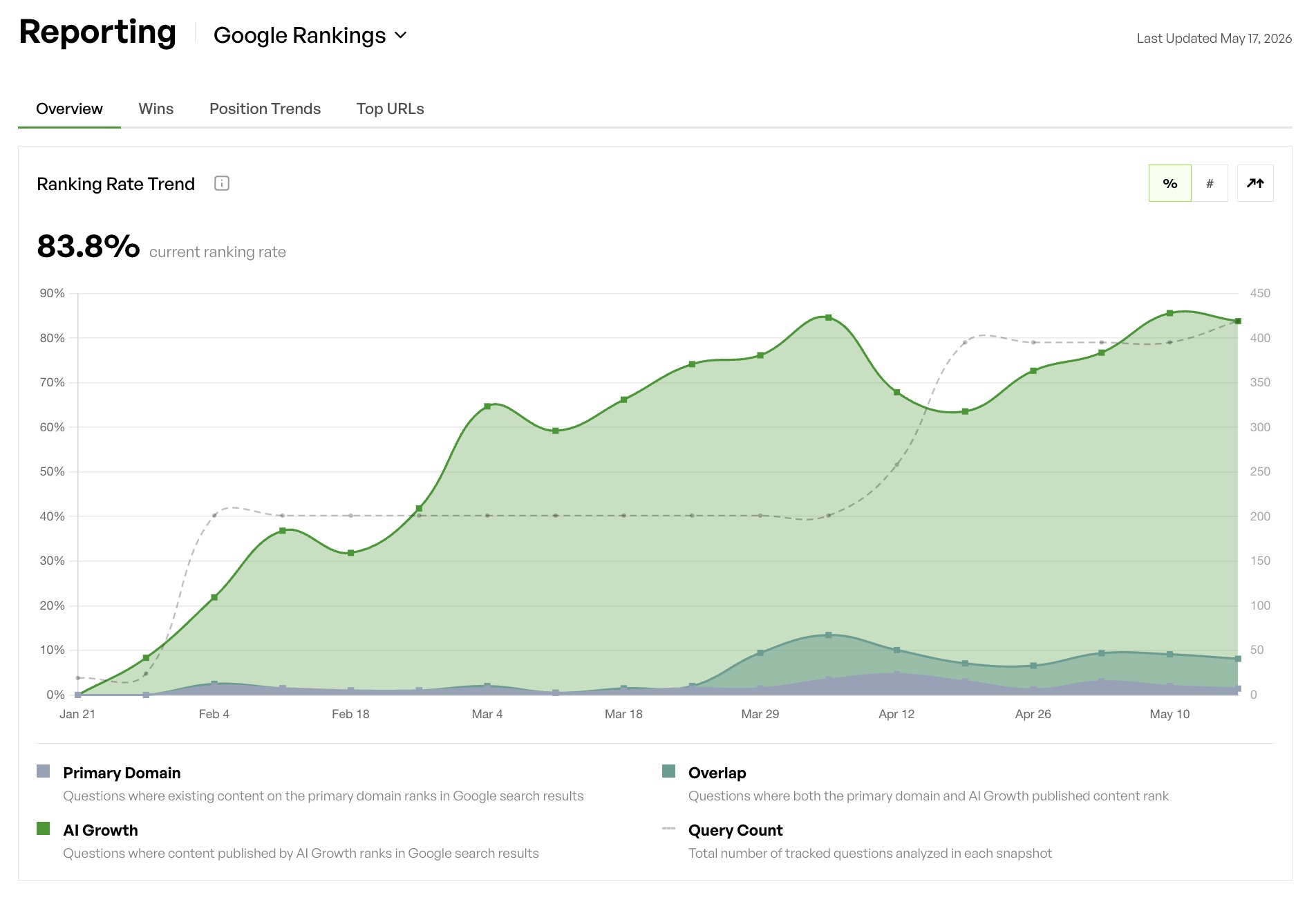
Only 19% of content marketing practitioners have implemented AI-specific measurement frameworks despite 74% using AI tools. Incremental visibility reporting isolates what a platform actually generated from visibility the brand already held. Without this separation, platforms take credit for organic momentum they did not create.
Long-Term Content Maintenance
Content updated within the last few months is cited more often than older content. Living content that self-heals and refreshes automatically compounds authority over time. Content that ships and goes stale decays in place, eroding the investment made to produce it. These six criteria form the basis for the platform comparison that follows.
Side-by-Side Platform Comparison
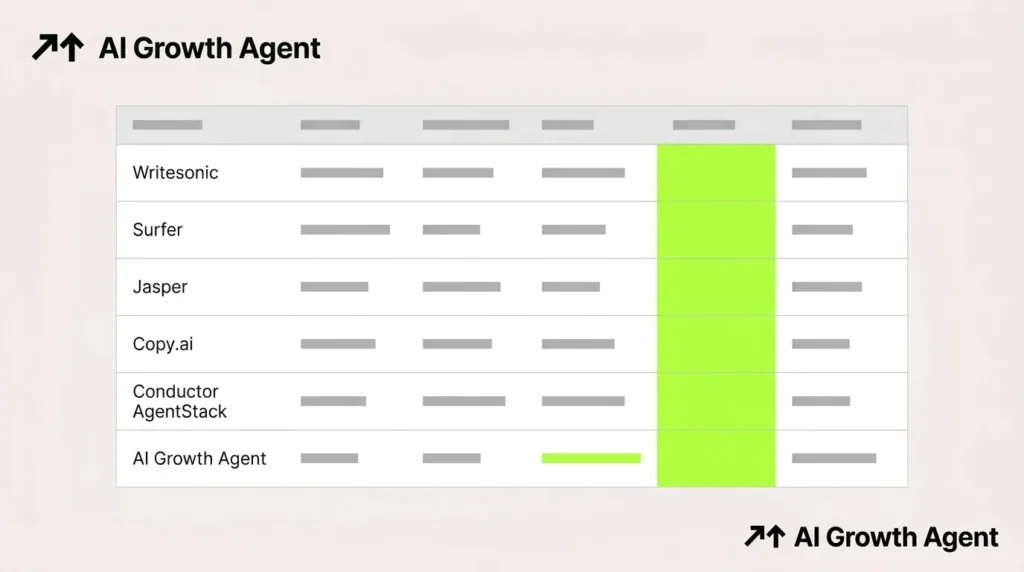
The table below evaluates representative platforms across four criteria using publicly documented capabilities. Implementation speed reflects time to first published content, universe coverage reflects whether prompt or query limits apply, agentic SEO readiness reflects published support for MCP, llms.txt, and agent discovery, and incremental visibility reflects whether the platform isolates new visibility from existing brand equity. The pattern is clear: most platforms excel at monitoring, data, or generation, while only integrated engines deliver the full pipeline from strategy through measurable visibility.
| Platform | Implementation Speed | Universe Coverage | Agentic SEO Readiness | Incremental Visibility Reporting |
|---|---|---|---|---|
| AI Growth Agent | First article live in about one week, indexing in as little as 10 days | Full universe, no prompt caps, 1,600+ queries at maturity | Blog MCP, llms.txt, llms-full.txt, /.well-known/ agent discovery, Markdown for crawlers | Separate publishing environment isolates incremental gains week over week |
| Jasper | Immediate generation, no publishing pipeline included | Prompt-based, no universe mapping | Not documented | Not documented |
| HubSpot AI Content Tool | Immediate within platform, no standalone site setup | ~50-prompt cap documented | Not documented for agentic layer | Monitors competitor visibility, does not isolate incremental gains |
| Semrush / Ahrefs | Data access immediate, no content production | Keyword data only, no content or publishing | Not applicable, no publishing layer | Rank tracking only, no content attribution |
| Profound / Athena (GEO monitors) | Monitoring active on setup, no content production | Capped prompt sets, blind to bot tracking and cross-referenced GSC signals | Not applicable, monitoring only | Reports existing visibility, does not generate or isolate new visibility |
| Claude / ChatGPT (DIY) | Immediate single article, no system for scale | No universe mapping, prompt-by-prompt only | None, no publishing, schema, or agent infrastructure | None |
| SEO Agency (traditional) | RFP about 3 months, first assets about 3 more months | Head terms only, long tail missed by default | Varies, rarely includes agentic layer | Rarely isolated from existing brand visibility |
Setup and Time-to-First-Content Analysis
Implementation speed divides platforms into three categories. Monitoring and data tools activate immediately but produce no content. Generation tools produce a first draft immediately but require the client to manage publishing, schema, and technical SEO independently. Integrated engines stand up a fully optimized owned property and deliver the first published article within days of kickoff.
For enterprise teams producing content at scale, AI content automation can deliver breakeven in a few months. The compounding effect of early indexing means that platforms with faster time-to-first-content create a structural advantage that slower implementations cannot recover.
Strategy Versus Production Capabilities
Most platforms in the market perform one function, generation or monitoring. Companies with unified data platforms deploy AI initiatives faster than those with fragmented ecosystems. A platform that generates text without a universe map produces content against queries the client already thought to ask. That approach misses the long tail where AI surfaces do most of their citing.
Original research and data-rich content earn more citations than standard content. Strategy-first platforms build content against evidence from real-time AI Overview and ChatGPT results, not against a generic keyword list. Production-only platforms generate volume. Strategy engines generate citations.
Technical Depth for AI Surfaces
Sites with a substantial number of blog posts receive significantly more AI crawler visits than sites with no blog. 56.9% of AI crawler visits are real-time user fetching rather than training. The action layer already operates at scale in 2026.
Agentic readiness requires more than traditional technical SEO. A valid llms.txt file produces no measurable citation lift according to multiple independent studies covering hundreds of thousands of domains. Platforms that deliver schema and sitemaps but omit MCP endpoints, agent discovery files, and Markdown serving for crawlers are technically incomplete for 2026 AI surfaces.
Team and Headcount Requirements
Fragmented stacks require coordination across editors, SEO specialists, designers, engineers, and agency contacts. The average knowledge worker switches between applications over 1,000 times per day. Employees spend a large share of their workweek searching for information or tracking down colleagues when data lives in disconnected systems.
Headless marketing removes this coordination layer. The client provides direction in plain language. The engine handles schema, publishing, bot tracking, self-healing, and reporting. No technical skill is required from the client side beyond the reverse proxy rewrite that connects the blog to the brand's domain.
Scalability Without Per-Prompt Billing
Consolidating multiple AI tools to fewer platforms can reduce total spending. Per-prompt billing creates a structural incentive to see less of the market. A brand tracking 50 prompts is blind to the hundreds of long-tail queries where AI surfaces make most of their citation decisions, the same fragmented landscape where, as noted earlier, only 11% of domains achieve cross-platform visibility.
Pages cited in Google AI Overviews earn 35% more organic clicks than non-cited competitors on the same results page. Fixed-fee engines that cover the full universe without prompt caps compound this advantage across every seed term the brand chooses to pursue.
Ongoing Governance and Self-Healing
Many B2B marketing teams now maintain centralized prompt libraries. Governance at scale requires more than prompt libraries. It requires a system that enforces brand voice, validates every claim against primary sources, and refreshes content automatically as the world changes.
Living content that self-heals on a defined cycle keeps authority compounding. Content that ships without a maintenance system begins to decay the day it publishes, which demands manual intervention that most teams cannot sustain at volume.
Best-Fit Use Cases by Role
Platform type maps directly to organizational need, and the pattern follows the complexity of the problem being solved.
- Enterprise CMOs managing portfolio brands face the most complex requirement. They must replace an entire agency stack while proving incremental results to a CEO. They need a headless engine that delivers incremental visibility reporting and requires no technical skill from a non-engineering internal team.
- Builders and founders typically need faster execution with less infrastructure. They need a system that produces authoritative content single-shot from an interview, publishes to an owned property, and proves results in numbers they can watch without managing another tool.
- PR agency owners occupy a middle ground. They need search intelligence that surfaces the full competitive landscape for each client, a content engine that produces and publishes at scale across multiple client accounts, and a new service line that monitoring-only tools cannot offer.
- Teams evaluating monitoring tools must distinguish between platforms that report existing visibility and platforms that generate new visibility. Monitoring functions as a rearview mirror. A content strategy engine functions as the steering wheel.
Operational and Long-Term Considerations
Gartner warns that over 40% of agentic AI projects are at risk of cancellation by 2027, usually because of weak data foundations, unclear ownership, and no measurement of business impact. Platforms that lack incremental visibility reporting create exactly this risk, which means investment without proof.
Long-term adaptability requires platforms built for AI search natively, not retrofitted from traditional SEO tools. 94% of enterprise organizations plan to increase AEO and GEO investment in 2026, making it the top marketing priority above paid media. This level of investment raises the bar for technical adaptability. Platforms that cannot evolve their technical stack to new agent protocols as they emerge will require replacement rather than iteration.
Risks, Limitations, and Common Misconceptions
Three misconceptions consistently lead teams to the wrong platform choice.
- Monitoring equals action. GEO monitoring tools report whether a brand appears for a capped set of prompts. They do not produce content, publish, or change what AI surfaces say. By early 2026, just 38% of Google AI Overview citations came from top-10 organic results, down from 76% in mid-2025. Monitoring a shrinking slice of the citation landscape is not a strategy.
- DIY AI scales. AI-only workflows produce a productivity paradox in which draft volume rises but time-to-publish and cost per publish-ready asset remain flat or increase because of fixed review capacity and extra revision cycles. One company produced about 300 articles through DIY AI and not one was cited.
- Prompt caps are a minor limitation. A platform capping tracked prompts at 50 is blind to the long-tail queries where Perplexity visitors convert at roughly 11 times the rate of traditional organic search traffic. Prompt caps are not a minor constraint. They are a structural ceiling on market visibility.
Decision Framework: If-Then Checklist
Use the following framework to identify the platform category that matches your situation.
- If your primary need is keyword and rank data with no content production requirement, then a traditional SEO suite such as Semrush or Ahrefs covers that function.
- If your primary need is monitoring whether your brand appears in AI answers for a defined set of prompts, then a GEO monitoring tool covers that function, with the understanding that it will not change what those answers say.
- If your primary need is generating article drafts on demand within an existing CMS and publishing workflow, then an AI writing tool such as Jasper covers that function, with the understanding that universe mapping, technical SEO, and agentic readiness remain your responsibility.
- If your primary need is controlling what AI surfaces say about your brand across the full query universe, publishing with complete technical and agentic SEO, proving incremental visibility, and doing so without adding headcount or managing an agency stack, then an integrated AI content strategy engine is the only architecture that covers the full pipeline.
- If your team is non-technical, your current agency controls your site, and your CEO is asking why the brand is not appearing in AI answers, then headless marketing replaces the dependency with one owned, fixed-fee engine.
This architecture, which combines full universe mapping, authoritative living content, complete technical and agentic SEO, and incremental visibility reporting in a single fixed-fee engine, is what AI Growth Agent was built to deliver. Clients average more than 12,000 additional AI citations and mentions, over 100,000 additional bot visits, and a 20%+ lift in impressions across the first twelve weeks, with the first article live within a week of kickoff.
Frequently Asked Questions
How long does it take to see results from an AI content strategy platform?
Implementation speed varies significantly by platform type. Monitoring tools activate immediately but produce no content and therefore no new visibility. DIY AI tools generate a first draft immediately but leave publishing, schema, and technical SEO to the client, which extends time to indexed content by weeks or months. Integrated engines that handle the full pipeline can deliver a first published article within a week of kickoff, with content indexing in as little as ten days. The standard engagement window for meaningful compounding results is three months because indexing timelines vary by industry and the long-tail citation effect builds over time rather than appearing in a single week.
Do I need a technical team to run an AI content strategy engine?
The answer depends entirely on the platform. Fragmented stacks that combine separate research, writing, publishing, and monitoring tools require coordination across editors, SEO specialists, engineers, and often agency contacts. Headless marketing engines are designed to remove this requirement. The only integration step on the client side is a reverse proxy rewrite connecting the blog to a subdirectory under the brand's domain. Everything else, including schema, robots.txt, sitemaps, MCP endpoints, agent discovery files, llms.txt, instant indexing, and 404 tracking, is provisioned automatically. The client gives feedback in plain language and the system learns. No technical skill is required from the internal team.
How is incremental visibility measured, and why does it matter?
Incremental visibility isolates the visibility a platform actually generated from the visibility a brand already held before the engagement began. Without this separation, platforms take credit for organic momentum driven by the brand's existing authority, which makes it impossible to evaluate whether the investment is working. Proper incremental visibility reporting requires publishing into a separate environment, cross-referencing bot traffic, Google Search Console data, and citation signals week over week, and reporting only the delta the platform produced. This matters because in a zero-click AI search environment, the only defensible proof of platform value is the visibility that would not have existed without it.
What is the difference between LLMO and traditional SEO, and why does it matter for platform selection?
Large language model optimization is the discipline of writing and structuring content so that AI surfaces find it, trust it, and cite it. It works natively in natural language, which makes it structurally different from traditional SEO's reliance on keyword density and backlink signals. Traditional SEO optimizes for a ranked list of blue links. LLMO optimizes for citation context, including where a brand appears in an AI answer, who it is grouped with, and what claim it is cited for. Platform selection matters because most tools were built for the traditional SEO model and later retrofitted with AI monitoring features. Platforms built natively for LLMO ship with agentic technical SEO, structured content formats that AI surfaces can extract cleanly, and universe mapping grounded in real-time AI Overview and ChatGPT data rather than historical keyword databases.
How do AI content strategy engines handle brand voice and compliance requirements?
Brand voice consistency at scale requires a system that enforces rules across every generation, not a style guide that a human editor applies inconsistently. Integrated engines use a brand manifesto as the primary source of truth, layered with style memories that carry voice rules such as preferred terminology, words to avoid, and house conventions. These rules are configured once and applied to every future generation without re-briefing. Compliance requirements, including legal disclaimers, claim prioritization for regulated sectors, and conservative language in fields like finance, are configured at the manifesto level and applied automatically. Anti-hallucination controls validate every claim, source, and quote against evidence found online rather than relying on a model's training data, which is the layer that matters most for regulated industries.
Conclusion: Choosing the Engine That Controls Your Narrative
The evaluation framework above produces a clear conclusion. Monitoring tools report what is happening. Data tools describe the landscape. Generation tools produce drafts. None of them change what AI surfaces say about a brand.
Narrative control in 2026 requires a platform that maps the full query universe, produces authoritative living content validated against primary sources, publishes with complete traditional and agentic technical SEO, and proves the incremental visibility it generates week over week. That is the architecture of an integrated AI content strategy engine. It also replaces the agency stack, removes headcount dependency, and compounds authority in a channel the brand owns.
The top 15 domains capture 68% of all consolidated AI citation share in 2026. The leaderboard is being written this year. Brands that establish authoritative content now are training the next generation of models with their own narrative. Brands that wait are training the next generation with whatever happens to be sitting on the open web.
Get your first article live within a week, start the conversation today.