Written by: Mariana Fonseca, Editorial Team, AI Growth Agent
Key Takeaways for Your AI Share of Voice Strategy
- AI share of voice benchmarks show how often a brand is mentioned, cited, or recommended across generative AI platforms compared with competitors, replacing traditional rankings in zero-click environments.
- Performance tiers range from Emerging (0–15%) to Leader (50%+), and trajectory and competitive momentum matter more than any single snapshot percentage.
- Targets vary by category, with SaaS and financial services typically requiring higher shares (20–40%) while e-commerce and consumer brands can succeed at lower thresholds (10–35%).
- Reliable measurement uses 150–300 prompts across platforms, position-weighted scoring, and supporting metrics like citation-based SOV and bot traffic to connect visibility to business outcomes.
- Improving AI share of voice depends on living content, agentic technical SEO, and long-tail expansion. AI Growth Agent delivers these through its full-service platform; book a demo to get started.
Defining a Strong AI Share of Voice Percentage
Most brands do not have a single universal success number, but 2026 analyses reveal consistent tier ranges that give CMOs and founders a defensible starting point. The table below consolidates ranges from multiple sources into a working framework.
| Performance Tier | AI Share of Voice Range | What It Signals |
|---|---|---|
| Emerging | 0–15% | Significant citation gap, AI does not reliably surface the brand |
| Competitive | 15–30% | Major player or challenger, present but not dominant |
| Strong | 30–50% | Established player consistently included in AI-generated answers |
| Leader | 50%+ | Category leader territory, AI consistently recommends the brand |
Two caveats apply to every number in that table. First, category leaders typically do not achieve full AI share of voice because AI systems tend to diversify their citation sources. Second, the percentage representing strong performance varies by market structure, with fragmented markets often requiring lower shares than more consolidated ones. The tier table acts as a compass, not a contract.
Trajectory carries more weight than any snapshot. A brand moving from 8% to 14% over 60 days is improving, while a brand static at 22% as a competitor rises from 10% to 19% is losing competitive position. Absolute percentage sets the baseline. Direction tells the story.
Understanding both your current position and your competitive momentum requires a structured measurement approach. See where your brand sits against these tiers and map your trajectory against competitors by booking a consultation.
Category-Specific AI Share of Voice Benchmarks
Performance targets shift by vertical because the number of credible sources AI systems draw from changes with market structure. The ranges below reflect cross-platform analyses and should be read as directional targets rather than hard ceilings.
| Category | Target AI Share of Voice Range | Notes |
|---|---|---|
| SaaS and B2B Software | 20–40% | Consolidated categories, leaders typically hold 35–50% in two-to-three player markets |
| B2B Services | 15–35% | Established leaders target 25–40%, challengers operate at 8–15% |
| Consumer Brands | 15–35% | Fragmented categories, 15% or above is considered strong per Trakkr cross-platform analysis |
| E-Commerce and Retail | 10–30% | Above 30% is strong in most competitive markets, below 10% indicates significant gaps |
| Financial Services | 20–40% | Category leaders achieve 40–70% mention-based SOV, top-three challengers reach 20–35% |
One structural finding cuts across every category. Nearly half of specialists and regional players never surface in any AI recommendation across a large-scale audit covering hundreds of brands. Invisibility is the default state, not the exception. Brands that have not yet built a structured AI share of voice program almost always sit in that invisible half.
Get category-specific targets and competitive benchmarks tailored to your market by booking a demo.
Practical Steps to Measure AI Share of Voice
Accurate measurement depends on a defined prompt set, consistent execution across platforms, and a calculation method that separates competitive share from raw visibility. The core formula is straightforward: AI Share of Voice (%) = (Brand Mentions ÷ Total Category Mentions) × 100. A brand appearing in 28 of 100 relevant AI answers holds 28% AI share of voice.
The prompt set often becomes the failure point. Tracking 150–300 prompts clustered by category and intent produces stable share of voice trends suitable for program-level reporting and executive decision-making. Fewer prompts create noise instead of signal. Prompts should span informational, comparison, and recommendation query types. Teams should refresh prompts weekly because cited domain sets drift 40–60% month over month in active categories.
Once you have a robust prompt set, the next measurement decision focuses on how to aggregate results across different AI platforms. Per-platform weighting matters because citation behavior differs significantly by engine. Only 11% of domains cited by ChatGPT overlap with those cited by Perplexity. One platform score does not represent overall AI share of voice. A practical approach assigns weights to each platform according to its relevance, then combines scores.
Competitor gap analysis completes the picture. Running the same prompt set against the full competitive set reveals where a brand stands and which competitors are taking share on which platforms. That gap, not the absolute percentage, guides content prioritization.
Supporting Metrics That Clarify AI Share of Voice
AI share of voice provides the headline number, and three supporting metrics sharpen the diagnosis and connect visibility to business outcomes.
Mention-based versus citation-based SOV. Mention-based SOV measures how much of the conversation is about the brand, while citation-based SOV measures how often a brand’s content is the source the model trusts. In a worked example using LLM Pulse methodology, the same brand scored 20% mention-based SOV but 31.4% citation-based SOV on identical data. That spread showed its content was trusted more often than its brand was named. The gap between those two numbers acts as a content authority signal.
Position-weighted SOV. Position-weighted SOV applies a harmonic decay (Position 1 = 1.0, Position 2 = 0.50, Position 3 = 0.33) to measure whether a brand is mentioned first or buried lower in AI answers. A brand mentioned consistently in third position holds a structurally weaker position than its raw mention count suggests. Citation position records where a brand’s citation appears in an AI answer, with first citation holding the highest value for shaping the response.
Incremental visibility and bot traffic. Share of voice numbers only become defensible when they connect to business outcomes. The signals that bridge the gap are bot traffic and impressions. AI search traffic converts at a higher rate compared to Google organic, making it more valuable per session. Tracking which bots crawl content, how often they visit, and which articles they cite connects the share of voice number to the pipeline it generates.
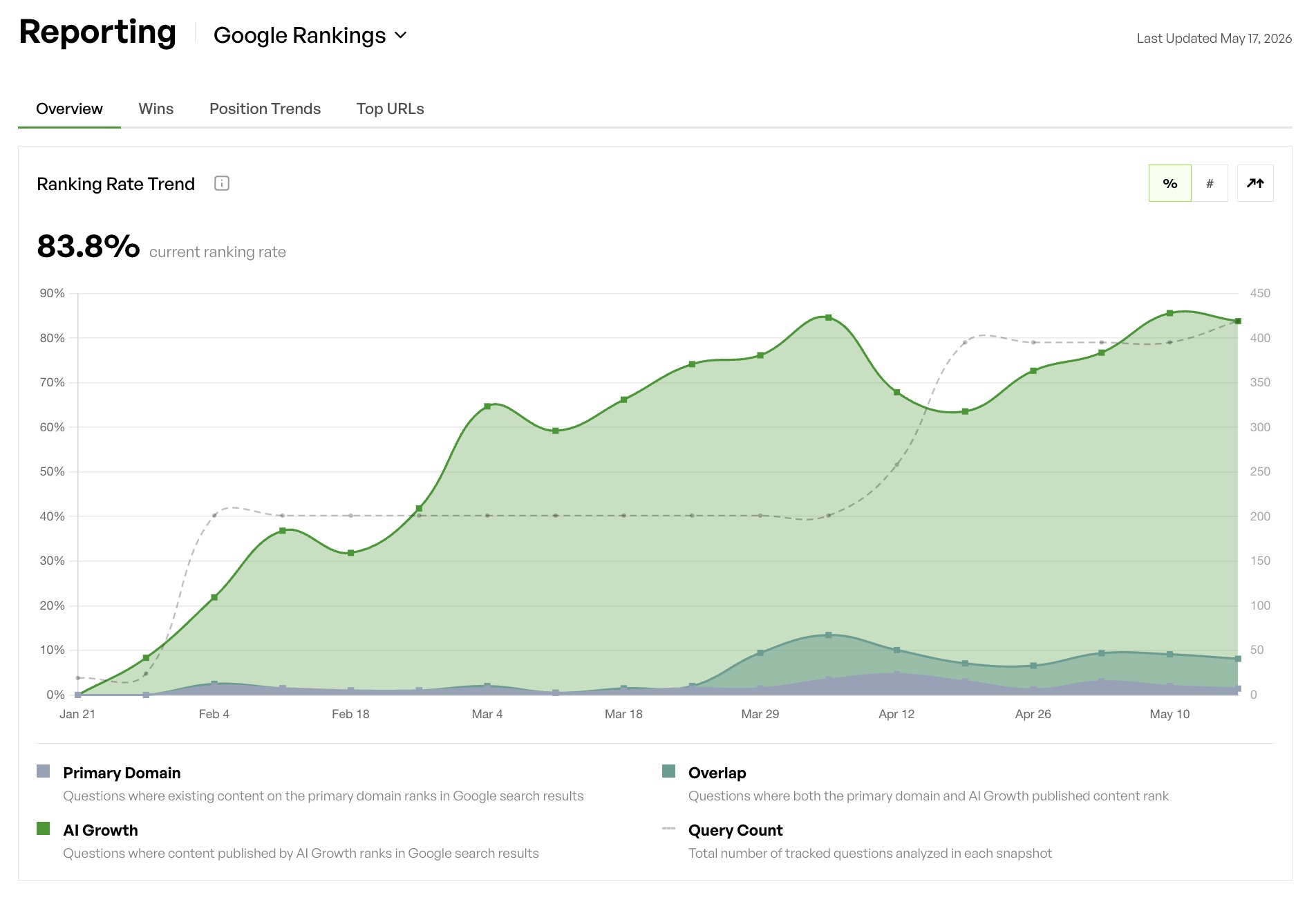
Across all three metrics, trajectory remains the key variable. Relative momentum in AI SOV is more important than absolute numbers. A brand improving steadily from a low base builds durable authority. A brand with a high static number while competitors close the gap loses the market without realizing it.
Playbook to Improve AI Share of Voice
Moving from low to high AI share of voice represents a content and authority challenge rather than a purely technical one. The improvement playbook has three interlocking components.
Living content at scale. Brands producing more optimized pieces of content per month achieve faster visibility gains in AI search compared with those producing fewer. Volume matters, and structure matters just as much. Content with sections of 120–180 words between headings earns more ChatGPT citations than pages with very short sections, and a significant portion of all LLM citations reference the first 30% of an article’s text. That pattern makes front-loaded, answer-first content a structural requirement. Content must also stay current. Most AI-cited pages were updated within the previous 12 months. Living content that self-heals over time, rather than going stale the day it ships, creates the architecture that sustains share of voice gains.
Agentic technical SEO. AI systems read content differently from human visitors, so technical infrastructure must support machine parsing as well as human rendering. The foundation starts with structured HTML and full schema markup, which allow models to understand content semantically instead of only extracting raw text. On top of that foundation, proper sitemaps and a robots.txt file that explicitly permits AI crawlers ensure models can discover and access your content. Agent-discovery files such as llms.txt and MCP endpoints then signal to AI systems that your content is prepared specifically for their consumption. Without this layered infrastructure, even strong content remains invisible to AI systems. Technical readiness is not optional; it is the floor.
Evidence-based long-tail expansion. Analyses show that referring domains and community presence on platforms like Reddit often predict visibility on Perplexity. Winning AI share of voice requires authority across the full universe of queries a buyer actually asks, not just the head terms a brand chooses to defend. Real-time AI Overview and ChatGPT search results act as the objective function for identifying which long-tail queries deserve attention. Teams can then systematically produce authoritative content for each priority query.
Measurement creates the foundation for narrative control. Without a baseline, teams cannot tell whether content investment moves share or simply adds volume. AI Growth Agent maps a brand’s full universe, produces authoritative living content, and reports the incremental visibility it generates week over week, isolating exactly what the engine contributed rather than claiming credit for visibility the brand already held.
Frequently Asked Questions
How to measure AI share of voice?
Teams measure AI share of voice by running a defined set of prompts across target AI platforms, counting how many responses mention or cite the brand, and dividing that number by total brand mentions across all competitors in the same responses. AI share of voice uses the formula described in the measurement section above. The key to reliability is running a sufficient prompt set, typically 150–300 prompts across at least two platforms, and tracking results week over week instead of relying on a single snapshot. Each prompt should be run multiple times and averaged because response sets vary between sessions. Per-platform scores should be weighted separately before combining into an aggregate, since citation behavior differs significantly by engine. The resulting number delivers the most value as a trend line tracked against a defined competitor set, not as a standalone absolute figure.
What is a good share of voice percentage?
A good AI share of voice percentage depends on market structure. In consolidated categories, higher percentages are typically needed to establish leadership, while in fragmented categories with many competitors, lower shares can still signal strong performance. Established leaders often target 25–40%, with major players at 15–25%. As noted earlier, AI systems diversify citations, so even leaders rarely capture every mention. The more actionable question focuses on whether a number improves or declines relative to the competitive set over time. A brand moving from a low base upward sits in a stronger position than one that remains static while competitors gain ground.
What does 50% share of voice mean?
A 50% AI share of voice means that across the tracked set of category prompts, half of all brand mentions in AI-generated responses go to that brand. That level places the brand in category leader territory, where AI systems consistently include it in answers to relevant queries. In practice, reaching 50% means the brand is cited or recommended in roughly one out of every two responses that name any brand in the category. It does not mean the brand appears in every response, since AI systems typically diversify their citations. A 50% share also does not guarantee first-position mentions. As discussed in the metrics section, position-weighted SOV tracks where citations appear, not just whether they appear. The 50% figure becomes most meaningful when it grows over time, when it is accompanied by strong citation-based share of voice, and when it correlates with measurable increases in bot traffic and organic leads.