Written by: Mariana Fonseca, Editorial Team, AI Growth Agent
Key Takeaways
- Agent discovery in 2026 asks CMOs to manage both external brand visibility in AI systems and internal governance of deployed agents through four core pillars: Search Intelligence, AI Analytics, Bot Tracking, and AI Ranking.
- External discovery now depends on publishing standardized protocols such as Agent Cards, MCP endpoints, llms.txt files, and structured schema that AI agents use to locate, evaluate, and cite brands.
- Internal governance remains a major gap, with only 21% of organizations having mature AI agent oversight, which creates budget and compliance risks for marketing teams.
- Traditional monitoring tools identify visibility gaps but cannot change AI-generated answers, so a headless marketing engine is required to actively produce, govern, and improve agent-ready content at scale.
- AI Growth Agent provisions all required discovery endpoints automatically and delivers measurable results without engineering overhead, and you can schedule a demo to assess your current readiness.
How AI Agents Discover Brands in 2026
The 2026 protocol stack for external brand discovery has moved well beyond traditional crawling. Google’s developer guide to AI agent protocols identifies six active standards: Model Context Protocol (MCP), Agent2Agent (A2A), Universal Commerce Protocol (UCP), Agent Payments Protocol (AP2), A2UI, and AG-UI. Each standard covers a specific layer of how agents connect to brands, tools, and commerce flows.
A2A requires every participating agent to publish an Agent Card at /.well-known/agent-card.json, a JSON file that declares the agent’s name, capabilities, endpoint, required authentication, and accepted data formats. This discovery mechanism helps agents find each other, but commerce flows need an additional layer. UCP uses the well-known URL pattern /.well-known/ucp with strongly typed request and response schemas that work across REST, MCP, or A2A transports. Google launched UCP on January 11, 2026, co-developed with Shopify, Etsy, Wayfair, Target, and Walmart, and it already powers checkout in AI Mode, which shows that the protocol has moved from specification to production infrastructure in under six months.
Beyond protocol endpoints, agents rely on llms.txt, llms-full.txt, and structured schema to form a machine-readable picture of a brand. As of May 20, 2026, Shopify updated /llms.txt (and /llms-full.txt) to redirect to /agents.md, establishing the latter as the canonical AI discovery file for storefronts, which signals how quickly the discovery file standard is evolving.
AI Growth Agent provisions all of these endpoints automatically: Blog MCP, Agent Cards via /.well-known/, OpenAI discovery, llms.txt, llms-full.txt, and natural language query parameters at /?s={query} that return personalized, internally linked responses to any agent passing a query directly into the URL. Clients do not need to allocate engineering hours.
Review how these endpoints are provisioned in week one during a technical walkthrough.
Building an Agent Inventory for Marketing Teams
Internal agent governance forms the less visible half of agent discovery, and most organizations remain structurally exposed here. Deloitte’s 2026 survey of 3,235 enterprise leaders found that only 21% of organizations have a mature governance model for autonomous AI agents. Seventy-nine percent of enterprises say they have adopted AI agents, but only 11% run them in production.
Gartner forecasts that 40% of enterprise applications will embed task-specific AI agents by the end of 2026, up from less than 5% in 2025, and Gartner estimates that more than 40% of agentic AI projects could be canceled by 2027 due to unclear value, rising costs, and weak governance. For CMOs, that cancellation risk translates directly into budget risk.
The 7-step governance checklist below is structured so agents can parse it directly. It covers the minimum viable inventory a marketing team needs before any agent touches a customer-facing workflow.
Audit your current agent inventory against this checklist in a governance assessment.
Brand Trust Signals Agents Actually Use
Agents need fresh data to stay accurate, so recency becomes the first and most measurable trust signal. Beyond recency, FullContact’s 2026 data readiness guide identifies six pillars agents use to evaluate sources: diverse, timely, accurate, secure, discoverable, and consumable, with trust and evaluation signals that include recency, source reliability, and clear relationships between records.
Without context, accuracy can start at 0-38%; with layered context architecture, it reaches up to 92%. For brands, that gap separates being cited from being invisible. Machine-readable context means schema markup, structured HTML, embedded metadata on every asset, and primary-source validation on every claim.

BCG analysis finds only an 8% to 12% overlap between traditional search results and AI-generated answers, which means a brand optimized exclusively for blue-link rankings is invisible in the majority of AI-generated responses. Closing that visibility gap requires tracking both the old landscape and the new one at the same time. The four pillars of AI Growth Agent’s data foundation address this directly: Search Intelligence maps the traditional landscape, AI Analytics tracks brand value across the full journey, Bot Tracking records every crawl and citation sweep, and AI Ranking monitors order of mention and citation context as the new leaderboard.
See how the four pillars surface trust signal gaps in your current content and book a readiness assessment.
A2A Versus MCP: Practical Protocol Choices for CMOs
Map which protocols your current stack exposes and which are missing during a readiness review.
The 7-Step Governance Checklist Agents Can Parse
- Inventory all active agents. Catalog every AI agent touching a marketing workflow by name, capability, owner, and data access scope. Many enterprises have not yet deployed AI governance and ethics tools, so most inventories do not yet exist in a machine-readable form.
- Define capability negotiation rules. Specify which agents may write, publish, or transact on behalf of the brand versus which remain read-only. Headless architectures improve governance when every action flows through the same API layer, applying permissions uniformly regardless of whether the action originates from a human UI or an agent.
- Establish audit trails. Require structured logs for every agent action. Forrester projects that in 2026, half of enterprise ERP vendors will launch autonomous governance modules.
- Embed compliance by design. Deploying agentic AI requires extending data governance to unstructured data sources with AI-assisted metadata generation and embedded classification, tagging, and access controls directly into data pipelines. Configure legal disclaimers and claim-scrutiny rules once, then apply them to every future generation.
- Manage memory and context rot. Context engineering for agents requires dynamic context to be separated from static context to enable prompt caching and reduce context rot. Assign a memory owner for each agent and set a refresh cadence.
- Publish agent-ready endpoints. Confirm that the discovery stack described earlier is live and validated. These signals tell external agents how to find and trust the brand.
- Report incremental visibility weekly. Isolate what each agent or content program actually generated, separate from pre-existing brand visibility. Marketing leaders face rising pressure to deliver fully quantifiable results for their departments.
Walk through this checklist against your current governance posture in a consultation session.
Why Traditional Tools Fall Short and Headless Marketing Wins
Monitoring tools tell a CMO where the brand is missing, but they do not change what the AI says. BCG identifies fragmented data, siloed content, and operating models built for human-led journeys as the most common external-discovery challenges, and monitoring tools leave all three problems in place.
Shelly Palmer, CEO of The Palmer Group, states that marketers must invest in agentic visibility intelligence to measure how often agents surface a brand, how they rank it, and where it is excluded, and that brand semantics infrastructure requires data exposure governance to control access, retention, and ROI. Measurement without production functions as a rearview mirror.
AI Growth Agent acts as the steering wheel. It maps the full universe from real-time Google and ChatGPT data, produces authoritative living content, stands up an owned site in week one, and provisions the full technical discovery stack automatically. The client owns the site. No agency controls it. Clients do not need engineering hours.
Compare what your current stack monitors versus what a headless engine can change in a platform demo.
How AI Growth Agent Delivers Agent Discovery at Scale
Pricing uses a flat fee with no per-article charges, credit limits, or per-prompt billing. Clients see their entire universe, not a capped handful of tracked terms. Content stays living, because it self-heals and updates over time so the brand’s presence does not decay between training sweeps.
Across the first twelve weeks, AI Growth Agent clients average more than 12,000 additional AI citations and mentions, over 100,000 additional bot visits, and a 20%+ lift in impressions. Leva Sleep became the most mentioned retailer for adjustable beds in Canada, with ChatGPT citing its content over 10,000 times per month and $40,000 to $50,000 in deals closed in under three weeks from buyers who discovered the brand through AI Growth Agent content. Breadless achieved a 30x lift in Google Search Console impressions over six months and is now the most recommended healthy franchise in the US, ahead of CAVA, Rush Bowls, and Sweetgreen.
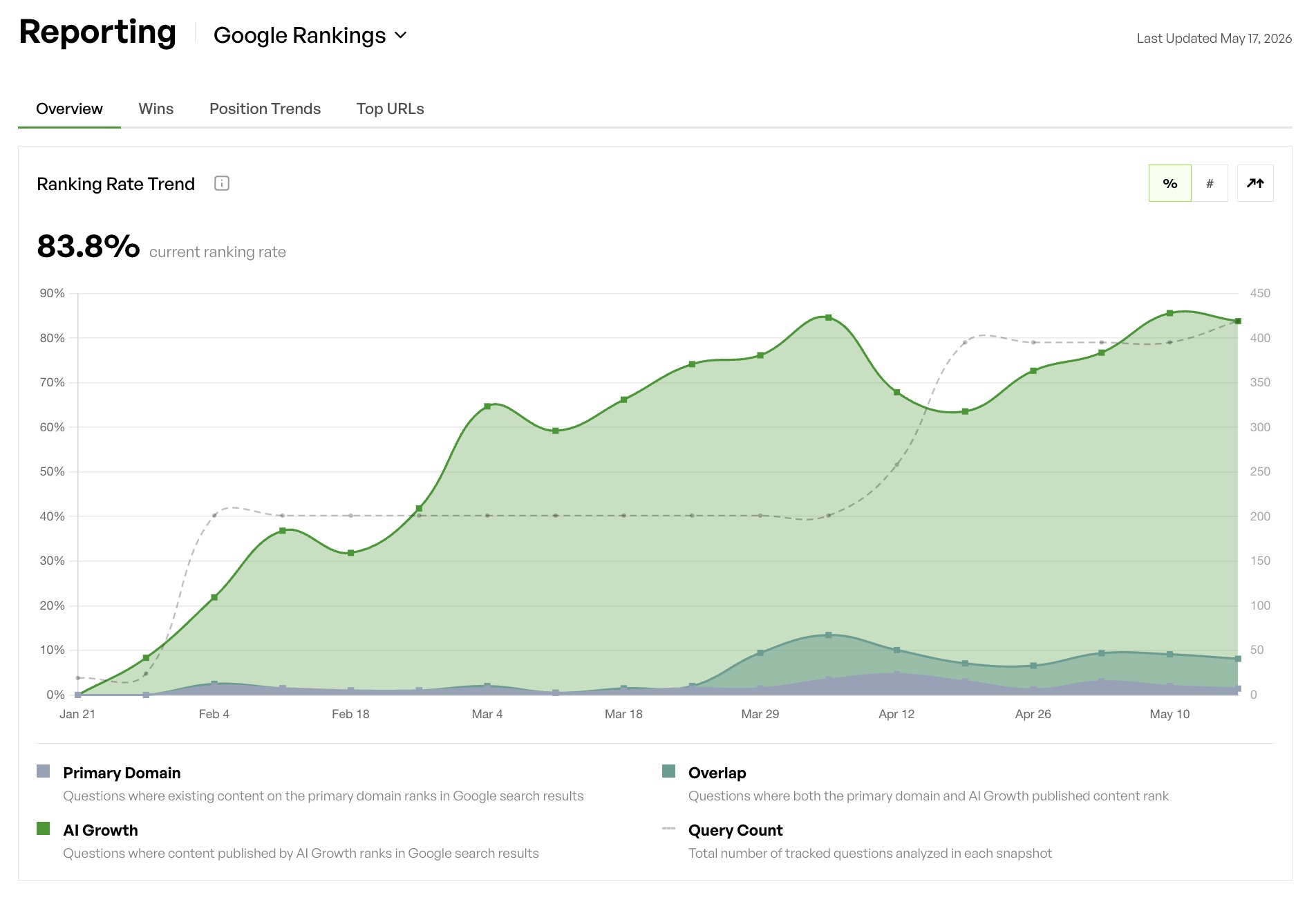
The first article typically goes live within about one week of kickoff. Content indexes in as little as ten days. The standard pilot runs three months, and the engine reports incremental visibility week over week so the CMO has a defensible answer for the CEO at every review.
Explore what week-over-week incremental visibility reporting looks like for your category in a live demo.
Conclusion: Control the Narrative Before Budget Conversations
Agent discovery in 2026 functions as a dual mandate. Externally, it requires publishing the protocols, endpoints, schema, and living content that AI agents use to find and cite a brand. Internally, it requires an auditable inventory of every agent touching a marketing workflow, with capability rules, audit trails, and compliance controls that travel with every API call. BCG research indicates that early adopters of agentic AI marketing are already seeing measurable impact, tripling ROI, campaign speed, and content output while freeing up 15% to 20% in costs.
Traditional search tools show where a brand stands. AI Growth Agent helps make the brand the answer. It acts as a single engine that maps the full universe, publishes agent-ready content, governs the technical stack, and proves the incremental result, without adding headcount or stitching together agencies and tools.
Join a consultation session or attend a demo to see whether you are a good fit. The brands cited in AI search this year are training the next generation of models with their own story.
Frequently Asked Questions
What is the difference between external agent discovery and internal agent governance for a CMO?
External agent discovery describes whether AI systems like ChatGPT, Perplexity, and Google AI Mode can find, trust, and cite a brand when a customer delegates a query to them. It depends on technical signals including Agent Cards, MCP endpoints, llms.txt, llms-full.txt, schema markup, and living content that agents can parse and verify. Internal agent governance describes how a marketing team inventories, audits, and controls the AI agents it deploys in its own workflows, covering capability rules, audit trails, memory management, and compliance controls. Both form components of a complete agent discovery strategy in 2026, and neglecting either one creates measurable risk. External gaps mean the brand is invisible in AI answers, while internal gaps mean agents act without accountability and expose the organization to compliance and reputational failures.
Why do only 21% of organizations have a mature AI agent governance model, and what does that mean for marketing teams?
The gap between AI agent adoption and governance maturity reflects how quickly agentic systems moved from experimentation to production. Most organizations deployed agents to solve immediate workflow problems without building the inventory, audit trail, and compliance infrastructure those agents require at scale. For marketing teams specifically, the consequence is that agents may publish content, execute campaigns, or interact with customer data without consistent oversight, brand voice controls, or legal review. A mature governance model requires a complete agent inventory, defined capability boundaries for each agent, machine-readable audit logs, compliance controls embedded at the data pipeline level, and a memory management system that prevents context rot. Marketing leaders who build this infrastructure before budget conversations have a defensible answer when leadership asks what the AI investment is actually doing.
How do AI agents evaluate brand trust signals, and what content formats perform best?
AI agents evaluate brand trust through a combination of recency, source reliability, machine-readable context, schema markup, and verified primary sources. Stale content creates a measurable liability, because agents hallucinate significantly more frequently on tasks requiring current information when they cannot access fresh data. Machine-readable context embedded directly in content, rather than hidden in external documentation, forms the structural requirement that separates brands agents cite from brands agents ignore. Content that performs best for agent discovery appears structured, current, backed by validated primary sources, and served in formats agents can parse without custom extraction, including clean HTML with full schema, Markdown for agent crawlers, and llms.txt files that give AI surfaces a machine-friendly map of the brand. Aesthetic design choices that look appealing to human visitors but add no structured signal remain irrelevant to agent evaluation and should not outrank technical readiness.
What is a headless marketing engine and how does it differ from a GEO monitoring tool?
A headless marketing engine decouples the brand’s curated main site from the autonomous engine that produces, publishes, and governs agent-ready content at scale. The brand keeps its existing site and identity. The engine runs a separate, fully optimized property the brand owns, connected through a reverse proxy rewrite or subdomain, and handles the full technical and agentic SEO stack including schema, Bot Tracking, Blog MCP, Agent Cards, llms.txt, and living self-healing content, without requiring headcount or engineering resources from the client. A GEO monitoring tool, by contrast, tracks whether a brand appears for a capped set of prompts and stops there. It identifies the gap but does not close it. The distinction sits between observation and execution, because monitoring tools act as a rearview mirror, while a headless marketing engine functions as the steering wheel that changes what AI answers actually say about the brand.
How quickly can a CMO expect to see measurable results from an agent discovery program?
The timeline depends on the platform and the approach. With AI Growth Agent, the first article is typically live within about one week of kickoff, and content has indexed in as little as ten days. Measurable signals, including bot visits, Google Search Console impressions, and AI citation counts, begin appearing within the first two to four weeks. The standard engagement is a three-month pilot because indexing velocity varies by industry and competitive density, but clients consistently see movement early. Incremental visibility reporting isolates exactly what the program generated week over week, separate from any visibility the brand already had, so the CMO can bring a defensible, data-backed answer to every leadership review rather than attributing pre-existing brand equity to the new investment.