Written by: Mariana Fonseca, Editorial Team, AI Growth Agent | Last updated: July 6, 2026
Key Takeaways
- AI share of voice analysis measures brand visibility across AI platforms using four distinct metrics: mention rate, citation rate, position-weighted score, and sentiment context. Each metric maps to a different content action.
- Raw mention share, citation share, position-weighted scoring with harmonic decay, and separate sentiment classification must be tracked independently to avoid misleading blended scores.
- A repeatable five-phase process of assessment, data collection, weighted calculation, gap mapping, and execution turns measurement into specific content updates that close visibility gaps.
- Brands should track 50 or more conversational prompts across multiple platforms, run each prompt 5–10 times for stability, and refresh content monthly to maintain citation eligibility amid a 31-day average citation half-life.
- AI Growth Agent maps your full brand universe across all four metrics and turns the data into published, self-healing content. Book a demo to see your current AI visibility and next content moves.
Phase 1: Assessment – Build Your Prompt and Presence Baseline
Goal: Establish a baseline picture of where the brand currently stands across AI platforms before any measurement infrastructure is in place.
This phase starts with a clear prompt universe. Most B2B brands monitor only 5–10 prompts when they should be tracking 50 or more to identify content gaps. Prompts should reflect real user intent in conversational language of 10–20 words, covering informational, comparative, and transactional query types rather than short SEO keywords.
The assessment sequence runs as a connected set of steps. First, audit existing brand presence by running 20–50 category-level prompts manually across ChatGPT, Perplexity, and Google AI Mode and recording whether the brand appears, in what position, and with what framing. This baseline shows where you stand and how the AI currently talks about you. Second, identify which competitors appear in responses where the brand does not, because those players are filling the gaps in your absence. Third, check technical accessibility, since 73% of websites have technical barriers such as robots.txt blocks, CDN restrictions, or JavaScript rendering issues that prevent AI crawlers from accessing their content. Fourth, confirm that the brand’s entity information is consistent across all indexed pages, because inconsistent entity signals fragment the share of voice signal AI models use to identify and cite a brand.
Required inputs: A seed term list organized by category, access to target AI platforms, and a structured log for recording responses. Roles involved: Marketing lead or CMO for prompt definition, technical team for crawler access audit. Validation point: The assessment is complete when the brand has a documented baseline mention rate and citation rate across at least three platforms for a minimum of 20 prompts.
Suggested visual: A heatmap showing brand presence (present / absent / cited) by prompt and by platform, updated after each assessment cycle.
Phase 2: Data Collection – Build a Stable Multi-Platform Dataset
Goal: Build a repeatable, multi-platform data collection system that produces statistically stable share of voice figures.
Single-run data is unreliable. Frequency data for AI share of voice becomes stable only when each prompt is run at least five to ten times, and major models agreed on their answer only 41.1% of the time across 797,644 comparisons run through eight AI engines. The data collection system must account for this variance by running each prompt multiple times per cycle and averaging results.
The collection sequence follows a clear progression. Start by defining the prompt set using the seed terms identified in assessment so the dataset reflects real demand. Next, run each prompt a minimum of five times per platform per collection cycle to smooth out model randomness. Then record brand presence, position, citation URL, and sentiment framing for every response so later calculations have full context. After that, log the full set of brands mentioned in each response to support an open-denominator calculation that captures emerging competitors. Finally, timestamp every run to enable recency analysis and trend tracking over time.
Required inputs: Finalized prompt list, access to target platforms, a structured data log or tracking tool. Roles involved: Marketing analyst for data entry, technical team for any automated collection scripts. Validation point: Data collection is valid when each prompt has at least five runs per platform and the variance between runs is documented.
Platform-Specific Weighting for Real-World Visibility
Once you have multi-platform data, the next challenge is combining it accurately. Platform behavior differs enough that aggregating raw counts across engines without weighting produces a distorted share of voice figure. ChatGPT controls the largest share of AI referral traffic in 2026, making it the highest-weight platform for most brands. Perplexity held approximately 7% of global AI referral traffic in March–May 2026, down from about 12% the prior year, which still makes it an important platform for forward-looking analysis.
Citation source preferences also differ by platform. ChatGPT favors Wikipedia and encyclopedic content (47.9% of top citations), Perplexity heavily cites Reddit (46.7% of top citations), and Google AI Overviews prefer YouTube and multi-modal content (23.3% of citations). A brand that focuses only on one platform’s citation preferences underperforms on the others. Position-weighted share of voice should be reported separately per model and per locale because retrieval behavior, citation policies, and source preferences differ across models and languages.
Apply audience-based weights when calculating aggregate share of voice. Assign higher weight to the platform where the brand’s buyers actually spend time, not simply the platform with the highest global traffic share. If 70% of buyers use ChatGPT versus 5% for Claude, weight the aggregate calculation accordingly.
Suggested visual: A per-platform share of voice table updated weekly, with a weighted aggregate column that reflects actual buyer platform distribution.
Phase 3: Weighted Calculation – Turn Raw Logs Into Four Metrics
Goal: Produce a share of voice figure that reflects competitive position accurately, not just raw presence counts.
The repeatable four-step calculation framework keeps each signal separate.
Step 1: Calculate raw mention share. Count every brand mentioned across all tracked prompt runs. Divide the brand’s total mentions by the total mentions of all brands combined and multiply by 100. Use an open denominator that includes every brand the AI names, not a pre-selected competitor list. Closed-denominator calculations are gameable, non-comparable across companies, and miss emerging competitors that the AI begins to mention.
Step 2: Calculate citation share separately. Count responses that include a link or explicit reference to a brand-owned URL. Divide by total responses sampled and multiply by 100. Citation rate is the most direct signal of whether content is improving LLM visibility, and it must be tracked independently from mention rate because the two diverge significantly in practice.
Step 3: Apply position weighting. Use harmonic decay. Position 1 = 1.0, position 2 = 0.50, position 3 = 0.33, position 4 = 0.25, position 5 = 0.20, following 1/n. Sum the brand’s position weights across all tracked responses. Divide by the sum of all brands’ position weights. Multiply by 100. Average across at least three to five prompt repeats per query before reporting.
Step 4: Score sentiment separately. Classify each brand mention as positive, neutral, or negative. Positive, neutral, and negative mentions should be scored separately, not collapsed into one raw count. A weighted AI visibility score can be constructed as: (0.4 × Answer Presence) + (0.3 × Citation Presence) + (0.2 × Prominence) + (0.1 × Recommendation Strength), then divided by the total category weighted score and multiplied by 100.
For example, if 10 brands are named 240 times across tracked prompts and the brand is named 35 times, its AI share of voice is 14.6%. At that level, the brand falls below the competitive threshold and the gap mapping phase identifies which prompts to target first.
Required inputs: Completed data collection logs with position and sentiment fields populated. Roles involved: Marketing analyst for calculation, CMO for benchmark interpretation. Validation point: Calculations are valid when mention share, citation share, position-weighted share, and sentiment scores are reported as four separate figures, not a single blended number.
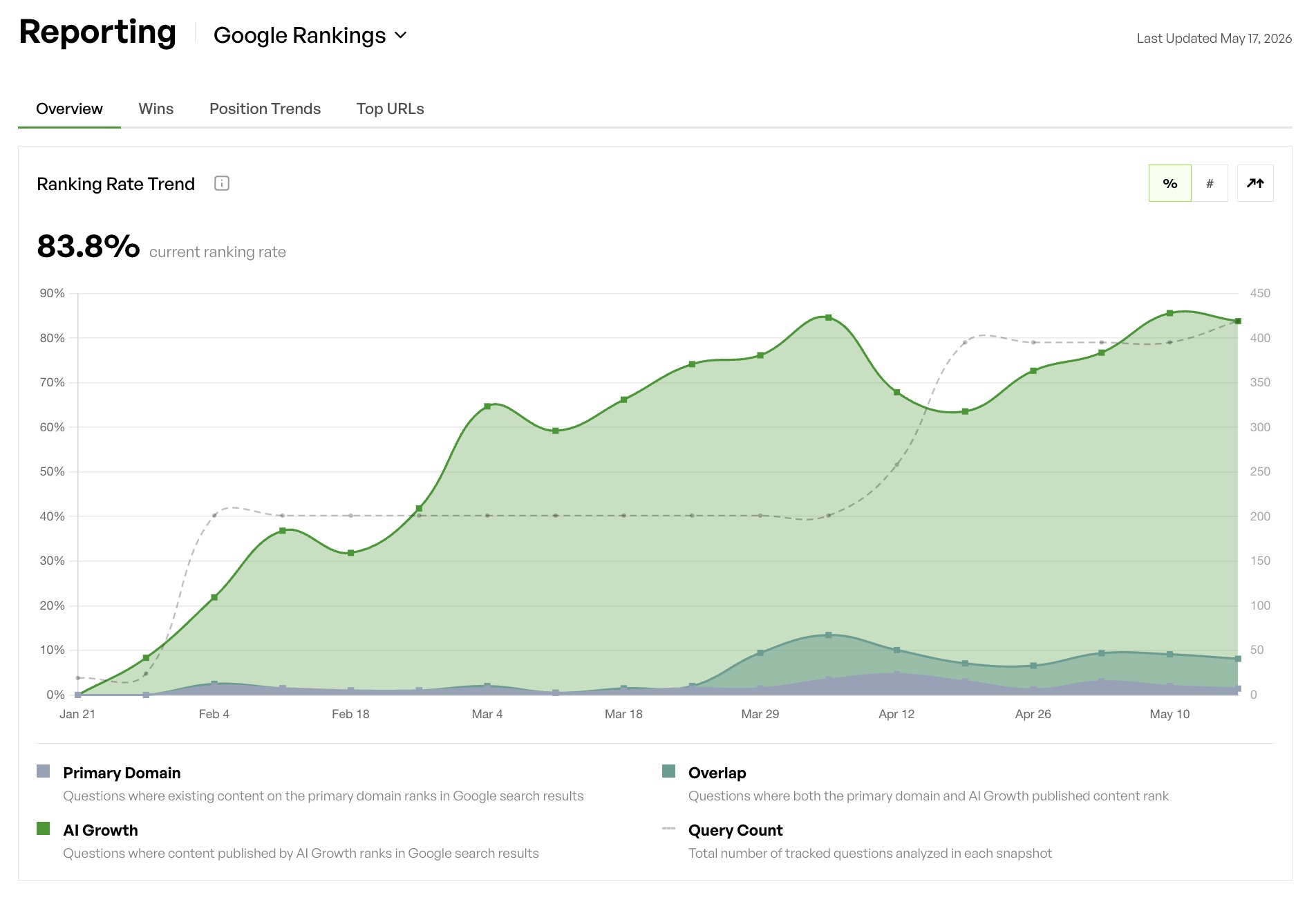
Suggested visual: A four-column calculation table with one row per platform, showing mention share, citation share, position-weighted share, and sentiment score side by side.
Phase 4: Gap Mapping – Turn Metrics Into a Prioritized Gap List
Goal: Identify the specific prompts, platforms, and content types where the brand is absent or underperforming, and prioritize them for execution.
Gap mapping starts with the prompt-level data from Phase 3. Sort prompts by the gap between the brand’s share of voice and the leading competitor’s share of voice on that prompt. Prompts where the brand scores zero are the highest priority because they represent queries where a competitor is being recommended and the brand does not exist in the conversation at all.
The gap mapping sequence follows the four metrics. First, identify zero-presence prompts. Next, identify prompts where the brand is mentioned but not cited, where mention rate exceeds citation rate. Then identify prompts where sentiment is neutral or negative and diagnose framing issues. Finally, identify platforms where the brand’s share of voice is disproportionately low relative to its aggregate score. Given the 40–60% monthly drift in cited domains noted earlier, gap maps require monthly refresh at minimum.
Required inputs: Phase 3 calculation outputs, competitor presence data from the same prompt set. Roles involved: Marketing lead for prioritization, content team for gap-to-content mapping. Validation point: Gap mapping is complete when every zero-presence prompt has a corresponding content brief assigned.
Suggested visual: A prioritized gap list sorted by competitive distance, with columns for prompt, brand share of voice, leading competitor share of voice, gap size, and assigned content action.
Citation Rate Versus Mention Rate in Gap Diagnosis
Citation rate and mention rate measure different things and require different responses during gap mapping. Mention rate measures how often the brand’s name appears in AI responses. Citation rate measures how often the AI links to or explicitly references a brand-owned URL as a source. A citation means the AI linked to the brand. A mention means it talked about the brand. Both matter, but they are different signals.
A high mention rate with a low citation rate indicates that the brand has sufficient awareness for AI systems to name it, but the brand’s owned content is not structured or authoritative enough to be used as a source. The content action is structural. Improve schema markup, add self-contained answer capsules of 50–150 words after H1 or H2 headings, and ensure pages are technically accessible to AI crawlers. Content with FAQPage schema markup achieves a 41% citation rate compared to 15% without schema, a 2.7x higher citation probability across AI platforms.
A low mention rate with a low citation rate indicates a broader visibility gap. The content action is coverage. Publish authoritative content targeting the specific prompts where the brand is absent. Brands have grown their AI share of voice by producing targeted content that directly addresses gap prompts.
Phase 5: Execution – Publish Content That AI Wants to Cite
Goal: Convert gap map findings into published, authoritative content that closes citation gaps and improves share of voice across target platforms.
Analysis without execution produces no change in share of voice. Every metric identified in Phases 3 and 4 maps to a specific content action. Zero-presence prompts require new content targeting those exact queries. Low citation rate on existing pages requires structural updates such as clearer H1/H2/H3 hierarchy, self-contained explanations, Article and FAQ schema, and visible last-updated timestamps. Low position-weighted scores require content that earns first-mention placement by being more authoritative and more specifically matched to query intent than competing sources.
The execution sequence links planning to publishing. Start by assigning content briefs to every gap prompt identified in Phase 4 so ownership is clear. Then produce content that includes original data, structured tables, and specific statistics, because adding statistics improves AI visibility by approximately 31% on Position-Adjusted Word Count according to the Princeton GEO study. After that, publish with full schema markup so AI systems can extract answers cleanly. Finally, set a refresh cadence for every published page to keep citation eligibility high.
Required inputs: Gap map with assigned content briefs, content production system capable of maintaining brand voice and validating every claim. Roles involved: Content team for production, technical team for schema and publishing, marketing lead for quality review. Validation point: Execution is complete when every gap prompt has a published, indexed page and the next measurement cycle shows movement in citation rate for those prompts.
Suggested visual: A content pipeline tracker showing gap prompt, assigned article, publish date, indexing status, and post-publish citation rate.
Sentiment and Context Tracking With 2026 Benchmarks
Sentiment tracking in 2026 goes beyond positive or negative classification. Context tracking records what claim the brand is cited for, who it is grouped with in the response, and whether the framing is an explicit recommendation or a passing reference. A brand cited as “a popular option but expensive” has a different competitive value than a brand cited as “the leading solution for X use case.”
The content action for negative or neutral sentiment is to replace ambiguous framing with validated, specific claims on the pages AI systems are citing. In a 96-hour case study, a single page updated with clearer structure, refreshed context, and stronger authority signals caused AI share of voice to consolidate around the updated source and fully displace legacy publishers that previously dominated the prompt.
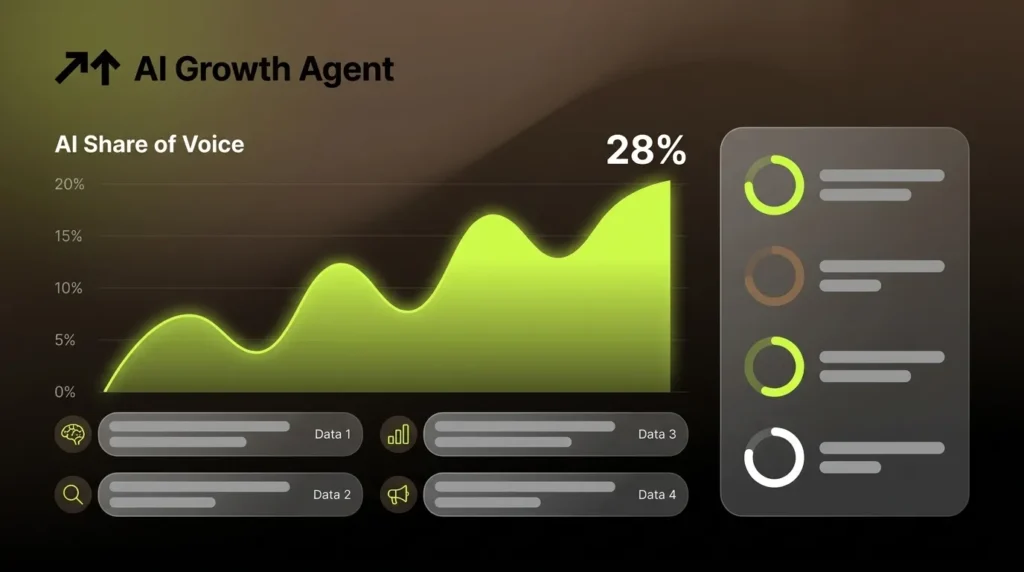
Benchmarks for AI share of voice in 2026 by performance tier provide context. Under 15% signals a significant citation gap, 25–40% represents a competitive range in most categories, above 40% suggests strong visibility, and category leaders rarely exceed 60%. Content freshness is a direct driver of citation probability. 65% of AI bot hits target content published within the past year and 89% target content updated within three years. For fast-changing verticals such as financial services, monthly updates to key pages are recommended. For evergreen verticals, quarterly refreshes maintain citation eligibility.
Living, self-healing content provides a structural answer to citation decay. The typical brand citation half-life is 31 days, with 73.5% of brand citations being one-and-done. Content that updates automatically in response to bot traffic signals and Search Console data maintains citation eligibility without requiring manual intervention at scale. This shift turns a content program from something that decays the day it ships into a system that compounds over time.
Where Most Teams Focus When the Metric Feels Broken
When AI share of voice analysis produces confusing or inconsistent results, most teams respond by adding more monitoring tools, expanding the prompt set without a corresponding content plan, or waiting for platform APIs to improve. None of these responses move the metric.
The metric feels broken for a specific reason. Only 14% of marketers currently track AI citations, despite 43% naming AI search optimization a core 2026 strategy. Measurement infrastructure is ahead of execution infrastructure at most organizations. Teams can see that they are missing from AI answers but have no repeatable system to change what those answers say.
A second common failure is treating share of voice as a single number. Monitoring dashboards that report one blended visibility score obscure the four distinct metrics that require four distinct content responses. A team that sees “32% AI share of voice” and concludes the brand is performing adequately may be missing that its citation rate is 8% and its sentiment score is trending negative on the highest-intent prompts.
A third failure is prompt set design. Vendors select arbitrary, small subsets of static prompts, creating measurements within a contrived and artificial environment rather than reflecting actual user behavior. A prompt set of 10 head-term queries misses the long tail of conversational queries where most AI recommendations actually occur. The brands winning AI share of voice in 2026 are tracking 50 or more prompts and expanding coverage continuously as the prompt universe grows.
The path from broken metric to narrative control runs through execution, not observation. Every gap identified in the analysis phase requires a published, authoritative piece of content that gives AI systems something better to cite. The four pillars of Search Intelligence, AI Analytics, Bot Tracking, and AI Ranking provide the data foundation. Living, self-healing content is the execution layer that converts that data into owned citations.
Frequently Asked Questions
How long does it take to see measurable improvement in AI share of voice after publishing new content?
Content can begin indexing in as little as ten days and often within two weeks of publication when the technical foundation is in place, including proper schema markup, a valid sitemap, and AI crawler accessibility. Meaningful movement in citation rate typically appears within four to eight weeks for targeted gap prompts, provided the content is authoritative, structured for AI extraction, and published on a domain with established entity signals. Position-weighted share of voice and sentiment scores take longer to shift because they depend on AI systems updating their retrieval patterns across multiple training and retrieval cycles. A three-month measurement window is the standard for evaluating whether an execution program is working, with early signals visible in bot traffic and indexing data before citation rate fully reflects the change.
Who should own AI share of voice analysis inside a marketing organization?
Ownership sits with the person accountable for brand visibility and content strategy, typically the CMO or VP of Marketing at mid-market and enterprise companies, or the founder acting as chief marketing officer at smaller organizations. The analysis itself requires inputs from three functions: marketing for prompt definition and competitive framing, content for gap-to-brief translation, and technical for crawler access audits and schema implementation. In practice, most teams lack the technical depth to run the full four-pillar system internally, which is why the most effective programs use an autonomous engine that handles Bot Tracking, AI Ranking, Search Intelligence, and AI Analytics in a single system rather than distributing ownership across disconnected tools and teams.
What is the difference between citation rate and mention rate, and which one should be the primary KPI?
Mention rate measures how often the brand’s name appears in AI-generated responses. Citation rate measures how often the AI links to or explicitly references a brand-owned URL as a source. Both are necessary KPIs because they diagnose different problems. A high mention rate with a low citation rate means the brand has awareness but its owned content is not structured or authoritative enough to be used as a source. A low mention rate with a low citation rate means the brand is absent from the conversation entirely and needs new content targeting gap prompts. Citation rate is the more actionable leading indicator of content quality and technical accessibility, while mention rate reflects broader brand presence across the AI answer landscape. Neither should be reported without the other.
How do the four pillars of Search Intelligence, AI Analytics, Bot Tracking, and AI Ranking connect to share of voice execution?
The four pillars form the data foundation that makes share of voice analysis actionable rather than observational. Search Intelligence provides a complete portrait of the traditional search landscape, identifying which domains and URLs are winning each query and where white space exists for new content. AI Analytics tracks brand value and consumer behavior across the full journey, from AI-tool queries through content consumption and sentiment, giving context to why share of voice is moving in a particular direction. Bot Tracking records every AI crawler interaction, including training sweeps and live citation passes, so teams can see whether their content is being read by the systems that generate AI answers. AI Ranking tracks where the brand appears in AI responses and how that position evolves week over week, replacing the static ranking number with a dynamic share of the answer. Together, the four pillars convert raw share of voice data into specific content decisions that can be executed in the same week the data is collected.
How often should AI share of voice analysis be run, and what triggers an out-of-cycle review?
Weekly measurement is the standard cadence for brands actively managing AI visibility, because cited domain sets in active categories drift significantly month over month and a monthly cadence misses the window to respond to competitive shifts. The four pillars should produce a fresh snapshot of the prompt universe every week, with position-weighted scores and sentiment context updated on the same cycle. Out-of-cycle reviews are triggered by three events: a significant drop in bot traffic to key pages, a competitor publishing a high-authority piece targeting a prompt where the brand previously held strong share of voice, or a platform-level change in citation behavior such as a model update that alters source preferences. Living, self-healing content reduces the manual burden of out-of-cycle reviews by automatically refreshing pages in response to bot traffic signals and Search Console data, maintaining citation eligibility without requiring a full re-analysis each time.
Conclusion: Turn Measurement Into Narrative Control
AI share of voice analysis in 2026 is not a dashboard exercise. It is a five-phase system that moves from baseline assessment through weighted calculation and gap mapping to execution, with every metric paired to a specific content action. The brands building durable AI visibility are the ones running this system on a weekly cadence, publishing authoritative content against every gap prompt, and maintaining living content that self-heals as the citation landscape shifts.
The measurement infrastructure described in this guide, the four pillars of Search Intelligence, AI Analytics, Bot Tracking, and AI Ranking, is the data foundation. The execution layer is living, self-healing content that gives AI systems something better to cite than whatever happens to be sitting on the open web. Together, they convert passive observation into narrative control.
The leaderboard in AI search is being written now. Brands that establish authoritative content this year are training the next generation of models with their own story. Brands that wait are training the next generation with their competitors’ story.