How to Use AI for Content Generation: 7-Phase Workflow
Written by: Mariana Fonseca, Editorial Team, AI Growth Agent | Last updated: August 22, 2026
Key Takeaways for Marketing Leaders
The 10/20/70 rule keeps humans in control of strategy while AI handles 70 percent of repeatable content tasks, which reduces brand-voice drift and rework.
A seven-phase workflow maps the full query universe, drafts with anti-hallucination checks, enforces brand voice, refreshes content, and isolates incremental visibility gains.
Real-time query data from Google and ChatGPT replaces demographic inputs so content targets the exact long-tail questions that earn AI citations.
Every claim is validated against primary sources before publication, and style memories automatically enforce brand voice across all channels without repeated human review.
AI Growth Agent executes the entire workflow end-to-end and reports incremental AI citations and bot traffic; book a kickoff to see your first article live within a week.
Phase 1: Idea Generation With Real Query Behavior
Goal: Produce a prioritized list of content opportunities grounded in real query data, not editorial instinct.
Most teams brief AI with demographic data. 67 percent of marketers still rely on demographic data as the primary input when briefing generative AI tools, despite 59 percent agreeing that traditional demographic segmentation is no longer effective. The correct input is behavioral: what queries your ideal customer actually types into Google and ChatGPT, not who they are on a spreadsheet.
AI Growth Agent's Content Planner show each brand's universe of search (tracked prompts/queries) and its visibility (ranking rate) on both Google Rankings, Google AI Overviews, and ChatGPT citations and mentions.
Sequence of actions:
Feed the brand manifesto, product pages, and any existing keyword data into the ideation prompt to establish clear content boundaries.
With those boundaries set, run real-time searches across Google AI Overviews and ChatGPT to identify which long-tail queries generate AI-cited answers within your scope.
Cluster those validated results into seed terms, each with a set of long-tail queries beneath it, so you evaluate opportunities at the topic level instead of query by query.
Score each cluster by query volume, competitive gap, and citation opportunity to decide which topics deserve production priority.
Prompt template:
You are a content strategist. Given the following brand manifesto [paste manifesto] and the following real-time search results for [seed term], identify the 10 long-tail queries most likely to earn AI citations. For each query, state the search intent, the content format most likely to win (guide, listicle, comparison), and the primary claim the content must make to be cited.
Anti-hallucination check: Validate every query cluster against actual search result data, not the model’s training memory. Remove any query with no real-world search evidence.
Memory-saving step: Save the approved cluster list and scoring rationale as a general memory so future ideation sessions build on the same universe instead of restarting from zero.
Roles: AI maps and scores. The human strategist approves the priority order and removes clusters outside brand scope.
Phase 2: Brief and Outline Creation Before Drafting
Goal: Produce a structured brief that grounds AI generation and eliminates rework downstream.
Assign the approved query to a content type (guide, listicle, comparison) based on what already wins the result.
Specify the primary claim, the supporting claims, the acceptable source types, and any deny-list terms so the model stays inside guardrails.
Generate an outline with H2 and H3 structure, word-count targets per section, and named internal linking targets to connect the piece into your universe.
Have a human editor review the outline for strategic alignment before drafting begins.
Prompt template:
You are a senior content editor. Using the following brief [paste brief] and the following approved outline structure, generate a detailed section-by-section outline for a [content type] targeting the query [query]. Each section must include: the primary claim, the evidence type required (statistic, case study, expert quote), and the internal linking target from this list [paste internal link targets].
Anti-hallucination check: The outline must not propose claims that require statistics the brand cannot source. Flag any section that depends on a single unverified data point before drafting begins.
Memory-saving step: Save approved outline templates by content type so the same structural decisions are not repeated for every article in the same cluster.
Roles: AI generates the outline scaffold. The human editor validates intent alignment and approves before drafting.
Example of long-form article produced by AI Growth Agent: fact-checked, credible research meets unique content, derives from a brand's Company Manifesto.
Sequence of actions:
Feed the approved brief, outline, manifesto, and primary-source URLs into the generation prompt.
Spawn parallel research agents to gather primary-source evidence for every claim the outline requires.
Generate the first draft with inline source citations attached to every verifiable claim.
Run post-draft claim re-extraction, then verify every statistic, quote, and named study against the primary source before the draft advances.
Ask a subject-matter expert to inject proprietary insights, case study data, and brand-specific context that AI cannot generate from public sources.
Prompt template:
You are a senior journalist. Using only the following verified sources [paste source list] and the following brand manifesto [paste manifesto], write a [word count]-word [content type] targeting the query [query]. Attach an inline citation to every statistic, quote, and named study. Flag any claim you cannot source from the provided materials with [UNVERIFIED] so the human editor can resolve it before publication.
Memory-saving step: Save verified primary sources to the brand’s source library so the same research is not repeated for related articles in the same cluster.
Roles: AI drafts and flags. Research agents verify. The subject-matter expert injects proprietary content. The human editor resolves flags and approves. With a verified draft in hand, the next challenge is ensuring it sounds like your brand across every channel.
Phase 4: Enforcing Brand Voice and Tone Variations
Goal: Enforce brand voice across every asset without re-briefing the model for each article.
Audit the approved draft against the brand’s style memory: preferred terminology, words to avoid, sentence length conventions, and house formatting rules.
Apply tone normalization to bring the draft into alignment without altering verified claims.
Generate channel-specific tone variants from the normalized draft, such as a more formal register for whitepapers, a conversational register for social, and a structured register for AI-citation-optimized pages.
Have a human editor spot-check tone variants against the style memory before approving for distribution.
Prompt template:
You are a brand editor. Apply the following style rules [paste style memory] to the draft below without changing any verified claim or its inline citation. Flag any sentence where applying the style rule would require removing a sourced fact. Return the normalized draft and a list of flagged sentences for human review.
Anti-hallucination check: Tone normalization must not alter numbers, named studies, or direct quotes. Escalate any sentence where style and accuracy conflict to the human editor instead of resolving it in the model.
Memory-saving step: Save every style correction the human editor makes as a style memory so the same correction is never needed twice.
Roles: AI normalizes and generates variants. The human editor approves tone and resolves conflicts between style and accuracy.
Phase 5: Repurposing Articles Into Multi-Channel Assets
Goal: Multiply the reach of every approved article without proportionally multiplying production cost or review time.
Companies using AI for content repurposing can achieve higher engagement rates and significant reductions in content production costs. The constraint is not generation speed. The constraint is maintaining claim accuracy and brand voice across every derivative asset.
Sequence of actions:
Identify the core claims and the primary audience insight from the approved article.
Generate channel-specific variants, including social posts, email segments, short-form video scripts, and infographic copy, each formatted for its platform’s native structure.
Verify that every statistic and quote in a derivative asset traces back to the verified primary source in the original article.
Ask a human editor to review derivative assets for brand voice and claim accuracy before scheduling.
Prompt template:
You are a content distribution specialist. Using only the verified claims and inline citations from the following approved article [paste article], generate: (1) three LinkedIn posts of 150 words each, (2) one email segment of 200 words, (3) one short-form video script of 90 seconds. Every statistic used in a derivative asset must appear verbatim from the approved article. Do not introduce new claims.
A strong AI content repurposing system should deliver 3 to 5 times the reach from a single source asset, measured as total impressions across all derivative pieces divided by source content impressions. The same research shows that pages not updated quarterly are three times more likely to lose AI citations, a decay pattern that Phase 6 addresses directly.
Anti-hallucination check: Derivative assets must not introduce new statistics or quotes that are not present in the approved source article. Any new claim requires a full verification pass before the asset is approved.
Memory-saving step: Save approved channel-format templates so the same structural decisions are not repeated for every repurposing cycle.
Roles: AI generates variants. The human editor verifies claim traceability and approves for distribution.
Phase 6: Refreshing Existing Content to Prevent Decay
Goal: Prevent citation decay by refreshing content before AI engines deprioritize it.
As noted in the repurposing discussion, pages not updated quarterly are three times more likely to lose AI citations than recently refreshed pages. Content that was accurate and well-cited at publication becomes a liability once its statistics age past their source dates or its competitive context shifts.
Sequence of actions:
Monitor Google Search Console signals and bot-traffic data to identify articles with declining impressions or citation frequency.
Run a freshness audit to find every statistic with a publication date older than 12 months and every competitive claim that may no longer be accurate.
Pull updated primary-source data for every flagged claim and regenerate the affected sections.
Update internal links to reflect new articles published since the original piece went live.
Have a human editor approve the refreshed version before republication.
Prompt template:
You are a content editor conducting a freshness audit. Review the following article [paste article] and identify: (1) every statistic with a source date older than 12 months, (2) every competitive claim that may have changed since publication, (3) every internal link that could be updated to point to a more recent article on the same topic. Return a prioritized list of updates with the replacement source for each flagged item.
Anti-hallucination check: Replacement statistics must be sourced from the same or a higher-authority primary source than the original. Downgrading from a peer-reviewed study to a blog post to fill a freshness gap is not acceptable.
Memory-saving step: Save the refresh cadence and the source library update as a general memory so the next refresh cycle begins with current data instead of re-auditing from scratch.
Roles: AI identifies decay signals and generates updated sections. The human editor approves before republication.
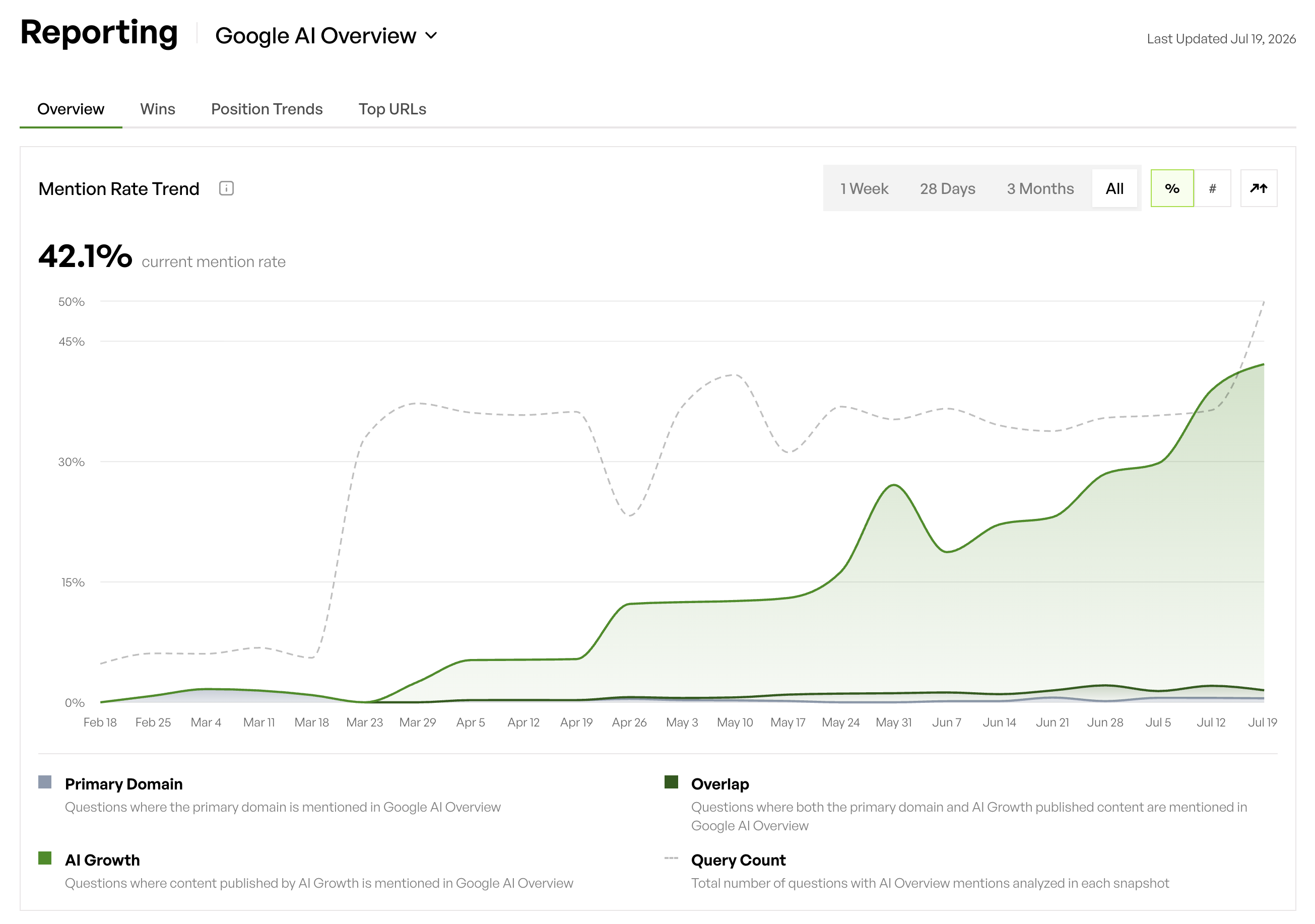
AI Growth Agent's Reporting dashboard, with ranking rates and their separation between Primary Domain results, Overlapping results, and AI Growth Agent content results (incremental visibility).
Sequence of actions:
Tag every AI-assisted URL with a consistent production-mode label in the CMS and analytics platform.
Filter Google Search Console by the AI-assisted URL set to isolate impressions, clicks, and average position for that cohort.
Monitor bot-traffic logs to identify when ChatGPT, Perplexity, and other AI crawlers visit and cite specific articles.
Track citation rate and answer inclusion rate for the target query set on a weekly basis.
Feed top-performing URL patterns back into the brief and outline templates for the next production cycle.
Answer inclusion rate: how often content appears inside an AI-generated answer for authoritative topical pages
Bot visits: every crawl by AI training agents and citation bots, tracked per article
Incremental impressions: Google Search Console impressions for the AI-assisted cohort versus the pre-launch baseline
LLM referral conversions: sessions originating from referrers such as chat.openai.com or perplexity.ai that result in a conversion event
Anti-hallucination check: Pull measurement data from primary sources such as Google Search Console, bot-traffic logs, and direct AI engine queries. Avoid third-party aggregators that may lag or misattribute citations.
Memory-saving step: Save the top and bottom 10 percent of performing URLs with their structural patterns so the next production cycle codifies what works and removes what does not.
Roles: AI compiles and surfaces performance data. The human strategist interprets results and adjusts the content plan.
Common Mistakes and Troubleshooting for AI Content Workflows
Planning gaps. Teams that skip the universe-mapping step described in Phase 1 optimize for the head terms they already know and miss the long-tail queries where AI citations are actually won, the same demographic-first mistake that traps two-thirds of marketers. The fix is to run real-time searches before briefing, not after.
Technical setup omissions. Content that is not structured for AI crawlers does not earn citations regardless of its accuracy. Implement schema markup for statistics, research findings, and factual claims to increase AI extraction rates. Schema, llms.txt, and proper sitemap configuration act as prerequisites, not enhancements.
Indexing assumptions. Teams often assume that publishing equals indexing. It does not. Bot-traffic logs must be monitored to confirm that AI crawlers have visited and that Google Search Console is registering impressions for the new URL set.
Measurement gaps. Tracking only Google Search Console impressions misses the citation and bot-traffic signals that indicate AI search performance. Channel metrics for AI-assisted content include citation rate, mention rate, share of voice, and sentiment score across AI engines such as ChatGPT, Gemini, and Perplexity. All three must be tracked to understand the full picture.
Competitors offering generic AI content tools address none of these gaps systematically. They provide no anti-hallucination cascade, no citation tracking, no brand-specific voice enforcement, and no incremental visibility reporting. The workflow above requires a system, not a chatbot.
Verification and Measurement Framework
Objective signals:
Google Search Console impressions and clicks for the AI-assisted URL cohort, isolated from existing brand visibility
Bot-traffic logs confirming AI crawler visits per article
Direct AI engine queries run weekly against the target query set
Operational metrics:
Number of articles published per week against the content plan
Percentage of articles passing the pre-publish verification checklist on first submission
Time from brief approval to publication
SEO metrics:
Average keyword position for the target cluster
Featured snippet and People Also Ask win rate
Internal linking coverage across the universe
Visibility metrics:
Citation rate and answer inclusion rate for the target query set
Brand mention frequency in AI answers across ChatGPT, Perplexity, and Google AI Mode
LLM referral sessions in Google Analytics 4, filtered by referrers including chat.openai.com and perplexity.ai
Review cadence: Run weekly checks on citation rate and bot traffic, monthly reviews of impressions, clicks, and pipeline influence, and quarterly ROI calculations comparing content investment against incremental visibility and revenue influenced.
Advanced Scenarios for Multi-Brand or Multi-Domain Teams
Multi-brand and multi-domain operations require a separate universe map, content topology, and style memory for each brand. Sharing a single manifesto across brands produces voice drift and competitive confusion, especially when two brands in the same portfolio compete for overlapping queries.
The correct architecture runs parallel engines, one per brand, each with its own seed-term universe, its own deny lists, its own primary-source library, and its own measurement cohort in Google Search Console. Internal linking operates within each brand’s domain, not across brands, to avoid diluting authority signals.
For agencies managing multiple client brands, the same principle applies. Each client requires its own manifesto, its own topology, and its own reporting environment so incremental visibility is attributed correctly and client results do not bleed into each other’s dashboards.
Acquia has achieved increases in brand visibility across LLMs by maintaining structured tracking at the topic level rather than the aggregate brand level. The same discipline applies at scale. Granular topic-level tracking is what makes incremental visibility reportable and actionable.
AI Growth Agent supports multi-brand operations through parallel engine deployments, each with its own manifesto, topology, and reporting environment, so agencies and enterprise portfolio teams can manage multiple brands without conflating their universes or their results.
How long does it take to see measurable results from an AI content workflow?
The first article is typically live within a week of kickoff. Content has indexed in as little as ten days and often within two weeks. Meaningful citation and impression data begins to accumulate within the first 30 days. The standard engagement is a three-month pilot because indexing timelines vary by industry and competitive density. Clients who track citation rate and bot traffic from day one see movement earlier than those waiting for Google Search Console impressions to compound.
Who owns the content and the site that AI Growth Agent publishes to?
The client owns the site outright. AI Growth Agent stands up a fully optimized blog connected to the client’s domain through a reverse proxy rewrite or subdomain. The client owns all content produced, and there is no agency dependency on the site structure. This is a deliberate architectural choice. Many brands do not own their own site because an agency controls it, and every change becomes a dependency. Headless marketing removes that dependency entirely.
How does the anti-hallucination system work in practice?
Anti-hallucination controls operate at every stage of generation, not as a single post-draft pass. The engine prioritizes claims from the brand manifesto and primary-source URLs over anything else. When it reaches outside those sources, it scrapes, qualifies, and verifies every external source before passing it into the generation pipeline. After a draft is generated, every claim is re-extracted and checked against product pages, the manifesto, verified external sources, and the standards defined in style memories. Any claim that cannot be backed up is removed or softened before the article advances. The client can also configure which claim types deserve the heaviest scrutiny, such as pricing claims or ingredient specifications, and the engine focuses its checks there.
What technical setup is required on the client’s side?
The only integration step required from the client is the reverse proxy rewrite that connects the blog to a subdirectory under their domain. Everything else, including schema markup, the WordPress plugin, robots.txt, sitemaps, automatic web stories, Blog MCP, agent discovery via /.well-known/, llms.txt and llms-full.txt, instant indexing, autoredirects, and 404 tracking, is provisioned automatically and included in every package. No technical skill is required from the client’s team.
How is AI Growth Agent different from a monitoring tool like Profound or an AI content writer like Jasper?
Monitoring tools track whether a brand appears for a capped set of prompts. They do not produce content, own publishing, or act on the data. AI content writers generate text on demand but provide no universe map, no results dashboard, no publishing, and no technical SEO. AI Growth Agent does all of it. It maps the full query universe from real-time Google and ChatGPT data, produces authoritative content with anti-hallucination cascades active, publishes with full traditional and agentic technical SEO, monitors bot traffic and citation rate per article, and reports the incremental visibility it generated, isolated from visibility the brand already had. The sharpest line is this: other tools tell you what is happening. AI Growth Agent changes what is happening.
Conclusion
The seven-phase workflow above is the operational structure that separates brands winning AI citations from brands generating AI text. The 10/20/70 rule governs the division of labor. Anti-hallucination cascades protect claim accuracy at every stage. Style memories enforce brand voice without re-briefing. Repurposing multiplies reach without multiplying review burden. Freshness monitoring prevents citation decay. Incremental visibility reporting proves what the engine actually generated, separate from the visibility the brand already had.
Generic AI content tools, monitoring platforms, and agency stacks address fragments of this workflow. None of them execute it end-to-end. There is no anti-hallucination cascade, no citation tracking, no brand-specific voice enforcement, and no incremental visibility reporting in any competing tool or agency offering. They are rearview mirrors. This workflow functions as the steering wheel.
AI Growth Agent is the only autonomous engine that maps the entire query universe from real-time Google and ChatGPT data, produces authoritative content single-shot with every claim validated, stands up a fully optimized site the client owns within the first week, and reports incremental AI citations, bot visits, and impressions week over week, at a flat fee with no per-prompt billing. Across the first twelve weeks, clients average more than 12,000 additional AI citations and mentions, over 100,000 additional bot visits, and a 20 percent or greater lift in impressions.
The leaderboard in AI search is being written this year. Brands that establish authoritative content now are training the next generation of models with their own narrative.