Written by: Mariana Fonseca, Editorial Team, AI Growth Agent | Last updated: August 20, 2026
Key Takeaways
- Sixty-eight percent of Google searches and 93% of Google AI Mode sessions now end without clicks, so traditional rank tracking no longer reflects real brand visibility in AI-driven discovery.
- A repeatable 7-step diagnostic process, built on a buyer-intent prompt taxonomy and run across ChatGPT, Gemini, Perplexity, and Google AI Overviews, turns raw AI outputs into content fixes within the same week.
- Three core KPIs (mention rate, AI share of voice, citation rate), supported by sentiment and source audits, reveal whether AI engines simply mention a brand or actively trust and recommend it.
- Weekly tracking of 40–80 locked prompts, combined with monthly strategic audits, converts visibility data into new content and measurable lifts in citations, bot visits, and impressions.
- Traditional search tools only show where your brand stands, while AI Growth Agent makes your brand the answer, so you can close the loop from measurement to published content in days.
7-Step Process to Track Brand Visibility Across AI Search Engines
- Build a prompt taxonomy. Create 50 to 100 buyer-intent prompts organized into brand, category, comparison, problem-led, and alternatives buckets. Pull language from sales call transcripts, support tickets, Google Search Console queries, Reddit threads, and site search logs instead of internal assumptions.
- Select your platform set. Run every prompt across ChatGPT, Gemini, Perplexity, and Google AI Overviews as a baseline. Add Claude if your audience uses it heavily. Track horizontal and vertical agents separately, because visibility in one tells you little about visibility in the other.
- Run prompts in clean sessions. Use incognito windows or logged-out accounts to reduce personalization bias. Run each prompt at least five times per platform so you can average out probabilistic variance.
- Log every signal in one tracker. Record engine, prompt category, mention status, position in the answer, citation URL (owned vs third-party), sentiment, accuracy, and competitors named. Capture screenshots as timestamped evidence, because AI outputs change frequently.
- Calculate your core KPIs. Compute mention rate, AI share of voice, citation rate, and recommendation position for each platform and prompt family. Segment by prompt type instead of blending all results into a single score.
- Run citation source analysis. Click footnotes in Perplexity and Google AI Overviews to see whether AI engines pull from Reddit threads, G2 reviews, or niche blogs instead of your own site. Third-party brand mentions correlate with AI citation at r=0.664, compared with r=0.218 for backlinks, so source mapping is a more powerful diagnostic than traditional link analysis.
- Map every gap to a specific content or technical fix. Use the diagnostic checklist in the “Why Aren’t We Showing Up?” section to convert each visibility gap into a concrete owned-site action with an owner and a re-measure date.
Designing a Prompt Taxonomy for AI Visibility Tracking
The foundation of any tracking program is a prompt taxonomy that mirrors how real buyers interact with AI engines. This taxonomy must span multiple intent types, because sources driving listings differ from those driving recommendations. A brand can appear in factual queries while disappearing from evaluative ones.
The table below provides a copy-paste starting structure.
| Prompt Family | Intent | Example Prompt | Primary Diagnostic Question |
|---|---|---|---|
| Brand | Recognition | “What does [Brand] do?” | Does the model know we exist and describe us accurately? |
| Category | Discovery | “Best [category] tools for [use case]” | Are we in the consideration set for non-branded searches? |
| Comparison | Shortlisting | “[Brand] vs [Competitor]” | How does the model frame us against direct competitors? |
| Problem-led | Discovery | “How do I solve [pain point]?” | Are we surfaced as a solution to the problems we solve? |
| Alternatives | Consideration | “Alternatives to [Competitor]” | Do we appear when buyers are actively switching? |
| Risk | Validation | “Is [Brand] trustworthy / worth it?” | What narrative does the model produce about brand credibility? |
Start with 10 to 20 queries across ChatGPT, Gemini, and Perplexity as an initial baseline, then expand to 30 to 50 well-defined prompts per key product area. Manual tracking of a small prompt set provides only partial coverage of real user interactions with AI, which is why systematic, repeated prompt-set monitoring has become the operational standard.
Comparing Four Leading AI Search Visibility Tools
Four platforms appear most often in enterprise evaluations for AI search visibility: Profound, Semrush, Ahrefs, and SE Ranking. The matrix below compares them on seven attributes using publicly available product information. When a direct comparison on a shared scale is not possible, the distinction appears in the prose that follows.
| Attribute | Profound | Semrush | Ahrefs | SE Ranking |
|---|---|---|---|---|
| Primary function | AI search monitoring and brand visibility tracking | SEO suite with AI visibility features | SEO suite with AI visibility features | SEO suite with AI visibility features |
| Automation level | Automated prompt monitoring on a defined schedule | Automated rank and AI Overview tracking within broader SEO workflows | Automated rank tracking, AI visibility features in active development | Automated rank tracking with AI Overview monitoring |
| Scalability | Scales prompt volume, prompt count is a billed metric | Scales across large keyword sets, AI visibility prompt capacity varies by plan | Scales across large keyword sets, AI visibility prompt capacity varies by plan | Scales across keyword sets, AI visibility prompt capacity varies by plan |
| Customization | Custom prompt sets, competitor benchmarking | Custom keyword lists, limited AI prompt customization | Custom keyword lists, limited AI prompt customization | Custom keyword lists, AI Overview tracking customizable by project |
| Integration ecosystem | API access, reporting integrations | Broad: Google Analytics, Search Console, social, CRM connectors | Google Search Console integration, API access | Google Analytics, Search Console, white-label reporting |
| Analytics depth | Mention rate, share of voice, sentiment, citation source per AI platform | Keyword rankings, AI Overview presence, traffic estimates, backlink data | Keyword rankings, traffic estimates, backlink data, AI visibility in development | Keyword rankings, AI Overview tracking, on-page and backlink data |
| Cost profile | Enterprise pricing, prompt volume affects cost | Tiered subscription, enterprise plans available | Tiered subscription, enterprise plans available | Lower entry price point, tiered subscription |
Profound is the most purpose-built option for AI search monitoring. It tracks mention rate, share of voice, sentiment, and citation sources per platform, which aligns closely with the KPI framework in this article. The practical constraint is that prompt count is a billed metric, so brands see only the slice of their market they already thought to ask about, while the real query universe remains much larger.
Semrush and Ahrefs are SEO suites that added AI visibility features to existing rank-tracking infrastructure. Their strength is breadth, combining keyword data, backlink analysis, traffic estimates, and Search Console integration in one platform. Their limitation for AI visibility is that AI prompt monitoring remains a secondary feature, and mention-rate plus citation-source analysis runs shallower than in a dedicated monitoring tool.
SE Ranking occupies a similar position to Semrush and Ahrefs at a lower entry price point, which suits mid-market teams that need AI Overview tracking alongside traditional rank data without enterprise-level spend. The tradeoff is a smaller integration ecosystem and less granular AI visibility analytics.
None of these four tools produce content, publish to an owned site, or convert visibility data into content fixes. They function as measurement instruments. The closed loop, which runs from measurement to diagnosis to published content to incremental visibility reporting, requires a separate execution layer.
How to Track Brand Mentions in AI Search
Three KPIs form the measurement core of any AI brand visibility program. The table below provides exact formulas and the sources that define them.
A mention occurs when a brand name appears somewhere in an AI response. A citation occurs when the brand’s domain is sourced as part of the answer. Both must be tracked separately against a defined prompt set and competitors, because a brand can be mentioned without citation or cited without being recommended. Tracking only one of the two hides where content and authority gaps actually sit.
Share-of-Voice, Citation Sources, and Sentiment Checks
Share of Voice. Accurate AI share of voice calculation requires a defined prompt set of 50 to 500 representative buyer-intent queries, a consistent competitive set, repeated sampling of each query 3 to 10 times to average results, and a single consistent reporting platform. As of mid-2026, Semrush, HubSpot’s AEO Grader, and Profound each use different methodologies, so figures from different platforms cannot be compared directly.
Citation Analysis. Citation source analysis identifies which domains AI engines actually pull from when they mention your brand. Wikipedia accounts for 47.9% of ChatGPT’s top-10 citations, so an entity mismatch on Wikipedia can shape AI answers for months. Perplexity cites sources in most search responses, which means citation rate benchmarks differ by platform and should not be averaged across engines. The fix sequence for citation gaps starts with owned pages such as pricing pages, product specs, service comparisons, case studies, and FAQ pages, then moves to third-party sources like Reddit, Wikipedia, review sites, and earned press.
Sentiment Audit. Sentiment analysis categorizes brand mentions as positive, neutral, or negative, with an 80%+ positive sentiment rate indicating strong brand perception. A composite visibility score can be calculated as (Mention Rate × 0.4) + (Citation Rate × 0.3) + (Positive Sentiment × 0.3), with 70+ indicating strong presence. Negative sentiment in AI answers creates compliance risk in regulated industries when inaccurate framing about pricing or product claims spreads across platforms without correction.
Weekly and Monthly AI Visibility Reporting Rhythm
Most B2B categories benefit from weekly AI visibility tracking using a locked set of 40 to 80 buyer prompts with stable wording. This approach balances signal and noise while enabling direct week-over-week comparisons. The cadence below fits a mid-market to enterprise team.
Weekly (operational):
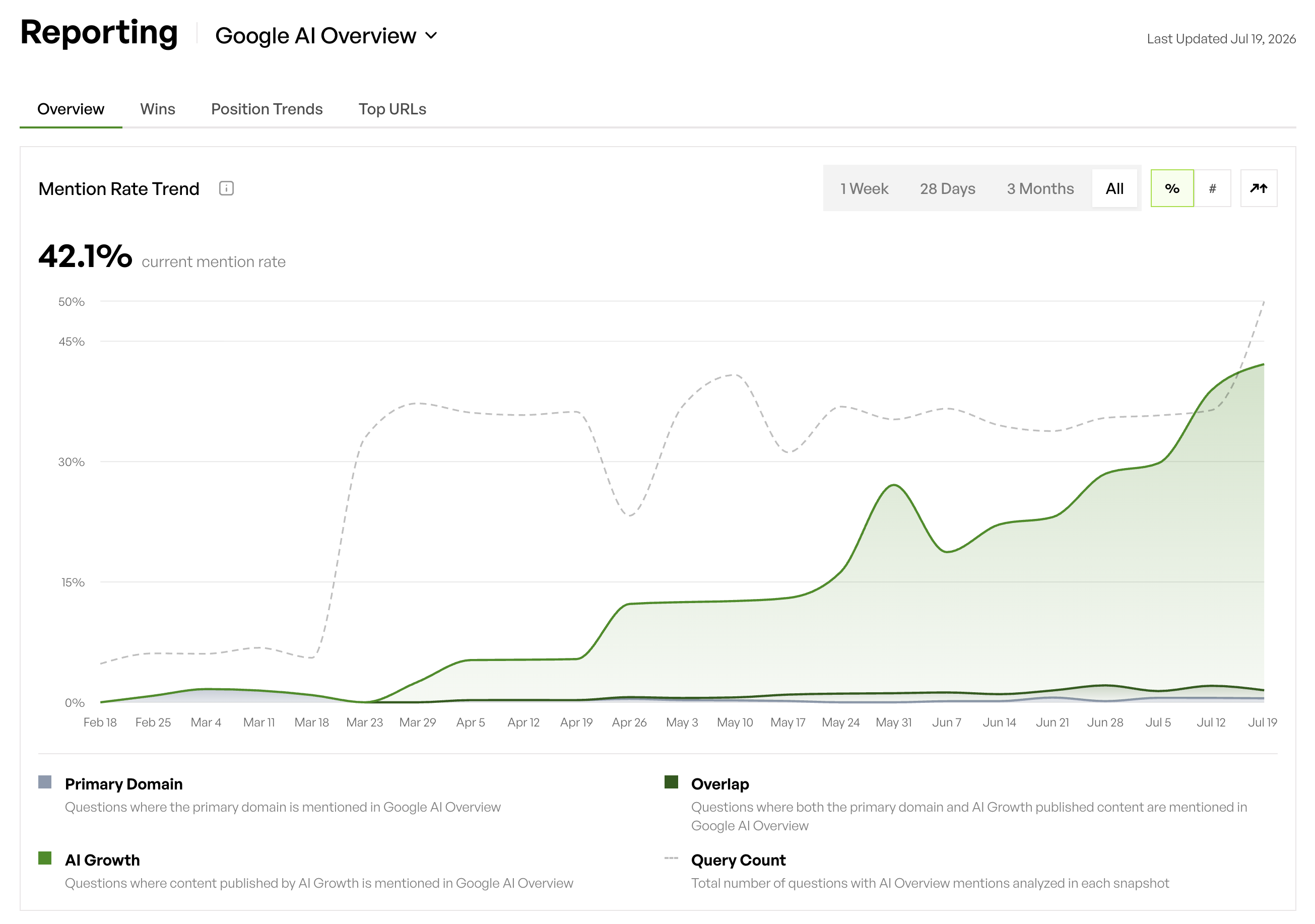
Start by running the locked prompt set across ChatGPT, Gemini, Perplexity, and Google AI Overviews. As results come in, log mention rate, citation rate, and competitor share movement to build a baseline. Next, flag prompts where mention rate dropped more than 10 points week over week, because these represent your highest-risk visibility gaps. From that flagged set, identify the single highest-priority page or schema fix, assign an owner, and set a re-measure date. Finish with a five-minute technical health check that covers schema presence, crawler access, and llms.txt integrity so infrastructure issues do not compound.
Monthly (strategic):
- Compare mention rate, AI share of voice, and citation rate against the prior three months.
- Run a full citation source audit to identify new third-party domains driving or suppressing visibility.
- Conduct a sentiment audit across all platforms and flag accuracy failures.
- Map highest-visibility prompt clusters to content pages that drive conversions.
- Publish or meaningfully update at least one piece of content based on visibility findings.
- Produce an executive summary that connects AI visibility trends to pipeline indicators such as referral traffic from answer engines and branded search volume shifts.
Organizations should reassess their reporting cadence quarterly and adjust based on whether stakeholders read and act on reports and whether critical issues are caught early. During product launches or major competitive shifts, move to daily monitoring on a reduced set of 20 to 60 high-intent prompts for 14 days.
Diagnosing Why Your Brand Does Not Appear in AI Answers
Every visibility gap maps to a specific root cause and a specific fix. The checklist below covers the most common failure patterns seen in AI search diagnostic work.
Never appears in category prompts:
- Root cause: Weak topic association, so the model does not connect the brand to the category.
- Fix: Publish category-defining content that leads with direct answers in the first 50 words, uses H2 headers phrased as questions, and builds internal links across the topic cluster.
Appears only in branded prompts:
- Root cause: Demand exists, but non-branded discovery remains weak.
- Fix: Build problem-led and category content that targets the long-tail queries buyers use before they know your brand name.
Appears often but is not recommended:
- Root cause: The model knows the brand but does not favor it in evaluative responses.
- Fix: Judgment queries shift trust to prestige editorial, social or UGC, and expert voice, so build earned media in those channels and ensure review sites carry accurate, positive framing.
Gets cited with outdated or inaccurate facts:
- Root cause: Page updates are overdue, or entity data on Wikipedia or Wikidata is wrong.
- Fix: Update owned pages, correct Wikidata entity records, and refresh third-party profiles that carry stale information.
Shows up on one engine but not others:
- Root cause: Source support differs by platform, and studies have found low similarity between the source sets different AI engines use.
- Fix: Diversify the third-party source base across Reddit, industry publications, and review platforms that each engine weights differently.
Technical crawlability failures:
- Root cause: Plugin updates rewrite robots.txt to block GPTBot or ClaudeBot, theme updates remove JSON-LD schema, or JavaScript rendering appears blank to AI crawlers.
- Fix: Audit robots.txt, validate schema with a structured data testing tool, confirm pages render in HTML for bot crawlers, and publish llms.txt and llms-full.txt.
Low citation rate despite acceptable mention rate:
- Root cause: Brand authority gap, where the model knows the brand but does not trust owned pages as primary sources.
- Fix: Build third-party coverage in press and industry publications, and structure owned pages in self-contained 120 to 180 word sections with declarative language that RAG pipelines can extract cleanly.
From Monitoring to Action with AI Growth Agent
All the tools and frameworks above answer a single question: where does the brand stand today? That view is necessary, yet it does not change outcomes on its own. Only 22% of marketers currently track AI visibility and traffic, and most of them stop at measurement without a system that converts data into published content in the same week.
AI Growth Agent acts as the headless engine that closes this loop. It maps a brand’s full universe of seed terms and long-tail queries using real-time Google and ChatGPT data, produces authoritative, self-healing content that validates every claim and source, stands up a fully optimized site the brand owns within the first week, and reports the incremental visibility it generates week over week. Prompt count never becomes a billed metric, so teams see the full universe instead of a capped handful of tracked terms.
The architecture follows a headless marketing model. AI Growth Agent deploys a separate, fully optimized blog connected to the brand’s domain through a reverse proxy rewrite, styled to match the main site, with the full technical and agentic SEO stack live on day one. That stack includes Blog MCP, llms.txt and llms-full.txt, OpenAI discovery via /.well-known/, valid schema across the full schema suite, automated web stories, instant indexing, and bot tracking that shows exactly when ChatGPT cites the content. Client engineering teams do not need to contribute hours.
Across the first twelve weeks, clients average more than 12,000 additional AI citations and mentions, over 100,000 additional bot visits, and a 20%+ lift in impressions. Breadless grew from 387,000 to 12.3 million Google Search Console impressions in six months and now ranks among the most recommended healthy franchises in the United States, ahead of CAVA, Rush Bowls, and Sweetgreen in its search universe. Leva Sleep closed $40,000 to $50,000 in deals in under three weeks from buyers who walked into the store carrying the blog and asking about specific features they discovered through AI Growth Agent content. Monitoring alone delivers a dashboard. Acting on monitoring delivers those outcomes.
Frequently Asked Questions
What is the difference between a brand mention and a citation in AI search?
A mention occurs when a brand name appears anywhere in an AI-generated response. A citation occurs when the AI engine includes a clickable link or source attribution that points to the brand’s domain as evidence for a claim. A brand can be mentioned without being cited, which usually indicates that the model has general awareness of the brand from training data but does not trust owned pages as primary sources. A brand can also be cited without being recommended, meaning the engine uses the content as a reference but does not position the brand favorably in evaluative responses. Tracking both separately against a defined prompt set is the only way to see which layer of the visibility problem requires a fix.
How many prompts do I need to get statistically reliable AI visibility data?
For a statistically meaningful baseline, most measurement frameworks recommend at least 50 to 100 prompts across three to five platforms, with each prompt run at least five times per platform to average out probabilistic variance. Enterprise programs often use 500 or more prompts. The number of repeated runs required for stable rankings varies by platform, and some research indicates 33 to 94 repeated queries are needed before citation order stabilizes on a given platform-topic combination. For an early-stage baseline, a set of at least five brand prompts, ten category prompts, and five problem prompts run weekly is the minimum viable starting point. Segments with fewer than 50 valid answers should be treated as directional only.
Why does my brand appear in ChatGPT but not in Perplexity or Google AI Overviews?
Each AI engine uses a different retrieval architecture and weights different source types. ChatGPT draws heavily on training data and Wikipedia, while Perplexity relies primarily on real-time web retrieval and cites sources in nearly every response. Google AI Overviews use the same ranking systems and E-E-A-T signals as classic Google Search. A brand that appears in ChatGPT but not in Perplexity typically has a training-data presence but lacks the third-party web coverage that retrieval-based engines require. The fix is to diversify the third-party source base across Reddit, industry publications, review platforms, and earned press, since each engine weights these sources differently. A brand absent from Google AI Overviews despite strong organic rankings may have a structured data or content extractability problem rather than an authority problem.
How long does it take to see results after fixing AI visibility gaps?
Timelines vary by fix type and platform. Retrieval-based platforms such as Perplexity and Bing Copilot can reflect content and citation improvements within weeks of publishing. Training-based platforms such as base ChatGPT and Claude update at the next training cycle, which can take six to twelve months. Google AI Overviews, which use live retrieval, can reflect content changes faster than training-based engines but still require indexing time. Technical fixes such as correcting robots.txt to allow GPTBot or ClaudeBot, adding schema markup, or publishing llms.txt often produce faster results than content changes because they remove crawlability barriers. A realistic expectation for a new content program is first indexing within ten to fourteen days and measurable citation movement within the first thirty to sixty days on retrieval-based platforms.
Conclusion
Generative AI traffic is growing 165 times faster than organic search traffic, and 69% of B2B buyers selected a different vendor than originally anticipated due to AI guidance. Brands that control what AI says about them this year train the next generation of models with their own narrative. Brands that wait train the next generation with whatever happens to be sitting on the open web.
A repeatable diagnostic system, built on a structured prompt taxonomy, core KPI formulas, citation source analysis, and a weekly cadence that turns data into content fixes, provides the operational foundation. Monitoring alone tells you the score. A closed loop that connects monitoring to content and technical changes is what improves it.