Written by: Mariana Fonseca, Editorial Team, AI Growth Agent | Last updated: July 16, 2026
Key Takeaways for Faster Gemini Citations
- Gemini cites content from the live Google Search index, so pages must be crawlable, fast-loading, and free of snippet-suppression directives to enter the citation pool.
- Structure every H2 section as a self-contained passage with the direct answer in the first 40 to 60 words and use question-style headings that mirror real user queries.
- Implement a complete JSON-LD schema stack including Organization, Article, FAQPage, BreadcrumbList, and HowTo markup with valid sameAs links and dateModified values.
- Secure third-party corroboration through editorial coverage, review platforms, Wikidata entries, and consistent NAP data across directories to convert single-source claims into network-verified citations.
- Schedule a consultation with AI Growth Agent to automate schema, llms.txt, and incremental citation tracking so your content earns Gemini citations faster.
Step 1: Lock In Google’s AI Prerequisites
Goal: Establish the baseline conditions Gemini requires before any content can enter its citation pool.
Gemini can optionally use Google Search grounding when the feature is enabled via API configuration, but does not perform an internal search before generating every answer, so a page’s Google rank directly determines whether Gemini’s retrieval system ever sees it. A page at position 1 in traditional search carries a higher chance of appearing in AI answers than a page at position 10.
The following conditions must be in place before structural or schema work will have any effect. Together they form a crawl-to-citation pipeline, and a single break in this chain prevents downstream Gemini visibility.
- Googlebot must be allowed in robots.txt. Googlebot is the sole retrieval source for AI Overviews, so blocking it removes the page from both Search and Gemini simultaneously.
- AI retrieval bots (OAI-SearchBot, PerplexityBot, ClaudeBot) must also be allowed if cross-engine citation is a goal. Blocking these bots prevents content from appearing in ChatGPT, Perplexity, and Claude responses even when pages rank highly in traditional search.
- Content must be served as static HTML. Pages with JavaScript-rendered content have a lower AI parsing success rate, while static HTML with schema markup reaches a higher rate.
- Page speed matters directly. Pages with faster First Contentful Paint tend to earn more Gemini citations than slower-loading pages.
- Snippet controls must not suppress extraction. Google documents that nosnippet, max-snippet, and data-nosnippet directives limit the text extractable for AI Overviews.
Validation checkpoint: Confirm Googlebot access in robots.txt, verify static HTML delivery, run a Core Web Vitals audit targeting fast FCP, and check that no snippet-suppression meta tags are applied to target pages.
Step 2: Turn Each Section Into a Standalone Answer
Goal: Structure every page so individual sections pass as standalone citation units.
Gemini cites at the passage level, not the page level. The engine runs a fan-out of multiple parallel sub-queries per search, extracts passages at the sentence level, and applies a confidence threshold before surfacing citations. A section that requires surrounding context to make sense will not pass that threshold.
The structural rules that govern extraction eligibility work together as a simple writing system for AI-ready passages.
- Place the direct answer within the first 40 to 60 words after every H2 heading. The first 40 to 60 words after the title should answer the query directly in one self-contained block, and this front-loading aligns with Gemini’s preference for early-page citations.
- Keep passages at moderate length, neither very short nor very long. Passages of moderate length are cited more often than longer or shorter passages, so aim for compact but complete paragraphs.
- Use definitive language throughout each answer. Cited text is more likely to contain definitive language, so remove hedged phrasing such as “may,” “might,” or “possibly.”
- Front-load every important claim in the early part of the page. A significant portion of AI citations come from the first 30% of a page’s content, so treat the opening sections as your primary citation real estate.
- Use question-phrased H2 and H3 headings that mirror real user queries. Headings that mirror real audience questions create explicit matches that AI systems can more easily extract and cite, which improves alignment with search intent.
- Write each paragraph so it makes sense when extracted completely out of context. Apply the liftability test by pasting the section alone into Gemini and confirming it produces a coherent answer without qualifiers like “as mentioned earlier.”
Validation checkpoint: Run the liftability test on every H2 section. Confirm the direct answer appears in the first two sentences. Verify no section exceeds 300 words without a sub-heading break.
Step 3: Build a Layered JSON-LD Entity Schema Stack
Goal: Give Gemini’s entity-driven retrieval system an unambiguous machine-readable anchor for every page.
After the March 2026 core update, Google shifted schema from a SERP display trigger to an AI trust and entity verification signal. Pages with proper schema markup are more likely to earn AI citations than unmarked equivalent pages. Schema errors are disqualifying, and a page with invalid schema is actively flagged as less trustworthy than a page with no schema at all.
The required schema stack for Gemini citation eligibility functions as a layered trust signal, where each type reinforces the others.
- Organization schema with an @id set to the canonical domain URL and a sameAs array that includes at minimum the Wikidata QID URL, LinkedIn company URL, and any verified Wikipedia article. The sameAs array should include Wikidata QID URL, LinkedIn company URL, and any verified Wikipedia article as primary signals, with Crunchbase and social profiles as secondary signals, which anchors the brand entity.
- Article schema with datePublished, dateModified, and an author @id linking to a Person entity. Article schema with the dateModified property feeds Gemini’s freshness signal, while linking the author property to a verifiable Person entity strengthens the E-E-A-T chain for citation eligibility.
- FAQPage schema on every page with a question-answer section. Adding FAQPage schema with multiple validated question-answer pairs per page is the schema type most frequently recommended in post-Gemini-3 recovery playbooks, because each pair becomes a discrete answer unit.
- BreadcrumbList schema to signal topical hierarchy. BreadcrumbList schema helps Gemini understand a site’s topical hierarchy, leading to higher authority treatment on topics where multiple related pages demonstrate depth.
- HowTo schema on process pages. Pages with Article and HowTo structured data schema are cited at a higher rate in AI Overviews than unstructured pages, especially for step-based queries.
Once all five schema types are in place, validation becomes the critical gate. A single error in any schema block can disqualify the entire page from citation consideration.
Validation checkpoint: Run every page through Google’s Rich Results Test. Confirm zero schema validation errors. Verify the sameAs array resolves to live URLs. Check that dateModified reflects the actual last update, not the original publish date.
Schedule a demo to see if you’re a good fit and see how AI Growth Agent provisions the full schema stack automatically on every article.
How Gemini Handles References and Citations
Gemini does give references, and the mechanism depends on the surface and the query type. When users ask questions that benefit from grounded retrieval, such as current information, factual claims, or source-backed answers, Gemini fires its own retrieval against Google’s index and produces answers with inline numbered citations next to supported claims.
The citation format varies by surface. In the Gemini API with Google Search grounding enabled, the model returns citations as url_citation annotations containing title, url, start_index, and end_index within model output content blocks. In Google AI Overviews, citations appear as inline links or source panels alongside the generated answer.
Citation volume has increased significantly. After the Gemini 3 upgrade, the number of source URLs per response rose, with the average increasing from previous levels. As of March 2026, Gemini cites about 8 sources per response on average, a moderate amount similar to ChatGPT but far below Perplexity.
Not every query triggers citations. Gemini answers from its training corpus by default and only grounds on Google Search when the model decides the question needs current or out-of-training information. Queries involving products, recommendations, statistics, or recent events are more likely to trigger citations than queries focused on definitions or general knowledge.
Step 4: Configure llms.txt and AI Crawler Access
Goal: Remove every technical barrier between your content and AI retrieval systems.
Crawler access functions as a prerequisite, not an optimization layer. A page blocked from crawling in robots.txt cannot become an effective AI source simply by being listed in llms.txt. The correct sequence starts with robots.txt access, then adds llms.txt as a content guidance layer.
The required crawler configuration works as a coordinated access policy across Google and other AI engines.
- Allow Googlebot (desktop and smartphone) for AI Overviews access. As noted in Step 1, Googlebot handles all AI Overviews retrieval, and Google deliberately did not create a separate opt-out crawler for AI Overviews because the feature retrieves passages from the standard Search index.
- Allow OAI-SearchBot and ChatGPT-User for ChatGPT citations. OpenAI states that data collected by its real-time agents is not used for LLM training, enabling site owners to permit citation access while blocking only GPTBot for training opt-out.
- Allow PerplexityBot and ClaudeBot for cross-engine coverage. This access ensures that the same AI-ready content can earn citations across multiple assistants.
- Use Google-Extended only for training control, not for visibility. Google-Extended is a robots.txt token that only controls whether content is used to train or ground Gemini; it does not affect Googlebot crawling, search indexing, or visibility in AI Overviews and AI Mode.
Validation checkpoint: Fetch each target URL as Googlebot, OAI-SearchBot, and PerplexityBot using a crawler simulator. Confirm HTTP 200 responses and full HTML delivery without JavaScript rendering requirements.
llms.txt: Give AI Crawlers a Content Map
llms.txt is a plain-text Markdown file placed at the root of a domain (yourdomain.com/llms.txt) that provides AI models with a curated map of a site’s most important content. The file was proposed by Jeremy Howard, co-founder of Answer.AI and fast.ai, in September 2024 to address limited context windows and imprecise HTML-to-text conversion.
The distinction between llms.txt and robots.txt is functional, not hierarchical. robots.txt governs crawl and access permissions while llms.txt governs how a model finds its way around once already reading pages. The two files address different problems and both support reliable AI access.
A correctly structured llms.txt file follows a simple, predictable pattern that AI crawlers can parse consistently.
- Exactly one H1 title that states the site or project name.
- A blockquote summary describing the site’s purpose in one to two sentences.
- H2 sections that group related links into clear categories.
- Markdown links in the format [Page Title](URL): Description.
- UTF-8 encoding and a 200 OK HTTP response from the root path.
An optional companion file, llms-full.txt, can contain the complete text of all documentation to give AI models deep, contextual knowledge beyond the navigation overview provided by llms.txt.
Adoption varies by platform. In 2026, Perplexity and some Claude retrieval use llms.txt, ChatGPT’s crawler handling is improving, and Gemini is inconsistent. The file functions as a low-cost hygiene signal rather than a guaranteed citation lever, and an llms.txt file at the domain root acts as a low-cost hygiene signal that helps AI crawlers identify and prioritize the most citation-ready content on a site.
Step 5: Turn Brand Claims Into Network-Backed Proof
Goal: Convert single-source assertions into network-verified claims that AI engines prefer during citation selection.
Third-party corroboration remains the most underweighted factor in most enterprise content strategies. The majority of Gemini citations come from third-party editorial and independent web content while owned domains account for a smaller share. A claim that exists only on your domain can earn a citation, while the same claim echoed by review platforms, independent comparisons, and community discussion can earn recommendations.
The corroboration actions with the highest measured impact work together as a staged outreach plan.
- Earn editorial coverage on topically relevant publications as a first wave. Distributing content to a wide range of third-party publications increases AI citations compared to publishing only on a brand’s own site.
- Build complete profiles on review and comparison platforms as a second layer. Brands are more likely to be cited via third-party sources such as G2, Capterra, and Trustpilot than via owned content.
- Establish a Wikidata entry to anchor the entity. Wikidata entries, which have no notability requirement unlike Wikipedia, provide a unique QID that AI engines use as the canonical reference point for disambiguating brands.
- Pursue Reddit and community mentions to add fresh, conversational proof. Reddit discussions deliver a higher citation rate in Gemini answers when the content is under 6 months old.
- Ensure NAP consistency across all directories so the entity resolves cleanly. Inconsistent naming causes AI tools to resolve the brand as multiple entities and cite none.
- Target multi-source validation as the final state. Brands with multi-source validation, meaning claims appearing across multiple external domains, see citation rates improve in AI overviews.
Validation checkpoint: Run the brand name through ChatGPT, Perplexity, and Gemini on five target queries. Note which third-party sources appear in citations. Identify the platforms where the brand is absent and prioritize those for outreach.
Schedule a consultation session to see if you are a good fit and learn how AI Growth Agent maps the full corroboration landscape for your brand automatically.
Step 6: Publish Content on Gemini-Reachable Surfaces
Goal: Ensure every piece of content lives on an indexed, crawlable surface that Gemini’s retrieval layer can reach.
AI engines cannot reliably parse PDFs or access content behind logins or forms, making authoritative content such as product guides and ROI data invisible to citation if hosted only in those formats. Content must live on indexed web pages to enter the citation pool.
Publication requirements for Gemini eligibility define where and how you host AI-ready material.
- Publish on a domain with a proper sitemap.xml submitted to Google Search Console. Confirm indexing within 10 to 14 days using the URL Inspection tool.
- Use a subdirectory or subdomain structure that inherits domain authority from the primary domain rather than a standalone domain with no authority history.
- Maintain a consistent publication cadence. AI platforms cite content from pages updated recently at a higher rate; brands updating core content regularly see higher AI coverage.
- Distribute the same claims across multiple indexed surfaces. Sites present on multiple platforms are more likely to appear in ChatGPT responses, and Gemini rewards similar corroboration.
- Include multimodal assets on key pages. Pages combining text, images, video, and structured data see higher selection rates on Gemini than text-only pages.
Validation checkpoint: Confirm all target URLs are indexed in Google Search Console. Verify sitemap.xml includes all published URLs. Check that no canonical tags point away from the intended indexable version.
How to Structure Pages for Reliable Gemini Extraction
Gemini extraction operates on a set of structural signals that differ from traditional on-page SEO. FogTrail’s analysis found that Gemini’s semantic completeness scoring is the single strongest predictor of citation selection, with a high correlation. Content scoring high on semantic completeness is more likely to be cited.
The structural patterns with the highest measured citation lift give you a repeatable layout for AI-ready articles.
- Answer-first H2 sections: As covered in Step 2, opening every H2 with a direct answer in the first 40 to 60 words is the single most impactful technique for AI citation in 2026. Starting every H2 section with a direct answer paragraph that stands alone as a complete statement is the single most impactful technique for AI citation in 2026.
- Comparison tables: Pages with tables are cited more often than equivalent pages with prose descriptions of the same data, because tables present structured, scannable facts.
- Numbered lists: Numbered lists are cited more than baseline prose; bullet lists are cited more, so use ordered steps when sequence matters.
- FAQ sections: Comprehensive FAQ sections with multiple complete answers are the highest-value AEO content format, as each answer can stand alone when extracted.
- Original statistics: Original statistics, survey results, and case study numbers create citation monopolies because AI engines must credit the source of unique data not available elsewhere.
- Clean heading hierarchy: A majority of pages cited in AI answers follow a clean sequential heading structure (H1 to H2 to H3), while skipped levels reduce citation likelihood.
Step 7: Track and Prove Incremental AI Citations
Goal: Isolate the visibility your content effort actually generated, separate from the visibility your brand already had.
Measurement in AI search requires a different framework than traditional rank tracking. AI answers have no static ordered list, so order of mention and citation context replace the old idea of a ranking number. The metrics that matter are brand mention rate, citation rate, bot traffic by source, and Google Search Console impressions on content published after the engagement start date.
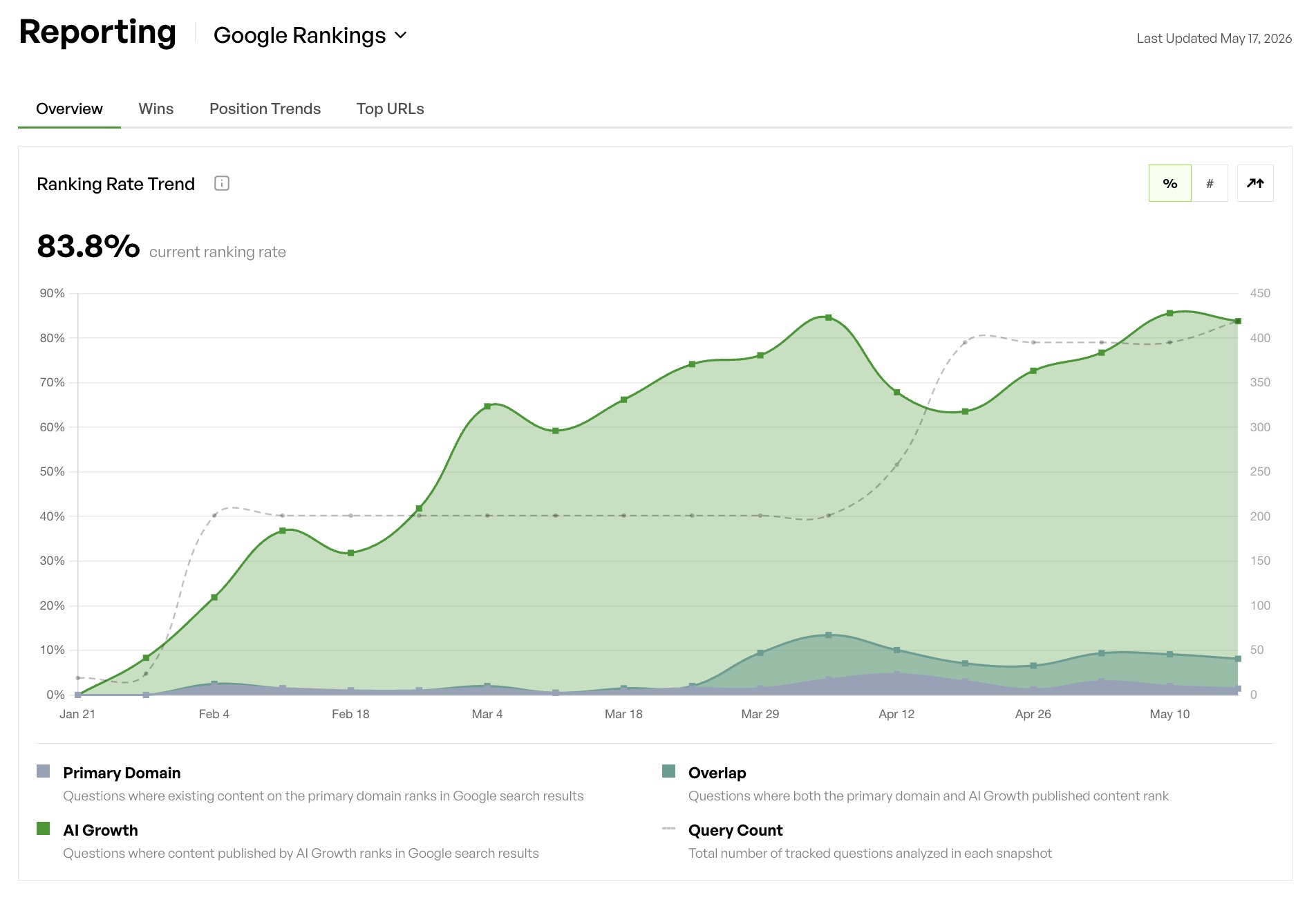
The measurement stack for incremental citation tracking combines traffic logs, search data, and live prompt sampling.
- Track bot traffic at the article level as the first signal. Every major AI platform sends identifiable bots when it cites a source, and separating ChatGPT-User, OAI-SearchBot, PerplexityBot, and ClaudeBot traffic from standard Googlebot traffic reveals which platforms are actively citing which pages.
- Use Google Search Console as an independent audit of visibility. Filtering impressions and clicks to the subdirectory or subdomain where new content lives isolates incremental gains from existing brand visibility.
- Run weekly prompt sampling across ChatGPT, Perplexity, and Gemini on 20 to 30 target queries. Recording citation position, surrounding context, and which competing sources appear alongside the brand shows how often and how prominently you appear.
- Monitor citation half-life to understand decay. ChatGPT citation half-life sits at several weeks, Perplexity at several weeks, and Google AI Overviews at several weeks, so content that is not refreshed within those windows loses citation eligibility to fresher sources.
- Cross-reference citation data with conversion events. AI-referred traffic converts at significantly higher rates than standard organic traffic, which makes source attribution at the conversion moment the most defensible proof of ROI.
Validation checkpoint: Confirm bot tracking is live and segmented by user-agent. Verify Google Search Console is filtering to the new content property. Establish a weekly prompt-sampling cadence before the first article publishes so baseline data exists for comparison.
Schedule a demo to see if you’re a good fit and see how AI Growth Agent’s incremental visibility reporting isolates exactly what the engine generates week over week.
Common Gemini Citation Mistakes and Fixes
The seven steps above fail in predictable ways. The following diagnostic covers the most common failure modes by step.
Step 1 failures: Outdated robots.txt rules originally written for Googlebot commonly create self-inflicted citation outages. Outdated robots.txt rules originally written for Googlebot commonly create self-inflicted citation outages that exclude brands from AI platforms. Audit robots.txt against the current list of AI crawler user-agents before any other optimization work.
Step 2 failures: Long unbroken prose and vague or hedged claims have low citation likelihood in Gemini. If sections are not passing the liftability test, the most common cause is context-dependent writing where the answer relies on information established earlier in the article.
Step 3 failures: As emphasized in Step 3, invalid schema is disqualifying. Inconsistencies between schema.org markup, Knowledge Graph data, and third-party listings create entity confusion that reduces citation probability. Run the Rich Results Test after every schema update.
Step 4 failures: llms.txt listed on a CDN that blocks AI bots upstream provides no benefit. robots.txt is the polite layer; it does nothing if a CDN blocks bots upstream. Verify that Cloudflare or other CDN firewall rules are not blocking AI crawler IP ranges before troubleshooting llms.txt.
Step 5 failures: Third-party profiles with inconsistent entity naming create disambiguation failures. The brand name, address, and description must match exactly across every external platform.
Step 6 failures: Content published on a subdomain with no internal linking to the primary domain builds authority in isolation. Connect the content property to the main domain through a reverse proxy rewrite or explicit internal linking to transfer topical authority.
Step 7 failures: Measuring only head-term prompt responses misses the majority of citation activity. Long-tail, conversational queries are more likely to trigger AI Overviews than short-form queries. Expand prompt sampling to include the full long-tail query universe.
Frequently Asked Questions
How long does it take to get cited by Google Gemini after publishing new content?
Most sites see first Gemini citations two to six weeks after Google crawls, indexes, and re-ranks updated pages. The timeline shortens when pages already rank in traditional search and only require better structure, schema, and fresher statistics. Content indexing can happen in as little as ten days when instant indexing is configured and the domain has existing authority. Citation frequency then builds over the following weeks as Gemini’s retrieval layer encounters the content across multiple sub-query fan-outs.
Does Google Gemini use the same index as Google Search?
Yes. Gemini grounds on Google’s own search index, shaped by Google’s ranking signals and the Knowledge Graph, rather than a separate retrieval layer. This means traditional SEO fundamentals, including indexing, crawlability, domain authority, and E-E-A-T signals, are prerequisites for Gemini citation eligibility. Optimizing for Gemini and optimizing for Google Search share the same foundation, with Gemini adding additional requirements around extractability, schema, and third-party corroboration.